49 works in this view — arrow keys or swipe to move between them.
Dance in Art · 1898
Unter Blumen
Alfred Roller
- Medium:
- Oil Painting
- Era:
- Late 1800s (Victorian Ballroom)
- Source:
- Wikimedia Commons
- Rights:
- Public domain — free to use, share and adapt.
- Recorded as:
- Public Domain
This work documents a pivotal moment in early modern dance history: the late nineteenth-century fascination with non-ballroom, non-classical movement forms—circus arts, acrobatics, and Orientalist fantasy—as resources for reimagining what dance could express. It shows how European artists used dance imagery to explore new formal possibilities: asymmetry, the extended body, partnered acrobatics, and sensual expressionism. The Orientalist content is troubling, but the formal innovations it carries—the vocabulary of the arch, the adagio support, the emphasis on fluidity over structure—became foundational to twentieth-century modern and contemporary dance.
What you are looking at
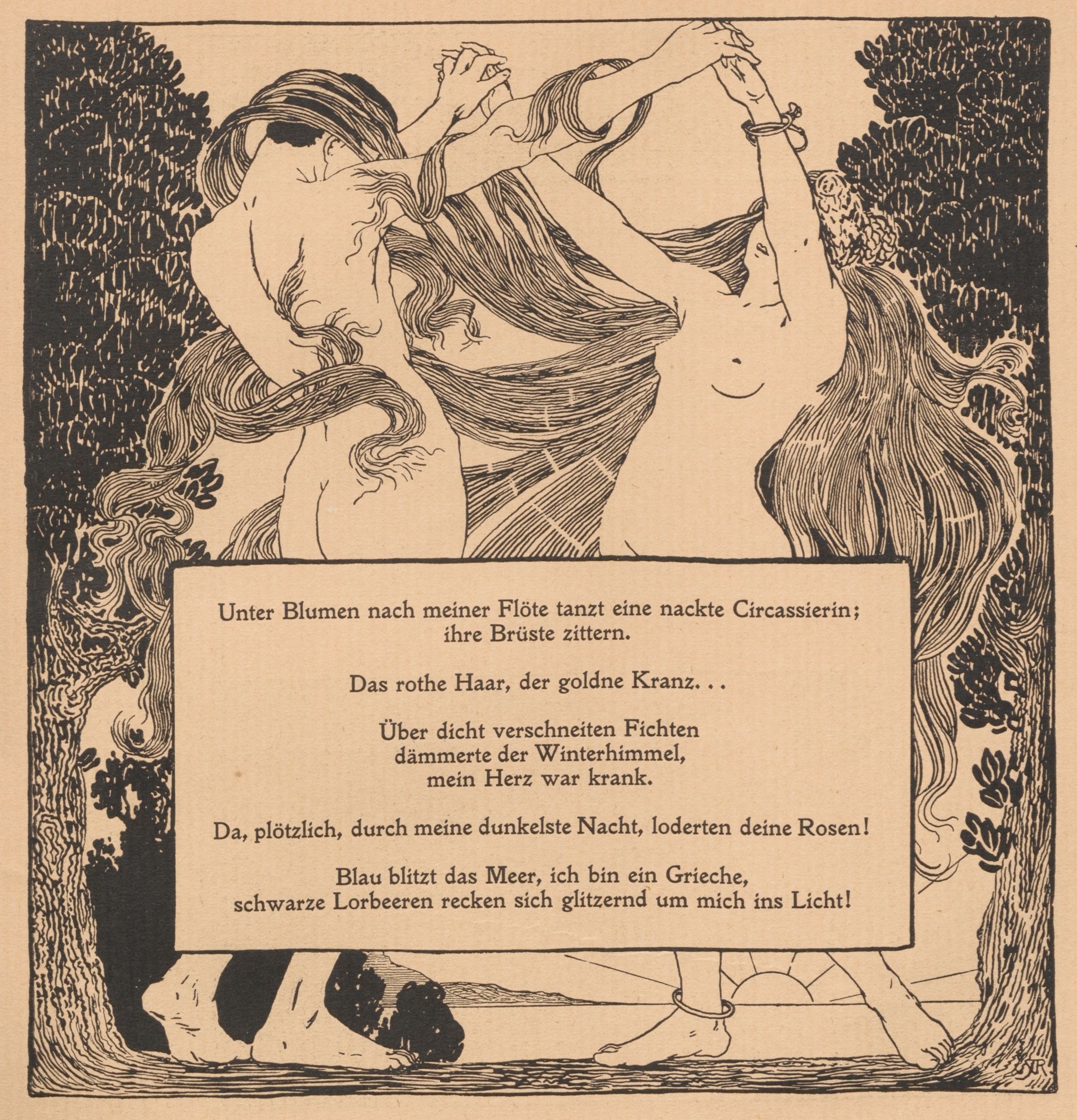
A pair of dancers in a wooded setting, illustrated in black-and-white line work with dense cross-hatched foliage framing the composition. The figures are rendered in a sinuous Art Nouveau style, with elongated limbs and flowing hair. At center, a female dancer in a translucent draped garment leans backward in an arch, her body weight supported and her arms raised overhead; a male figure behind and beside her creates the support, his own body angled to accommodate hers. Both have long, streaming hair rendered as expressive linear elements. Dense trees form a dark border on either side. Below the image, German text is set in a rectangular panel—lines from a poem by Arno Holz—beginning 'Unter Blumen nach meiner Flöte tanzt eine nackte Circassierin' (Under flowers to the sound of my flute dances a naked Circassian woman). The whole composition emphasizes sinuousness, exoticism, and the romanticized fusion of nature, music, and the female body.
The dancing
The primary figure is female, depicted nearly nude or in transparent drapery, arching backward in a dramatic curve with her torso extended and her arms raised toward the vertical. Her male partner provides physical support from behind, his posture oriented to enable and frame her extension. Both figures have voluminous, elaborately rendered hair falling in loose waves. The backward arch suggests a moment of abandonment or ecstatic movement rather than a structured ballroom or classical frame; the weight is entirely distributed through the supporting partner, indicating a acrobatic or sensual partnered form. The composition emphasizes asymmetry, fluidity, and the visual drama of the female form in extreme extension.
The dance depicted
The subject is labeled as a 'Circassian woman' dancing to a flute, conjuring Orientalist imagery popular in European art and entertainment of the 1890s. The pose—a deep backward arch in partnered support—most closely resembles the *adagio* or acrobatic partnering vocabulary of early modern dance and circus arts rather than ballroom technique. The extreme flexibility and the emphasis on the female body's extension into space suggest influence from circus tradition, music-hall spectacle, or the experimental theatrical dance emerging in the 1890s. The poem's reference to music and the sensual, near-nude presentation point toward a romantic or theatrical fantasy rather than documentary dance, though the acrobatic vocabulary is real and would have been recognizable to audiences familiar with circus or avant-garde performance.
How it was made
The work is a woodcut or engraving, evident from the bold linear black-and-white aesthetic, the dense parallel hatching used to render shadow and texture, and the formal borders typical of printed illustration. The technique allows for precise, expressive linework—particularly visible in the rendering of hair as flowing, dynamic elements—and the high-contrast framing of the figures against the dark natural setting. This is a reproducible medium, indicating the work was designed for circulation in print, likely as a book or periodical illustration. The cataloguing record states 'oil painting,' but the visual evidence—the line-based technique, the hatching, the formal border—indicates this is a print. The original may have been drawn for reproduction.
About this work
This is an Art Nouveau illustration to a poem by Arno Holz, depicting a pair of dancers in an exoticized, Orientalist fantasy frame. The female figure performs an extreme backward arch in acrobatic partnership, rendered in the sinuous, linear vocabulary of late-nineteenth-century modernist print-making. The work sits at the intersection of theatrical avant-garde dance, circus arts, and Symbolist poetry—a moment when European artists were beginning to imagine dance outside ballroom convention, drawing on non-European imagery and acrobatic vocabularies to express new ideas about the body, performance, and artistic freedom. The image records not an actual Circassian dance but a European fantasy of one, filtered through the aesthetics of Art Nouveau and the erotic, exoticist imagination of the 1890s.
How to look at it
Attend to the moment of suspension captured in the pose: the female figure is at full extension, fully supported by her partner, in a position of apparent vulnerability or surrender that is also one of display and control. The artist has frozen a moment of maximum dramatic potential—the arch is held, not transitional. Notice how the hair and drapery stream as if caught mid-motion, emphasizing fluidity and momentum even within the static frame. The dense, dark forest creates an erotic, transgressive atmosphere: this is fantasy, not fact, a European dream of othered femininity and sensual freedom. The linear, decorative style of the print itself—the flowing lines, the ornamental borders—mirrors the movement vocabulary, making form and content inseparable.
The artist
Alfred Roller (1864–1935) was an Austrian painter, graphic designer, and set designer associated with the Viennese Secession and Art Nouveau movements. He was trained as a painter and became known for bold, linear illustration work and innovative theatrical design; he worked with Gustav Klimt and other Secession artists and designed sets and costumes for avant-garde theater and opera in Vienna. His graphic work emphasized expressive linework, decorative composition, and the integration of text and image—hallmarks of Symbolist and Art Nouveau print culture. The collaboration with poet Arno Holz on this dance illustration exemplifies the Secession's integration of poetry, visual art, and performance.
The period
The 1890s saw a radical questioning of ballroom and classical ballet conventions across European avant-garde circles. Isadora Duncan was beginning her revolutionary practice; circus and music-hall performance were attracting serious artistic attention; and Symbolist and Decadent poets were exploring themes of eroticism, nature, and altered consciousness. In Vienna, the Secession (founded 1897) embraced experimental visual forms and drew on non-Western imagery as a source of liberation from academic tradition. Orientalism was endemic to European culture, and the fantasy of the 'Circassian' dancer embodied contemporary fascinations with exoticism, female sexuality, and the 'primitive' body. The acrobatic, backward-arching pose reflects both circus tradition and the emerging modern dance interest in the extended, flexible, responsive body—a stark contrast to the corseted, upright posture of ballroom dance.
Where it lives
The work is known from Wikimedia Commons; no collection or accession information is recorded. The catalogue record lists it as an oil painting, but the visual evidence indicates a print, likely a woodcut or engraving made for book or periodical publication. Roller's illustration work was widely reproduced in Secession and Art Nouveau publications of the 1890s–1900s.
Dance in this work
Questions about this work
Is this a real dance?
No. The label 'Circassian woman' reflects European Orientalist fantasy rather than documentation of actual Caucasian dance. The pose and acrobatic vocabulary are drawn from circus arts and experimental theater. What matters historically is not whether the dance is 'authentic,' but how European artists used exoticized imagery to imagine new movement vocabularies outside ballroom and classical convention.
Why is the woman nearly nude?
The near-nudity is part of the Orientalist and Symbolist aesthetic of the period: the fantasy of the 'exotic' female body as naturally free, sensual, and available for aesthetic display. This reflects both the erotic interests of late-nineteenth-century European art and the deliberate rejection of Victorian moral constraint by avant-garde artists. It is also a marker of the acrobatic or performance context—circus performers and modern dancers were beginning to expose the body in ways that shocked ballroom audiences.
What is the connection to early modern dance?
This illustration captures the moment when European artists and performers (notably Isadora Duncan) began looking outside classical ballet and ballroom tradition toward circus arts, exotic fantasy, and the unrestrained moving body as sources of artistic innovation. The acrobatic backward arch and the partnered support are vocabularies that would become central to modern dance development. The work shows the intellectual and aesthetic ferment from which twentieth-century dance emerged.
Who was Arno Holz?
Arno Holz (1863–1929) was a German Symbolist poet and playwright. His work was characterized by experimental form, sensual and often erotic content, and an interest in nature and altered consciousness. He was part of the European avant-garde circles in which this illustration was produced, and his poetry reflects the same Orientalist fascinations and formal innovations visible in Roller's visual art.
More dance artwork