48 works in this view — arrow keys or swipe to move between them.
Dance in Art · 1939
William H. Johnson - Jitterbugs (II) Smithsonian American Art Museum
William H. Johnson
- Medium:
- Oil Painting
- Era:
- 1920-1950 (Swing Era)
- Source:
- Wikimedia Commons
- Rights:
- Public domain — free to use, share and adapt.
- Recorded as:
- Public Domain
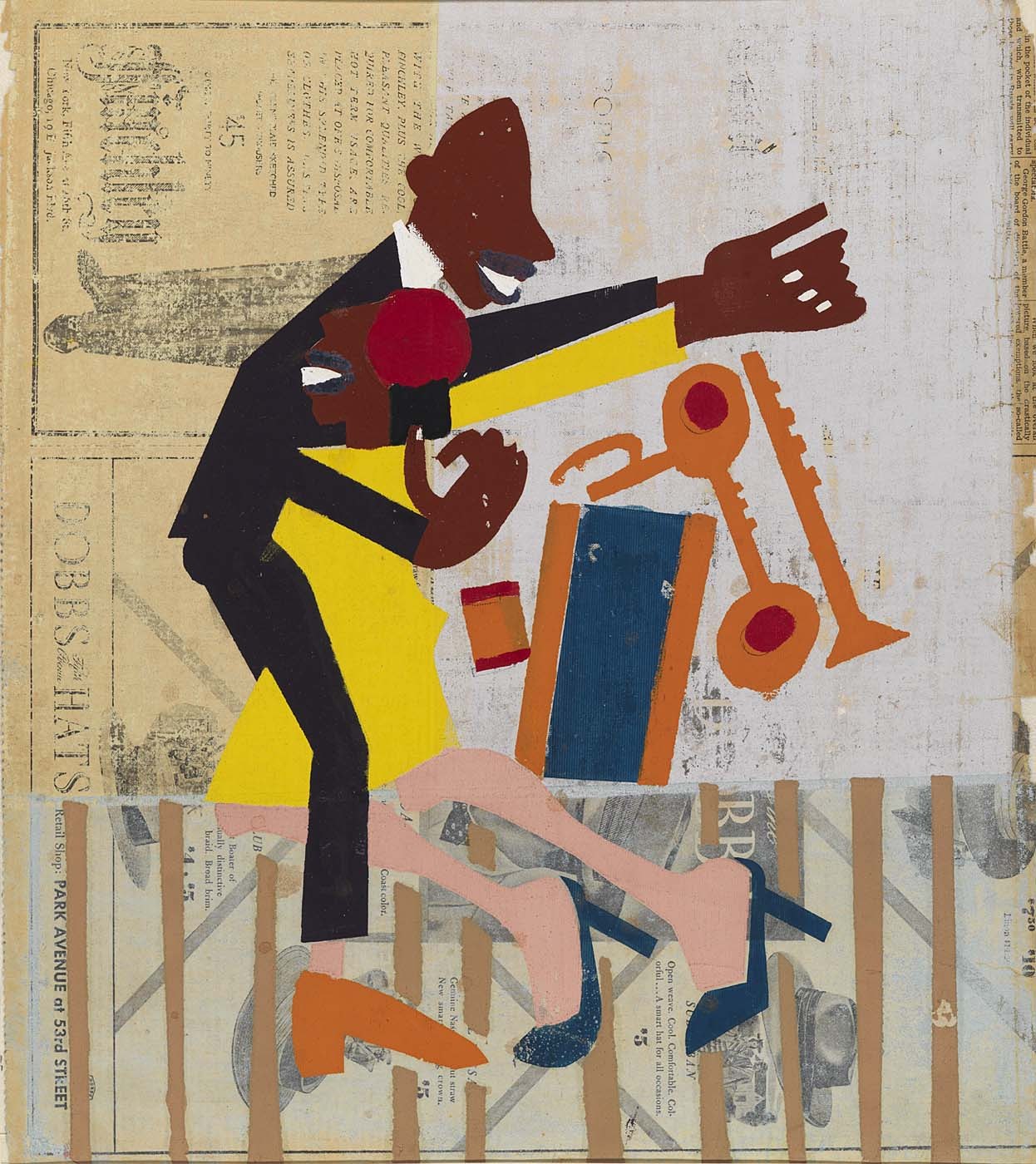
This painting is crucial visual evidence of how modernist fine artists engaged with vernacular African American dance as a subject worthy of serious artistic treatment. Johnson's formal choices—the angular dynamism, the integration of collage, the silhouetted form—demonstrate that swing dancing was recognized as embodying modern aesthetic values of speed, energy, and abstraction. The work appears in major museum collections and is frequently cited in histories of both American modernism and swing culture, making it a canonical image of the relationship between avant-garde art and social dance.
What you are looking at
A dynamic composition centered on a single dancer captured mid-movement against a collaged background of newsprint and printed matter. The figure wears a black jacket with a high collar, a bold yellow garment (possibly a vest or undershirt), and has a deep reddish-brown complexion rendered in silhouette. The dancer's body is sharply angled, with one arm extended outward in an energetic gesture while the other bends at the elbow. The legs are rendered in peachy tones with navy accents, caught in an active stride or step. To the right, a geometric abstraction in orange outlines—possibly a stylized instrument or prop—echoes the dynamism of the figure's pose. The background layer includes fragments of what appear to be newspaper columns, dance advertisements, and printed typography in cream and tan tones, creating a documentary quality that grounds the image in a specific historical moment and commercial culture.
The dancing
A single standing figure dominates the composition, weight shifted forward in a lunging or striding posture that suggests rapid movement. The extended arm reaches outward with open fingers, a gesture of exuberance or directional emphasis. The body's angle is sharp and diagonal, with the torso twisting away from the direction of the extended arm—a classic contrapposto motion. The legs show active stepping: one leg forward, the other back, suggesting the figure is in mid-locomotion. The closed, silhouetted head with simplified features is turned slightly to follow the direction of movement.
The dance depicted
This work depicts the Jitterbug, the most popular swing-era social dance of the 1930s–40s in African American and mainstream American culture. The title and era (1939) confirm this. The composition captures the explosive, improvisational energy that defined the dance: a solo dancer in the moment of a dramatic weight transfer, with the characteristic momentum and directional focus of swing dancing. The Jitterbug was danced in partnerships but was also known for individual flourishes and "breakaway" moments; this image may capture one such moment of solo expression. The dynamic diagonal composition and the emphatic gesture convey the speed, joy, and physicality that made swing dancing distinctive.
How it was made
This is an oil painting executed with bold, flattened forms and strong outlines—a modernist approach indebted to Cubism and German Expressionism. The artist has used collage or mixed media elements, incorporating actual newsprint fragments beneath and around the painted figure, which grounds the work in the material culture of its time. This technique allowed Johnson to embed the dance within its social and historical context: the newspaper fragments reference the commercialization and popular documentation of swing culture. The high-contrast palette and simplified forms suggest the influence of avant-garde movements that celebrated vernacular American subjects.
About this work
William H. Johnson's *Jitterbugs (II)* is a 1939 oil painting that captures the explosive energy of swing-era social dance at its cultural apex. The work depicts a single dancer in a moment of dynamic, forward-propelled motion, rendered in bold modernist forms with flattened shapes and strong outlines. By embedding the figure within collaged newsprint, Johnson situates the Jitterbug within the commercial popular culture and mass media that surrounded African American dance innovation in the swing era. The painting is both a celebration of individual bodily expression and a document of a specific historical moment when this dance form was crossing from African American venues into mainstream American culture and commercial entertainment.
How to look at it
Attend to the moment Johnson chose: not a partnered exchange or a static pose, but a single body in explosive forward motion, with the arm extended in a gesture that reads as both directional and celebratory. Notice how the diagonal thrust of the figure's body and limbs conveys kinetic energy; the artist has exaggerated the angle and extension to make stillness feel like motion. Look at the relationship between the painted figure and the newsprint collage: the figure emerges from and is grounded in the commercial culture around it, suggesting that swing dancing was inseparable from mass media, advertising, and public consumption. The silhouetting and bold outlines are characteristic of 1930s modernism, showing how avant-garde form and vernacular subject matter were being synthesized.
The artist
William H. Johnson (1901–1970) was an African American modernist painter based in New York who was a central figure in the Harlem Renaissance and beyond. He worked across multiple modernist styles—Expressionism, Cubism, and geometric abstraction—and was deeply committed to depicting African American life, culture, and spirituality. Johnson exhibited widely and was championed by major institutions; his work alternated between figural scenes of daily life, religious subjects, and abstract compositions. The *Jitterbugs* series (of which this is the second version) represents his engagement with contemporary popular culture and the body in motion, themes that recur throughout his practice.
The period
In 1939, swing dancing was at the peak of its popularity and cultural influence in the United States. The Jitterbug had emerged from African American vernacular dance in the late 1920s and had become a mass phenomenon by the mid-1930s, particularly after the success of swing orchestras led by Duke Ellington, Count Basie, and Benny Goodman. The dance was associated with youthful exuberance, racial mixing in dance halls, and a modernist aesthetic of speed and spontaneity. Meanwhile, American modernist artists were increasingly turning to vernacular and popular subjects as worthy of serious artistic attention, and African American culture—including jazz and social dance—was becoming a recognized touchstone of American modernity. Johnson was working in this context of aesthetic revaluation, treating social dance as a subject of the same formal complexity as fine art.
Where it lives
The painting is held in the Smithsonian American Art Museum, a major U.S. collection of American visual art. The work is documented in the museum's collection and has been widely exhibited and reproduced in scholarship on American modernism and swing culture.
Dance in this work
Questions about this work
What is the Jitterbug and why was it important?
The Jitterbug was the dominant swing-era social dance of the 1930s–40s, performed to big-band jazz in both African American and mainstream American dance halls. It was known for its speed, improvisation, and exuberance, and it played a significant role in breaking down racial segregation in entertainment venues. The dance is central to the cultural history of swing music and to the history of African American contributions to American popular culture.
Why did a modernist painter choose to paint swing dancers?
By the late 1930s, American modernist artists were actively seeking subjects in vernacular and popular culture, including African American culture, as a way to validate non-European sources of aesthetic value. Swing dancing embodied modernist principles of speed, abstraction, and energy; painters like Johnson saw the Jitterbug as a legitimate subject for serious artistic treatment and a way to celebrate African American modernity.
What does the collaged newsprint in the background signify?
The newspaper fragments ground the dance in the mass media and commercial culture that surrounded it. They suggest that swing dancing was not an isolated folk practice but a documented, publicized phenomenon—part of the modern commercial landscape. This collage technique was pioneered by Cubism and Futurism and allowed Johnson to embed the dance within its historical context.
Is this a realistic or abstract painting?
It is both. The figure is recognizable and depicts an actual body in motion, but the forms are flattened, simplified, and arranged according to modernist principles of composition—bold outlines, high contrast, geometric shapes. This hybrid approach was typical of 1930s American modernism, which sought to honor the subject matter while also embracing formal innovation.
More dance artwork