49 works in this view — arrow keys or swipe to move between them.
Dance in Art · 1883
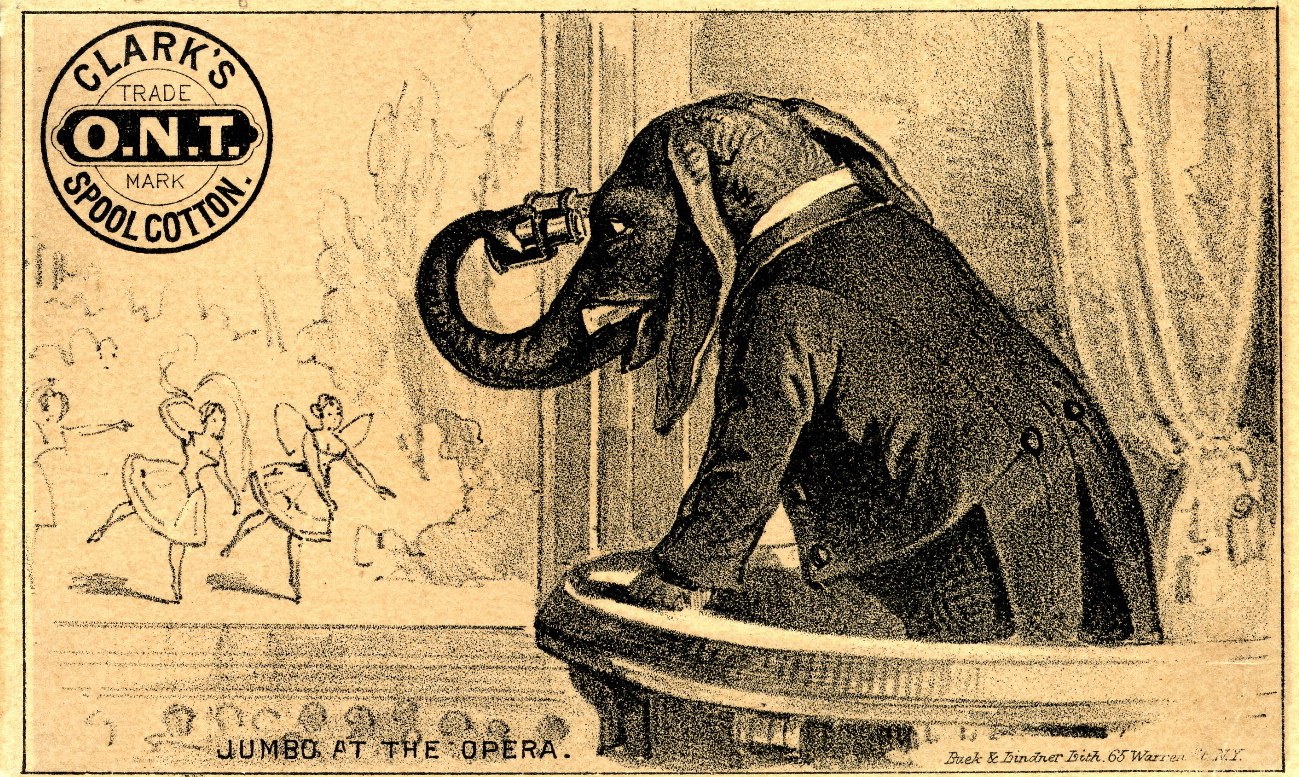
Advertising card for spool cotton featuring Jumbo at the opera
Buek and Lindner
- Medium:
- Oil Painting
- Dance:
- Ballet
- Era:
- Late 1800s (Victorian Ballroom)
- Source:
- Wikimedia Commons
- Rights:
- Public domain — free to use, share and adapt.
- Recorded as:
- Public Domain
Trade cards are primary documents of how dance figured in nineteenth-century popular culture—not as an art form in its own right, but as a symbol of refinement that could sell consumer goods. This card demonstrates that ballet's cultural capital was so established by 1883 that a thread manufacturer could invoke it in passing, confident that their audience would understand the reference. For dance historians, it shows the visibility of ballet in everyday commercial life and the gendered spectacle of female consumption that ballet advertising reinforced.
What you are looking at
An advertising card rendered in sepia tones depicts an elegantly dressed woman in dark formal evening wear—a fitted jacket with white collar detail and what appears to be a small hat or fascinator—using opera glasses to peer intently at something beyond the frame's right edge. She is positioned in profile, leaning forward with concentrated attention. The background suggests an opera house or theater interior, with vertical architectural elements visible behind her. In the far left background, rendered in lighter, more delicate lines, three small figures in tutus and classical ballet dress are visible, appearing to dance or pose in a line. The card bears the circular Clark's O.N.T. Spool Cotton trade mark in the upper left corner. The entire composition is an exercise in witty juxtaposition: the fashionable woman in the foreground, absorbed in the spectacle of the opera, is herself part of a promotional composition advertising thread.
The dancing
The main figure is a single woman shown in three-quarter view, her body angled and forward-leaning to engage the opera glasses, suggesting active looking rather than passive presence. Her posture is rigid and purposeful, the torso upright despite the forward tilt. The three distant figures in the background are rendered as simplified, silhouetted forms in classical fifth-position ballet stance, their arms in port de bras positions typical of academic ballet, though the small scale and delicate rendering make precise technique difficult to assess. The contrast between the solid, weighty foreground figure and the ethereal, stick-like background dancers is compositionally intentional.
The dance depicted
The background figures appear to represent classical ballet—most likely Romantic ballet of the mid-nineteenth century, given their tutus and formal stance. The women are positioned in what appears to be a theatrical performance configuration, arranged in a diagonal line as one might see in a corps de ballet. However, the image is not primarily about dance: it is a commercial advertisement using ballet as cultural scenery. The opera house setting and the woman's fixed attention suggest this is commentary on fashionable leisure and spectatorship rather than documentation of dance itself. The dance figures function as props in a social scene.
How it was made
This is a chromolithograph or color lithographic print, as evidenced by the uniform color palette, the flat tonal areas, and the registration visible at the edges. The technique allowed for mass production of advertising cards—a new commercial form in the 1880s—and enabled fine detail in the foreground figure while using economy of means for background elements. The small format, color printing, and oval trade mark stamp all identify this as a trade card, a collectible promotional item distributed by thread manufacturers to shopkeepers and consumers. Such cards were inexpensive to produce but reached a vast audience. The signature 'Buek & Lindner' visible at the bottom indicates the printing firm responsible.
About this work
This is a commercial advertising card from Clark's spool cotton, designed to promote the company's thread product through witty social commentary. The image uses the spectacle of ballet—visible through a theater interior—as a backdrop to a scene of fashionable female consumption and leisure. The woman with opera glasses becomes the true subject: she is the consumer, the viewer, the modern woman of means who attends cultural events and buys quality thread. The painting (despite the catalogue's labeling) is almost certainly a lithographic print, created for mass circulation and intended to be collected and displayed. It belongs in the dance gallery because it captures ballet as a cultural phenomenon—not as a subject of artistic documentation, but as a marker of social status and modernity that could be invoked in a moment to signal elegance and sophistication.
How to look at it
Notice the absolute division between foreground and background, between the solid, realistic woman and the ethereal, sketched dancers. The artist is not interested in dance technique or movement; the background dancers are ciphers, almost abstractions. Look instead at the woman's intensity, the way she leans into her viewing, the precision of her dress and accessories. This is a picture about consumption and leisure, not performance. The opera glasses are the true subject—the instrument of fashionable looking. The ballet dancers exist only to justify that looking, to make it seem cultured and refined rather than merely curious.
The artist
Buek & Lindner was a New York lithographic printing firm active in the 1870s–1880s, specializing in chromolithographic trade cards and commercial advertising. The firm was one of many that produced the huge volume of decorative cards that were collected, swapped, and pasted into albums during the Victorian era. The artists whose work they printed are rarely individually credited; the attribution to the firm name indicates a commercial workshop rather than a fine artist.
The period
The 1880s were the height of the trade card craze: chromolithography made color printing affordable, and competitive manufacturers distributed millions of cards to build brand loyalty. Simultaneously, Romantic ballet had faded from its mid-century peak, but classical ballet training and performance remained fashionable among the urban middle and upper classes who attended opera houses. Ballet had become firmly associated with respectability, refinement, and female beauty—an ideal tool for marketing luxury goods. The image captures the moment when ballet was ceasing to be an avant-garde spectacle and becoming a standard symbol of culture.
Where it lives
This trade card is held by Wikimedia Commons. Trade cards of this type were mass-produced consumer goods, distributed in the thousands, and most surviving examples are untraced and uncollected until recent digitization efforts. The card's survival reflects the fact that some were kept and preserved by collectors, while millions were discarded.
Dance in this work
Questions about this work
Is this actually oil painting as the record says?
Almost certainly not. The flatness, the color registration, and the printed signature 'Buek & Lindner' (a lithographic firm) indicate this is a chromolithograph—a mass-produced print. The catalogue record is incorrect.
What is Clark's O.N.T. Spool Cotton?
Clark's was a major British thread manufacturer founded in 1814, famous for their 'O.N.T.' (Our New Thread) brand. The company was among the largest producers of sewing thread in the world and distributed billions of trade cards as advertising.
Why use ballet in an advertisement for thread?
Ballet signaled refinement, femininity, and cultural status. Threading and sewing were feminine accomplishments, as was attending the opera. By linking thread to the spectacle of ballet, the advertisement positioned sewing as part of a woman's cultivated life, not mere domestic labor.
Who would have received this card?
Trade cards were distributed to shopkeepers, inserted into product boxes, given away at stores, and mailed as promotions. They were collected voraciously by the public, especially children and women, and pasted into albums. They were a form of popular print media comparable to baseball cards or modern collectibles.
More Ballet artwork