49 works in this view — arrow keys or swipe to move between them.
Dance in Art · 2023
Bailando sobre fa
Italo somma
- Medium:
- Oil Painting
- Dance:
- Ballet
- Source:
- Wikimedia Commons
- Rights:
- Public domain — free to use, share and adapt.
- Recorded as:
- CC0
For dancers and historians of ballet, this work documents how contemporary visual artists are engaging with classical ballet form in the 2020s—not celebrating its ethereal tradition but interrogating its physicality, vulnerability, and the discipline required. The artist's attention to the precise mechanics of pointe work combined with the deliberate visual emphasis on bandaging and effort offers an alternative visual language for representing what professional ballet actually is.
What you are looking at
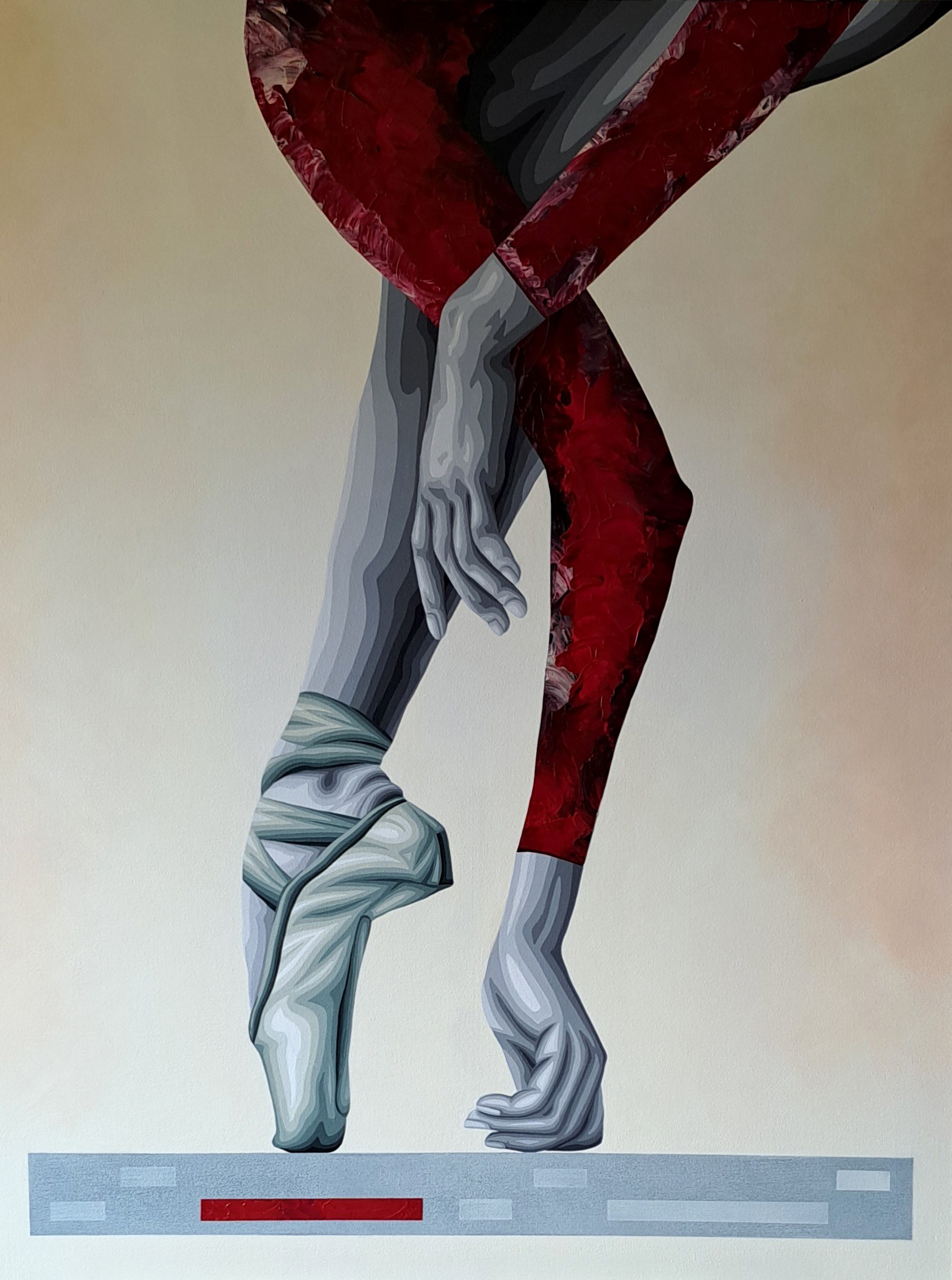
A single dancer poised on pointe shoes against a neutral cream background, captured in a moment of extreme extension and control. The figure wears a deep burgundy velvet costume with raw, frayed edges—the fabric appears deliberately distressed or torn, creating a textured, almost sculptural silhouette. The dancer's pale legs are rendered in cool grays and whites with strong linear hatching that models the musculature and strain of the pose. The lower body, from mid-thigh downward, is wrapped in bandaging or tape in teal and dark tones, suggesting either classical pointe preparation or injury. Below the figure, a small rectangular shape in muted blues and reds may represent a stage floor or the artist's signature mark. The composition is vertical and intimate, focused entirely on the isolated body and its technical capacity.
The dancing
A solitary dancer stands in profile, weight fully committed to one pointe shoe while the opposite leg extends in a long line parallel to the torso—a classical arabesque or attitude devant position. The upper body is held in precise alignment, the arms positioned to balance the extended leg. The rendering of the legs shows anatomical knowledge: the supporting leg is heavily shaded to emphasize the muscular effort of supporting the dancer's weight on the ball of the foot, while the extended leg receives lighter modeling to suggest its lifted, weightless quality. The bandaging around the ankle and foot draws attention to the precise mechanics of the pointe shoe and the dancer's physical vulnerability.
The dance depicted
This is unambiguously ballet, and specifically a study of classical ballet technique in its most demanding form. The pointe work, the extended leg line, the balletic frame, and the professional preparation of the feet all mark this as theatrical ballet rather than any other form. The artist has chosen to represent the dancer at the moment of maximum technical demonstration—a static balance on pointe that displays strength, control, and the transformation of the human body into an ideal geometric form. The distressed costume and the emphasis on physical wrapping suggest an interest in the cost and strain behind the aesthetic, or an exploration of how contemporary artists address classical ballet's relationship to the body.
How it was made
The painting employs oil on canvas with a technique that emphasizes layered color and strong linear definition. The artist builds form through hatching and modeling rather than through smooth blending—the legs in particular show this linear, almost engraving-like approach, which creates a tension between the painterly material and the precision of line. This technique allows the artist to render both the soft fabric of the costume and the hard anatomical clarity of the supporting musculature. The sparse background and close framing suggest this is a studio study or deliberate formal composition rather than a narrative scene, inviting the viewer to focus entirely on the body's geometric language.
About this work
This 2023 work by Italo Somma depicts a classical ballet dancer in arabesque, rendered in oil with particular attention to the technical strain and physical vulnerability of pointe work. The burgundy velvet costume with its raw, frayed edges contrasts with the precise anatomical rendering of the legs, which are emphasized through teal and dark wrapping that suggests both classical foot preparation and bodily injury. The work belongs in the Gallery of Dance in Art because it makes visible the classical ballet body as both an aesthetic achievement and a site of physical labor—a contemporary meditation on how we represent and understand the virtuosity and cost of professional dance. Somma's use of distressed fabric and stark anatomical modeling pushes against the ethereal, disembodied ideal that ballet imagery often promotes, grounding the form in flesh, effort, and material reality.
How to look at it
Attend first to the pose itself: this is a test of static balance and alignment, not a moment of dynamic movement. The artist has frozen the dancer at the moment of greatest extension and control, when the position can be held and measured. Notice how the distressed fabric and the bandaging shift the register from ethereal to material—the costume is not flattering or beautiful but present as textile and weight. Look at how the legs are rendered differently: the supporting leg is heavily modeled to show muscular effort, while the extended leg is lighter, almost dematerialized. This contrast between effort and weightlessness is the painting's central visual argument.
The artist
Italo Somma is a contemporary artist who works with a method he calls 'Código Somma' (Somma Code), a systematic approach to color and composition in dance painting. According to the existing catalogue note, this work is part of a series of dance paintings in which red indicates tension or emotional intensity—here deployed in both the costume and the floor or framing element. Somma's practice appears focused on making visible the inner experience and physical effort of dance through color theory and symbolic marking rather than through narrative or gesture.
The period
In the 2020s, contemporary visual artists are increasingly returning to ballet as a subject after decades of neglect, but with a fundamentally different approach than early twentieth-century modernists who were invested in ballet's avant-garde credentials. The interest now is often in labor, precarity, and the lived experience of the dancer's body, reflecting broader conversations about embodied work, femininity, and physical vulnerability in contemporary art. This work sits within that moment while maintaining a formal, almost classical composure in its approach to the figure—a restraint that contrasts with more expressionistic recent ballet imagery.
Where it lives
The work is recorded as sourced from Wikimedia Commons with no known holding collection noted. It is dated 2023 and titled 'Bailando sobre fa' (Dancing on F), a title that may reference the artist's Código Somma system in which colors and tensions are mapped to musical notes.
Dance in this work
Questions about this work
What does the red fabric and the red mark at the bottom mean?
According to the artist's own note, red in Somma's code indicates tension. In this painting, the red costume and the red rectangular element below may represent emotional or physical intensity, and possibly locate the dancer's emotional state. The system is systematic rather than purely symbolic, mapping colors to psychological or kinetic content.
Is the dancer injured?
The bandaging around the foot and ankle is ambiguous by design. It may represent standard pointe shoe preparation and taping, or it may suggest injury or strain. The artist's emphasis on this wrapping—rendering it in multiple colors and making it visually prominent—suggests an interest in the question of what lies beneath the classical ballet surface, whether injury, effort, or care.
Why is the costume so rough and distressed?
The raw, torn edges of the burgundy velvet push against the polished, ethereal aesthetic that ballet costumes are usually designed to project. By rendering the costume as material—frayed, textured, present as fabric—the artist emphasizes the physical reality of the dancer's clothed body rather than presenting her as a weightless ideal.
Is this a specific dancer or a type?
The face is not visible and the figure is presented as a type—the classical ballet body in its most idealized pose. This generalization supports the work's focus on form, technique, and the abstract ideal that ballet represents, rather than on individual personality or narrative.
More Ballet artwork