49 works in this view — arrow keys or swipe to move between them.
Dance in Art · 1855
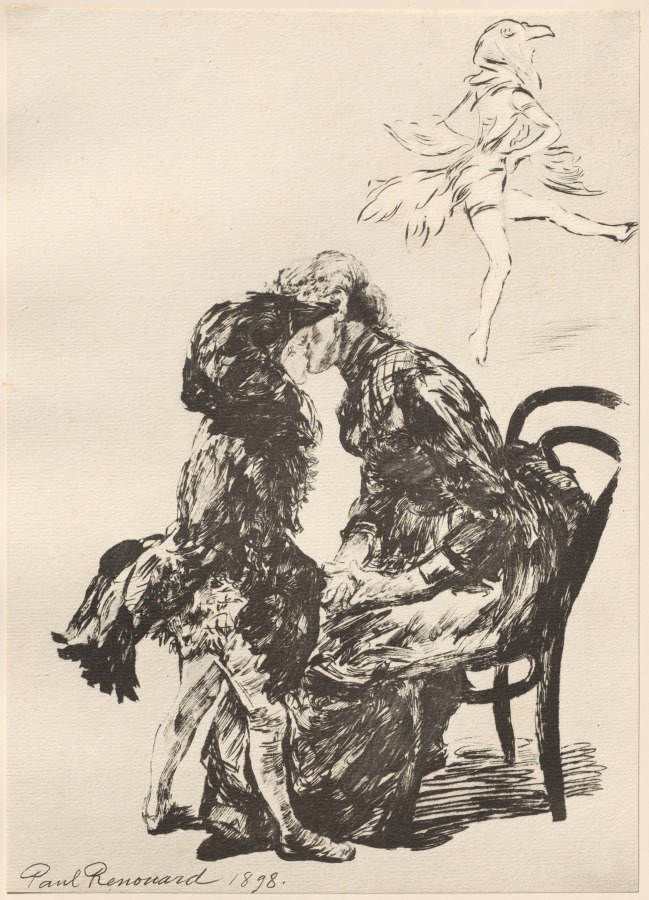
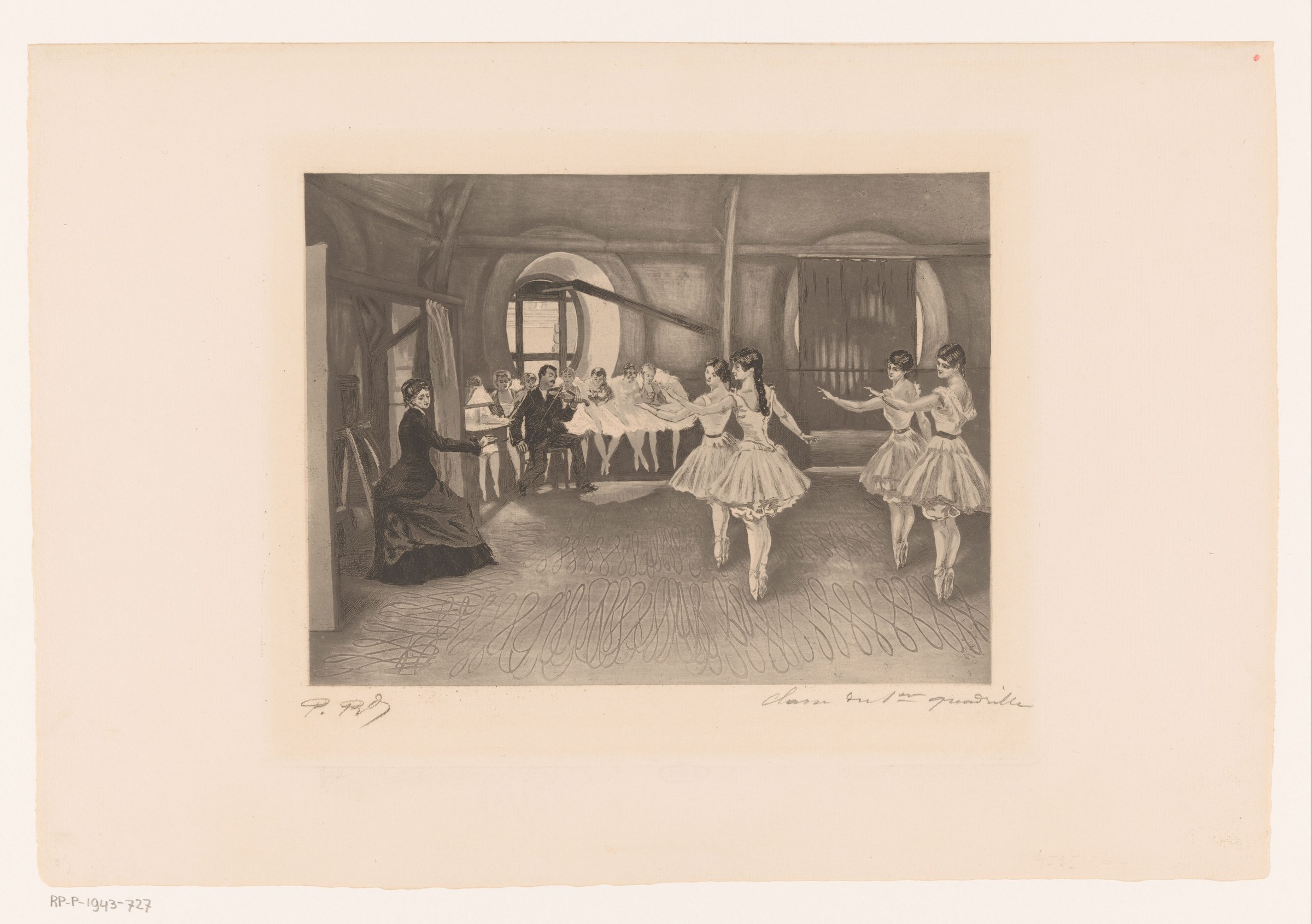
Balletles in zaal met violist, RP-P-1943-727
Unknown (Rijksmuseum collection)
- Medium:
- Oil Painting
- Dance:
- Ballet
- Era:
- Mid 1800s (Polka Era)
- Source:
- Wikimedia Commons
- Rights:
- Public domain — free to use, share and adapt.
- Recorded as:
- CC0
This image is one of the rare visual documents of ballet pedagogy from the Romantic era, showing the daily practice and teaching methods that produced the dancers performing on stage. For historians of dance technique, it is invaluable evidence of posture, dress, studio setup, and the role of live music in training. For artists, it demonstrates how a sophisticated printmaker approached the problem of rendering the ephemeral discipline of classical ballet.
What you are looking at
A ballet class or rehearsal takes place in a high-ceilinged studio with large arched windows. Four dancers in pale tutus and pointe shoes occupy the center of the composition, arranged in a line facing toward the back wall. They are caught mid-movement, their bodies extended in attitudes suggesting sustained positions or transitions. A violinist stands at left playing for the dancers. At the far left, a woman in dark dress (likely the instructor) watches from a seated position. Several figures in dark clothing—possibly other students or staff—cluster at the center background near what appears to be a piano or music stand. The wooden floorboards are rendered with careful perspective lines drawing the eye into the depth of the room. The light is cool and even, suggesting the bright north light of a teaching studio.
The dancing
The four dancers in the foreground are arranged in a loose line, with bodies held in positions that suggest classical ballet vocabulary—extensions, raised arms, and sustained verticality. The two rightmost dancers display the clearest poses: raised arms in classical port de bras and legs in extension or attitude. Their poses do not suggest a unified group choreography but rather individual positions held for demonstration or correction, which supports a class setting. The two leftmost dancers are less distinctly posed but similarly vertical and extended. All four wear identical pale tutus and pointe work, marking them as serious ballet students. The violinist's posture—standing with instrument raised—indicates active performance rather than accompaniment from a score.
The dance depicted
This is almost certainly a ballet class or training session, most likely from the mid-nineteenth century when the four-position classical technique codified by teachers like Cecchetti was spreading across Europe. The presence of live violin music, the teaching figure at left, and the demonstration of individual positions strongly suggest an instructional context rather than a staged performance. The dancers' pale tutus and pointe work place this firmly within the Romantic or early Classical ballet tradition. The title given in the record—'Balletles in zaal met violist' (Ballet lesson in a room with violinist) and the alternative title 'Classe de premier quadrille' (Class of the first quadrille)—both confirm a teaching setting, though 'quadrille' may refer to four dancers rather than the social dance form.
How it was made
This is an aquatint and etching, a sophisticated printmaking technique that combines the tonal gradations of aquatint with the linear precision of etching. The catalogue identifies the artist as Paul Renouard (1845–1924), a French printmaker and illustrator known for social and theatrical scenes. Aquatint allowed the artist to achieve the subtle modeling of light on the dancers' bodies and the depth of the studio interior, while etching provided the crisp detail of faces, costumes, and the wood floor. The technique was well suited to circulation among dancers, teachers, and ballet enthusiasts; prints were affordable, portable, and more durable than drawings. This scale and finish suggest publication or distribution beyond a single patron.
About this work
This is a mid-nineteenth-century French aquatint and etching depicting a ballet class in session, captured with the documentary precision of a social realist artist. The work belongs to a tradition of studio scenes and rehearsal imagery that became popular in Europe as ballet professionalized and formalized its training methods. The print records not just the physical appearance of classical ballet technique but also the social structure of instruction: the watching teacher, the attentive accompanist, and the disciplined students in their standardized dress. It is a record of how ballet was actually taught and learned at a moment when the technique was codifying itself into a system.
How to look at it
Attend to the moment chosen: the artist has frozen the dancers mid-class, not in spectacular poses but in the sustained, quietly demanding positions that classical technique requires. The compositional geometry—the perspective lines of the floor, the symmetry of the standing figures—reflects the order and discipline of the class structure itself. Notice how the instructor's gaze directs the viewer's attention to the dancers, and how the violinist's active pose underscores that this is living, musical instruction rather than silent rehearsal. The subtle modeling of light and shadow on the dancers' bodies and limbs demonstrates the artist's understanding of the physical demands of the technique: these are working bodies, not merely graceful shapes.
The artist
Paul Renouard (1845–1924) was a prolific French illustrator and printmaker who documented contemporary life with wit and precision. He was known for social scenes, theatrical subjects, and fashion illustration, and his work appeared regularly in satirical and literary journals. His interest in ballet as a subject places him within a wider nineteenth-century practice of artists attending rehearsals and performances to create studies for exhibition and publication. Renouard's technique was always assured and his observation sharp; his prints circulated widely and influenced how ballet was visualized in popular and critical discourse.
The period
By the 1850s–1870s, when this print was likely made, European ballet was consolidating its classical technique through systematic instruction. The Romantic era was giving way to the later nineteenth century, and the role of the professional ballet master and the formalized class structure—with its positions, ports de bras, and progression of difficulty—was becoming standardized. This period saw the rise of the professional dance school and the publication of instructional treatises (notably the Cecchetti system, which was being refined in this same era). French ballet culture was dominant, and Paris was the center of both innovation and documentation. Printmaking was the primary medium for circulating images of dance among the educated public and within the dance world itself.
Where it lives
The work is held in the Rijksmuseum in Amsterdam (accession RP-P-1943-727) and was accessed through Wikimedia Commons. It is catalogued as a print, bearing a collector's mark (Lugt 2228, indicating a known collection mark).
Dance in this work
Questions about this work
How do we know this is a ballet class and not a performance?
The title identifies it as a class ('Balletles' and 'Classe de premier'). The setting—a bare studio with large windows and simple wooden floors—is consistent with a teaching space, not a theater with wings or drops. The presence of a watching instructor and the isolated, stationary poses of the dancers confirm instruction. The informality of the arrangement and the presence of students in uniform costume also distinguish this from a staged performance.
Why is the violinist so prominent in the composition?
Live violin accompaniment was standard in ballet training and rehearsal in the nineteenth century. The violinist provided both tempo and musical character to support the dancers' work, much as a pianist does in modern classes. The artist's decision to give the musician a prominent standing pose and clear profile emphasizes that this was a collaborative practice: dance and music were inseparable parts of instruction.
What do the tutus tell us about the era and the dancers' status?
The pale, short tutus visible in the image became standard dress for ballet students and performers in the mid-nineteenth century, replacing longer Romantic skirts for training purposes. The uniform tutus indicate these are serious, formally trained students, likely at a professional or semi-professional school. The fact that they are all identically dressed also speaks to the standardization and professionalization of ballet as a discipline.
Is Paul Renouard recording an actual class he witnessed?
It is likely that Renouard attended a real ballet class or rehearsal and made sketches or studies, which he then refined into this composed print. However, the precise studio and individuals are not identified, and the composition shows artistic arrangement rather than photographic reportage. It is best understood as a truthful genre study of ballet pedagogy rather than a portrait of a specific moment or location.
More Ballet artwork