49 works in this view — arrow keys or swipe to move between them.
Dance in Art · 2023
Inquino n.2
Italo somma
- Medium:
- Oil Painting
- Dance:
- Ballet
- Source:
- Wikimedia Commons
- Rights:
- Public domain — free to use, share and adapt.
- Recorded as:
- CC0
For dancers and ballet historians, this work articulates contemporary artistic questions about the ballet body—its construction, display, identity, and meaning—at a moment when ballet itself is being reassessed for whom it serves and what it perpetuates. The series concept ("Codice Somma") suggests a system or code underlying ballet's visual and technical language, making explicit what is usually implicit: that ballet is a constructed visual form, not a natural expression of the body.
What you are looking at
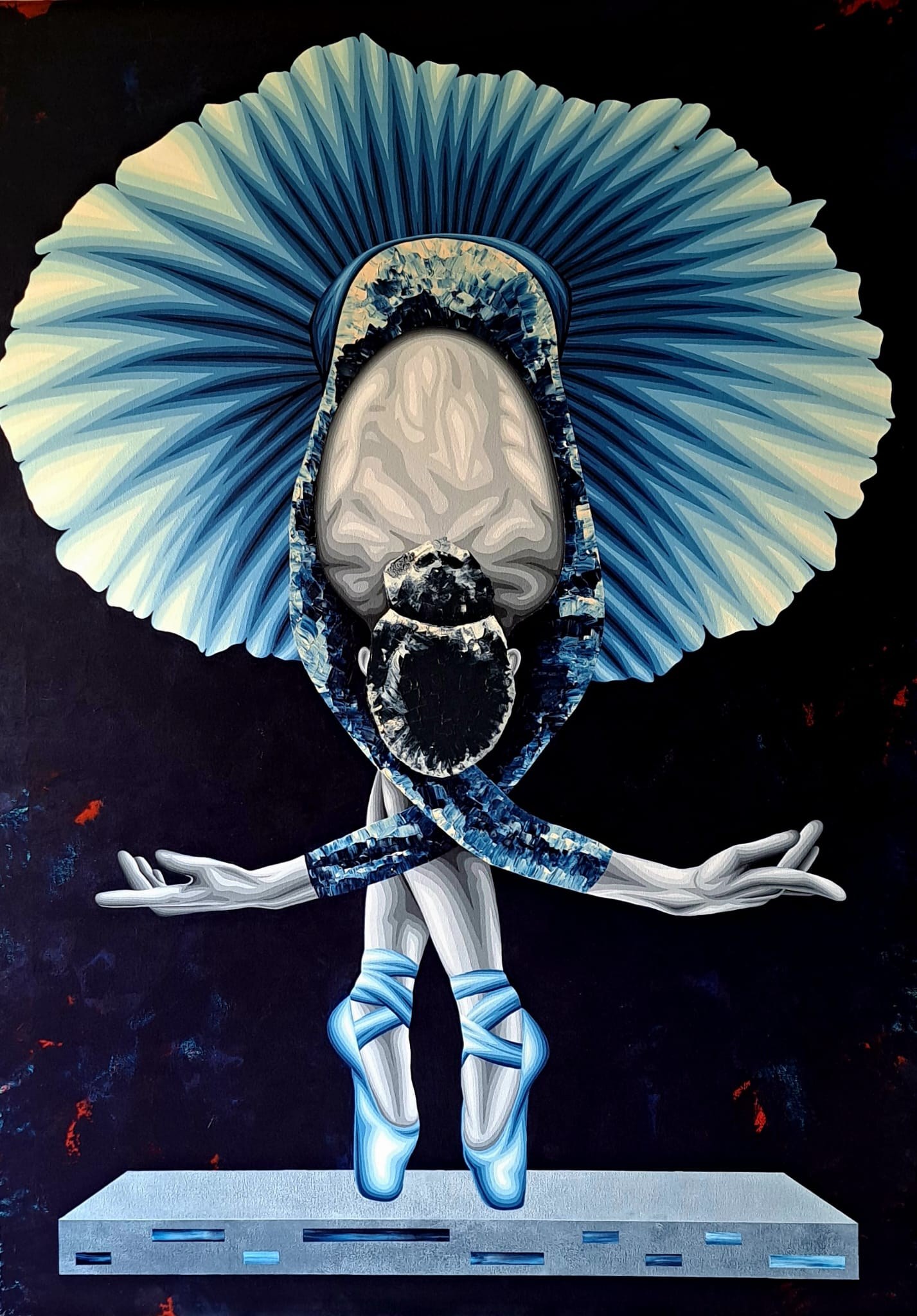
A single figure in classical ballet pointe shoes dominates the composition against a black ground. The dancer stands en relevé, arms extended horizontally in a second position frame. The figure's head is abstracted into smooth, undulating contours rendered in pale grey and white, lacking facial features or recognizable human anatomy. Most striking is the elaborate costume: a vast radial collar of pale blue and white striped fabric extends outward from the neck like a Elizabethan ruff or the petals of a daisy, creating a halo effect. Below this, a corseted torso in iridescent blue and white is cinched tightly. The dancer wears blue pointe shoes with white socks or leg wrappings that extend to the knees. The lower legs are rendered in pale white with blue accent lines suggesting musculature or articulation. The figure stands on a simple horizontal platform rendered in grey with rectangular cut-outs. Small red marks appear in the upper corners and lower edges of the black ground, possibly indicating damage or intentional marks.
The dancing
A single dancer in full extension, weight balanced on both feet en relevé in pointe shoes. The arms are held in a classical second position frame at shoulder height, palms facing neutral or slightly downward. The torso is held rigidly upright, suggesting the controlled vertical alignment demanded by classical technique. The abstracted head shows no movement or expression, presenting an almost sculptural quality. The overall silhouette is symmetrical and frontal, presenting the figure as a formal study rather than capturing a moment of dynamic motion.
The dance depicted
This work depicts classical ballet, specifically the formal, stationary poses fundamental to the technique. The pointe shoes, the arm position, and the upright carriage all identify this as theatrical ballet in the classical tradition. The title—*Inquino* (possibly referencing *inquietude* or restlessness in Italian/Spanish)—and the catalogue note about a series on ballet using the "Codice Somma" suggest this is part of a conceptual project examining ballet through abstraction. Rather than representing a narrative moment from a ballet, the image appears to study the ballet body as a formal structure, with the exaggerated costume piece—the enormous collar—potentially commenting on the artificiality of classical ballet dress or on the display and presentation of the dancer's body.
How it was made
Oil painting on canvas, identifiable from the brushwork visible in the smooth, blended passages of the face and the more gestural rendering of the costume. The artist has used glazing and layering to build the subtle tonal variations in the grey and white head, and more opaque, structured paint application for the geometric forms of the costume and platform. The technique permits both precise control (in the architectural costume elements) and expressive abstraction (in the featureless, morphing head), allowing the artist to render the dancer simultaneously as a technical apparatus and as something fluid or unknowable.
About this work
Italo Somma's *Inquino n.2* (2023) is an oil painting that abstracts the classical ballet body into formal and conceptual components. Part of a series examining ballet through what the artist terms "Codice Somma," the work presents a dancer en pointe in a rigidly frontal pose, stripped of facial identity and dressed in an exaggerated theatrical collar that reads as both homage to ballet's artificiality and critique of how the dancer's body is displayed. The painting sits at the intersection of contemporary art practice and dance history, using abstraction and formal reduction to interrogate what ballet as a visual and technical tradition actually is.
How to look at it
Attend to the radical asymmetry between the highly detailed, architectural rendering of the costume (especially the enormous striped collar) and the complete abstraction of the head and face. The artist is asking the viewer to consider what ballet's visual language actually prioritizes: the dressed, positioned body, not the individual person. Notice too the rigid frontality and symmetry of the pose, which speaks to ballet's classical training in formal presentation—this is not a figure caught in movement or expression, but a figure held in formal display. The platform beneath the dancer grounds the figure as a kind of monument or specimen, further emphasizing the construction of the ballet body as a visual object.
The artist
Italo Somma is an Italian artist working primarily in painting and based on the series title and date, appears engaged in conceptual reinterpretation of classical ballet through abstraction. The *Inquino* series, of which this is the second work, uses oil painting to deconstruct ballet imagery, combining precise technical rendering of costume and anatomy with abstraction of the head and face. This approach—using representational painting technique to explore the conceptual status of a familiar subject—is characteristic of contemporary figurative practice that questions rather than reproduces its source material.
The period
Created in 2023, *Inquino n.2* emerges in a moment of sustained critical and artistic reassessment of ballet's institutional, racial, and gender politics. Contemporary artists and dancers have increasingly turned to visual art, installation, and multimedia to challenge the homogeneity and traditional aesthetics of classical ballet. Somma's abstraction of the ballet body—removing the face, exaggerating costume elements into geometric forms—aligns with broader contemporary art interest in deconstructing classical representation and with dance scholarship questioning what ballet's visual codes actually encode and for whom.
Where it lives
Sourced from Wikimedia Commons; no collection holding is recorded. The work is dated 2023 and identified as part of a series exploring ballet under the conceptual framework termed "Codice Somma."
Dance in this work
Questions about this work
Why is the dancer's head abstracted?
By removing the face and rendering the head as smooth, undulating forms, Somma directs attention away from the dancer as an individual person and toward the body as a formal, technical structure. This abstraction aligns with classical ballet's long history of emphasizing the positioned body over individual expression or identity—the dancer becomes a vehicle for the choreography and the aesthetic system, not a character or personality. The choice also raises contemporary questions about the erasure of individuality within classical ballet training.
What is the enormous collar?
The striped radial collar resembles both Elizabethan court dress and the petals of a daisy or flower, and serves multiple functions in the composition. Visually, it frames and isolates the dancer as a spectacle, emphasizing how ballet costumes present the body for viewing. It may also reference the historical artificiality of classical ballet dress, or comment more broadly on how costume in ballet both enables and constrains the body. The exaggeration of this element suggests it carries conceptual weight in Somma's investigation of ballet's visual codes.
What does 'Inquino' mean?
The title is likely derived from Italian or Spanish roots suggesting disquiet, restlessness, or agitation (*inquietudine*). For a work depicting a perfectly still, formally controlled ballet pose, this title creates an ironic or conceptual tension—there is unease or questioning embedded in what appears to be perfect classical formality. This disjuncture between title and image reinforces the work's interest in interrogating, rather than celebrating, ballet's traditional visual language.
What is the 'Codice Somma'?
Based on the catalogue note, "Codice Somma" appears to be the artist's own conceptual framework or system for examining ballet. *Codice* (code) suggests that Somma understands ballet not as a transparent art form but as a constructed visual and technical language with its own rules and meanings. The series of which this work is part uses this code to deconstruct and reinterpret ballet imagery, making explicit the conventions and power structures embedded in how ballet presents the body.
More Ballet artwork