49 works in this view — arrow keys or swipe to move between them.
Dance in Art · 1931
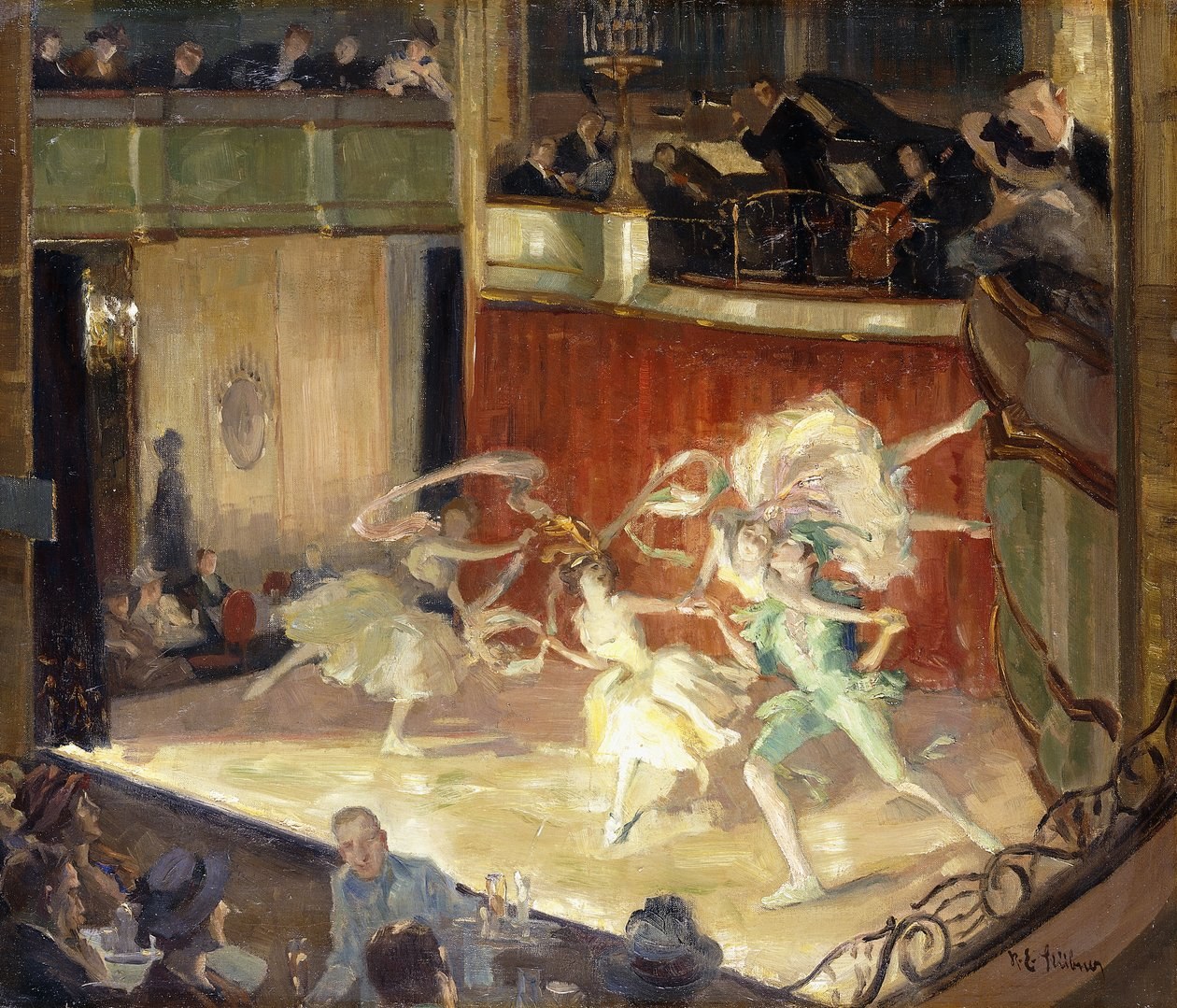
Robert Emil Stübner Im Theater
Robert Emil Stübner
- Medium:
- Oil Painting
- Dance:
- Ballet
- Era:
- 1920-1950 (Swing Era)
- Source:
- Wikimedia Commons
- Rights:
- Public domain — free to use, share and adapt.
- Recorded as:
- Public Domain
This work documents a distinct theatrical tradition—acrobatic performance as concert art, with trained male and female performers executing synchronized feats of strength and extension on a formal stage. It provides visual evidence of how acrobatic skill was organized, presented, and received as high theatrical entertainment in early twentieth-century Europe, a context now largely invisible in dance and theatre scholarship.
What you are looking at
A circus or theatrical performance captured mid-action, set in a grand interior with tiered balconies holding spectators and an orchestra platform. The stage floor is a warm sandy-beige, framed by a deep red curtain backdrop. In the foreground, a male performer in green tights and a flesh-coloured tunic executes a dramatic acrobatic pose, arms and legs extended in a dynamic split or mid-air suspension. Around him, multiple female performers in white tunics and pale tights move in coordinated motion—some airborne, some grounded—creating a sense of synchronized, athletic display. The lighting is brilliant on the stage, drawing the eye downward from the shadowed audience above. The composition emphasizes the spectacle: elegant spectators in dark dress lean forward from the balconies, while musicians occupy the elevated platform, all witnessing a virtuosic moment of physical achievement.
The dancing
The central male dancer is captured in a moment of extreme extension, with his body held in a flying or suspended pose that requires tremendous core strength and partnering skill. The female dancers surrounding him show sharp, synchronized positioning—some with raised arms, others in tilted or airborne attitudes—suggesting coordinated group acrobatics rather than partnered ballroom hold. The bodies are elongated, weightless-seeming, and held in classical alignment, with legs pointed and torsos lifted. Multiple dancers occupy the stage simultaneously in what appears to be an ensemble display of technical virtuosity.
The dance depicted
This depicts theatrical acrobatic or classical adagio performance, likely from a circus, music hall, or avant-garde theatrical spectacle of the early twentieth century. The extreme extensions, weightless suspensions, and synchronized ensemble suggest partner acrobatics (adagio) or acro-dance performed in a theatrical setting rather than social or ballroom dance. The presence of an orchestra and formal stage architecture indicates this was professional exhibition work. The 1931 date and style suggest European circus or cabaret performance, possibly German given the artist's name and 'Im Theater' title. The athleticism and sculptural quality of the poses indicate trained acrobats rather than ballroom or ballet dancers in the classical sense.
How it was made
Oil painting on canvas, rendered with loose, gestural brushwork that captures atmospheric light and movement through color rather than precise detail. The artist uses warm golden tones for the stage floor and skin, deep reds and browns for shadow and drapery, and cooler greens for the male dancer's costume—creating visual depth through temperature contrast. The handling is sketchy and impressionistic, allowing the viewer to read the action and emotion quickly without photographic accuracy. This technique was well suited to capturing the dynamism of live performance and suggests the work may have been made from sketches or memory rather than direct observation.
About this work
Robert Emil Stübner's *Im Theater* (In the Theater) depicts a moment of virtuosic acrobatic performance on a theatrical stage, witnessed by an elegant audience in a grand interior. Painted in 1931 in a loose, gestural style, it captures the spectacle and athleticism of early twentieth-century theatrical acrobatics—a now-forgotten performance tradition that bridged circus, cabaret, and avant-garde theatre. The work is valuable as evidence of professional acrobatic exhibition as theatrical art, showing the technical sophistication, formal staging, and social prestige of such performances before cinema and modernism shifted entertainment culture.
The painting sits at the intersection of dance history and theatre history, documenting a performance mode—theatrical acrobatics with orchestral accompaniment—that has largely vanished from Western stages. It records not just the movement itself but the entire apparatus of performance: the composed bodies, the framing architecture, the audience relation, the social context of theatrical spectacle.
How to look at it
Notice first the male dancer's extreme arabesque or flying split at the painting's centre—the moment the artist chose is the peak of extension and apparent weightlessness, not a preparatory or recovery moment. Observe how the female dancers are positioned in echo or counterpoint to him, creating a visual composition rather than a narrative sequence. The orchestra platform is visible and active, indicating that this acrobatics was accompanied by live music and thus integrated into a full theatrical production. The spectators' rapt attention and formal dress signal that this was high entertainment, not vernacular or recreational performance.
The artist
Robert Emil Stübner was a German painter active in the early twentieth century, known for theatrical and social subjects rendered in an expressionistic, gestural style. His interest in circus, theatre, and performance subjects placed him within a broader early modernist tradition of artists documenting entertainment culture—a tradition including Toulouse-Lautrec, the German Expressionists, and Constructivists. The loose handling and warm palette of *Im Theater* suggest influence from Impressionism and Expressionism, while the subject matter reflects the sophisticated cabaret and theatrical world of Weimar-era Germany.
The period
The 1930s saw both the height and decline of European circus and music-hall culture. In Germany specifically, the Weimar period (1918–1933) had witnessed an explosion of experimental theatrical and cabaret performance, with acrobatics, dance, and spectacle at the forefront. Simultaneously, cinema was beginning to displace live theatrical acrobatics as popular entertainment. Stübner's painting thus captures a moment of transition: theatrical acrobatics as refined, orchestrated art form, performed before cultivated urban audiences in grand civic or commercial theatres. The formal staging and polished virtuosity suggest this was elite theatrical entertainment, not street or carnival performance.
Where it lives
The work is recorded as held in an unspecified collection and sourced from Wikimedia Commons. It is catalogued as oil on canvas, dated 1931, and titled *Im Theater* (In the Theater).
Dance in this work
Questions about this work
What kind of dance is this?
This is theatrical acrobatics—a professional exhibition of virtuosic feats of strength, balance, and flexibility performed on a formal stage by trained athletes. It is not ballet or social dance, but rather a specialized performance mode that combined circus skills with theatrical presentation and orchestral accompaniment. Such acrobatic performance was a major form of theatrical entertainment in early twentieth-century Europe.
Why are there so many dancers performing at once?
Ensemble acrobatic performance was common in theatrical acrobatics of this period. Groups of trained acrobats would perform synchronized routines involving complex supports, suspensions, and formations. The coordination visible here suggests extensive rehearsal and professional training.
Is this painting based on a specific performance?
The catalogue record does not indicate a specific performance or theatre. However, the formal architecture, orchestra platform, and elegantly dressed audience suggest this depicts a major German or Central European theatre or concert hall, likely during the Weimar period.
How does theatrical acrobatics differ from circus or ballet?
Theatrical acrobatics emphasizes spectacular feats of strength and extension performed by trained athletes in synchronized ensembles, often with orchestral accompaniment. Unlike circus, which typically emphasizes danger and novelty, theatrical acrobatics presented skill and beauty. Unlike ballet, it did not require turned-out positions, pointed feet, or narrative structure—though both could appear in the same programme.
More Ballet artwork