49 works in this view — arrow keys or swipe to move between them.
Dance in Art · 1889
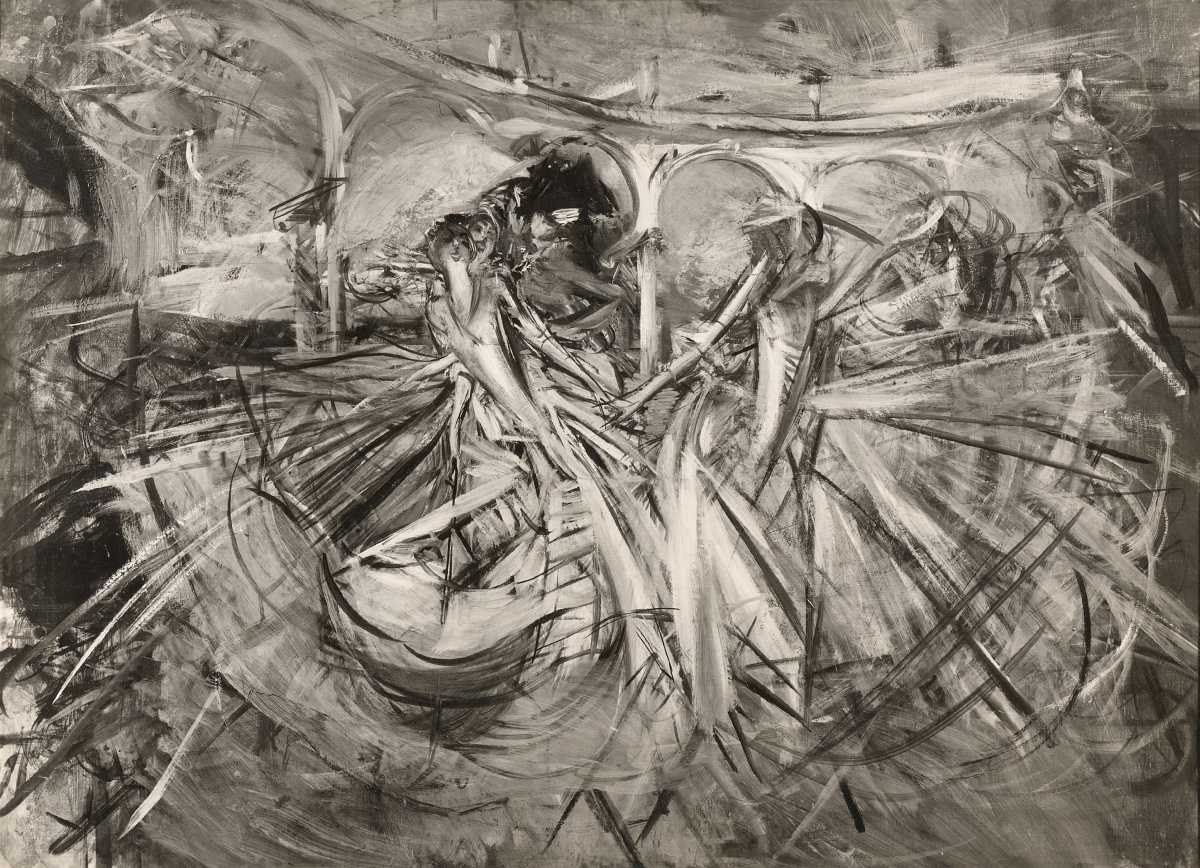
Boldini - Danza, 1889
Giovanni Boldini
- Medium:
- Oil Painting
- Era:
- Late 1800s (Victorian Ballroom)
- Source:
- Wikimedia Commons
- Rights:
- Public domain — free to use, share and adapt.
- Recorded as:
- Public Domain
This painting documents the Romantic iconography of waltz in the Gilded Age, showing how late 19th-century society painters visualized dance as emotion and fashion rather than as technical practice. For historians, it reveals the cultural meanings attached to the waltz and the fluidity with which European artists translated dance into visual form. For dancers and dance scholars, it offers a window into how their art was understood and marketed to non-dancing audiences: as spectacle, beauty, and modernity rather than as choreography or technique.
What you are looking at
This is a monochromatic oil painting depicting an energetic dance scene rendered in loose, gestural brushwork. Multiple figures in flowing, translucent garments occupy the composition, their bodies moving through space with swirling momentum. The central figures are arranged in a loose circle or group, with their bodies tilted, arms raised and extended, and drapery billowing around them. The painting uses diagonal lines and curved strokes to suggest rapid movement and spinning; the background is sketchy and atmospheric, rendered in grays and whites with emphatic directional brushstrokes that echo the motion of the dancers. The overall effect is one of whirling, Romantic-era movement rather than precise geometric positioning—the artist has prioritized the sensation of dance over anatomical or spatial clarity.
The dancing
The dancers appear to be in loose couples or small groups, with bodies angled toward one another and arms frequently raised or extended outward. The garments—long and flowing—are treated as essential to the movement, with the fabric itself becoming part of the compositional rhythm. Weight appears to shift and sway; the bodies are elongated and graceful rather than firmly grounded. There is no evidence of the closed holds or squared frames of ballroom technique; instead, the figures suggest freer, more romantic or Classical forms of partnered movement. The brushwork itself mimics the fluidity of the bodies, making it difficult to discern precise footwork or technical detail.
The dance depicted
This appears to be a Romantic-era theatrical dance, most likely a waltz or similar turning dance of the 1880s–1890s. The swirling composition, the paired figures in motion, and the ethereal treatment of the fabric all point toward waltz imagery as it was understood and romanticized in late 19th-century art—a genre of social and theatrical ballroom dancing that prioritized grace, turning, and the illusion of weightlessness. The painting does not depict the precise technical execution of Viennese waltz hold or the geometric clarity of ballroom technique, but rather captures the emotional and visual impression of the dance: spinning, embrace, and abandon to the music. This is waltz as Romantic imagination rather than technical documentation.
How it was made
The work is oil paint on canvas, handled in a loose, impressionistic manner characteristic of late 19th-century salon painting. Boldini was known for rapid, gestural brushwork and sketchy backgrounds; here the technique serves the subject, with the paint itself seeming to capture movement and fluidity. The monochromatic or nearly monochromatic palette—grays, blacks, whites, and warm earth tones—unifies the composition and emphasizes the interplay of light and shadow rather than local color. This approach allows the artist to focus on form, movement, and the emotional tenor of the scene rather than decorative detail, and it would have been legible to contemporary audiences as a work of sophistication and spontaneity suited to exhibition.
About this work
This oil painting by Giovanni Boldini captures a moment of Romantic-era waltz or theatrical dance, rendered not as technical instruction but as a mood and sensation. Boldini was one of the most celebrated portrait and society painters of the Gilded Age, and his dance subjects—though less famous than his portraits—reveal his interest in capturing movement, fashion, and the allure of fashionable leisure. The work exemplifies how late 19th-century artists understood dance not as a discrete technical practice but as an emblem of grace, femininity, and social pleasure. Boldini's fluid brushwork and atmospheric treatment anticipate Modernist approaches to figuration while remaining rooted in academic tradition; the painting sits at the intersection of Impressionism, Salon realism, and Romantic iconography.
For viewers today, the painting shows how waltz was visualized and marketed to affluent European audiences in the 1880s–1890s. The emphasis on swirling fabric, paired movement, and emotional abandon rather than technical precision tells us something important about how dance was consumed as visual spectacle: as fashion, romance, and modernity, not as technical practice. The work belongs in a dance history context because it documents not how waltz was actually performed, but how it was seen, desired, and represented by society painters.
How to look at it
Attend to the way the painting captures the sensation of turning and swirling rather than the moment of an individual step. Notice how the fabric of the garments—rendered with long, flowing strokes—is as much the subject as the bodies themselves; for a contemporary viewer, the dress was part of the seduction of the dance. The background is deliberately sketchy and atmospheric, pushing focus onto the clustered figures and their motion. The artist has chosen to freeze not a moment of perfect stillness or clarity, but a moment of abandon and momentum—the instant of maximum spin or lift. This was a conventional choice in 1880s salon painting: to capture the emotional essence of a moment rather than its technical detail.
The artist
Giovanni Boldini (1842–1931) was an Italian society portrait painter who achieved immense success in Paris and London during the Belle Époque and Edwardian periods. He was celebrated for his quick, nervous brushwork, his ability to capture likeness and character in rapid sessions, and his paintings of fashionable women in luxurious dress. While best known for his portraiture—he was called the 'Master of Swish'—Boldini also painted historical and theatrical subjects, including dance scenes. His approach to all subjects was characterized by gestural spontaneity, atmospheric background treatment, and an emphasis on elegance and movement. He exhibited widely at the Paris Salon and maintained studios in Paris, London, and Venice.
The period
The 1880s–1890s were a period of intense fascination with the waltz in European high society and in artistic circles. The waltz had originated in Vienna and had conquered Europe over the preceding century; by Boldini's time, it was not only a ballroom staple but a subject of visual representation and nostalgia. This was the age of the Strauss dynasty and the Vienna Waltz as cultural commodity; it was also the period in which Romantic ballet was giving way to more sensational and technical forms (notably, the rise of Italian technique and the dominance of Russian Imperial Ballet). Society painting of this era often depicted leisure, fashion, and dance as interwoven pleasures of the elite. Boldini's dance subjects fit squarely into this market for paintings that celebrated fashionable life.
Where it lives
The source record lists this work as sourced from Wikimedia Commons, with no holding collection recorded. The original location and current whereabouts are not documented in the available catalogue information.
Dance in this work
Questions about this work
Is this a waltz or a different kind of dance?
The composition and the flowing, turning movement strongly suggest a waltz or similar Romantic-era ballroom or theatrical dance of the late 19th century. The paired figures, the emphasis on spinning, and the ethereal fabric treatment are all consistent with how artists of the period visualized the waltz. However, the painting is not precise enough to rule out other forms of partnered dance, such as a salon polka or a theatrical waltz choreographed for the stage.
Why is the painting so sketchy and blurry?
This is not damage or incompleteness, but Boldini's deliberate technique. Rapid, loose brushwork was his signature approach and was admired as a sign of virtuosity and spontaneity in late 19th-century salon painting. The sketchiness serves the subject: it conveys movement, speed, and emotional intensity rather than precise detail. For a contemporary viewer, this approach would have conveyed sophistication and modernity.
Could this be a specific ballet or staged production?
The painting does not show the technical vocabulary or costume specificity of a particular famous ballet. The garments appear to be contemporary fashionable dress (1880s–1890s) rather than a historical or fantasy costume. It is more likely a scene of social or theatrical waltz of the period rather than a documented production.
How do we know this is by Boldini and from 1889?
The catalogue record attributes it to Boldini and dates it to 1889. The style—loose brushwork, salon composition, the subject matter of fashionable leisure—is consistent with Boldini's documented practice, but without access to signatures, provenance records, or exhibition documentation, the attribution and date cannot be independently verified from the image alone.
More dance artwork