49 works in this view — arrow keys or swipe to move between them.
Dance in Art · 1910
Burljuk - Tänzerin 1290047
Wladimir Burliuk
- Medium:
- Oil Painting
- Era:
- 1900-1920 (Ragtime/Early Jazz)
- Source:
- Wikimedia Commons
- Rights:
- Public domain — free to use, share and adapt.
- Recorded as:
- Public Domain
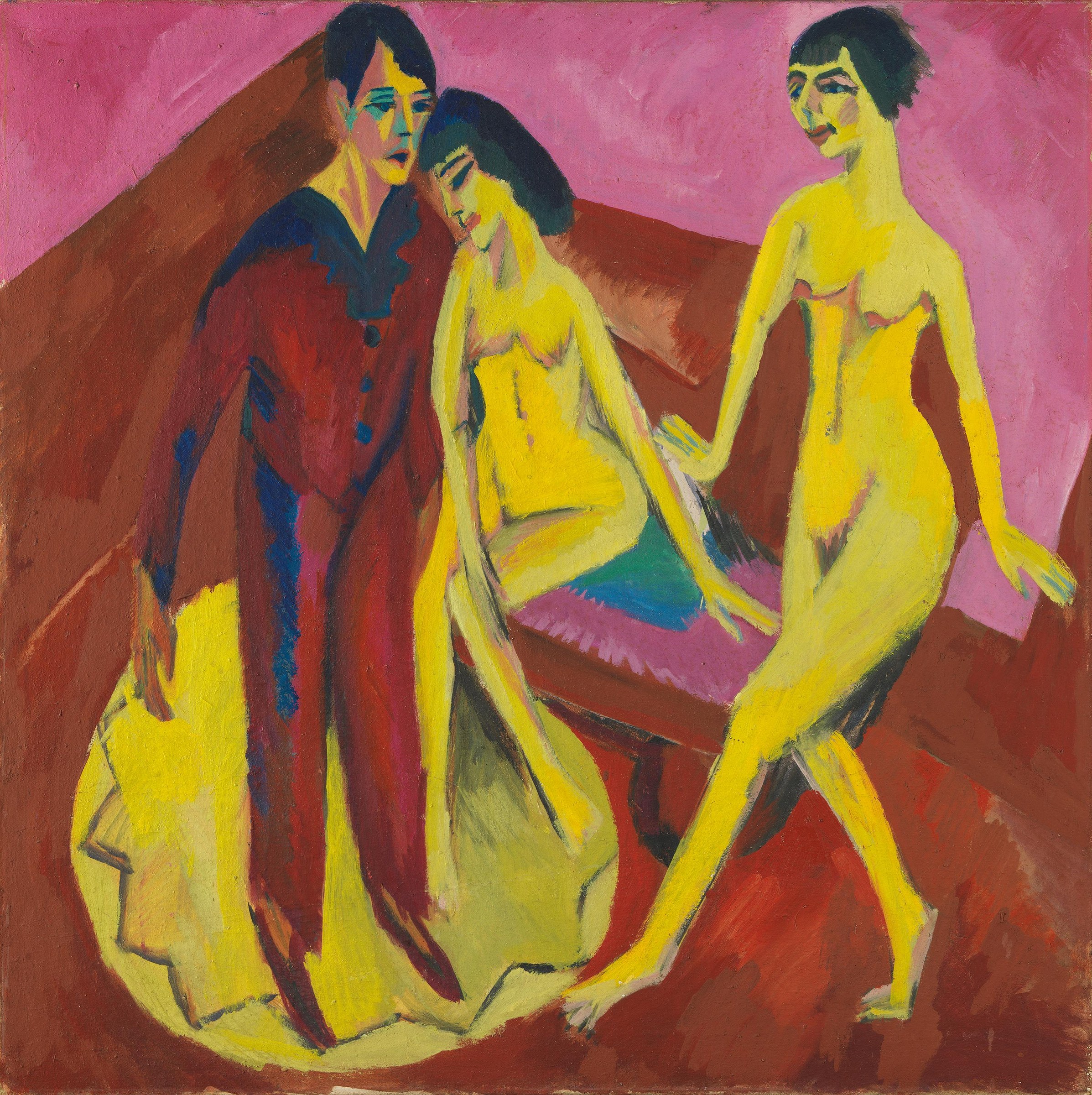
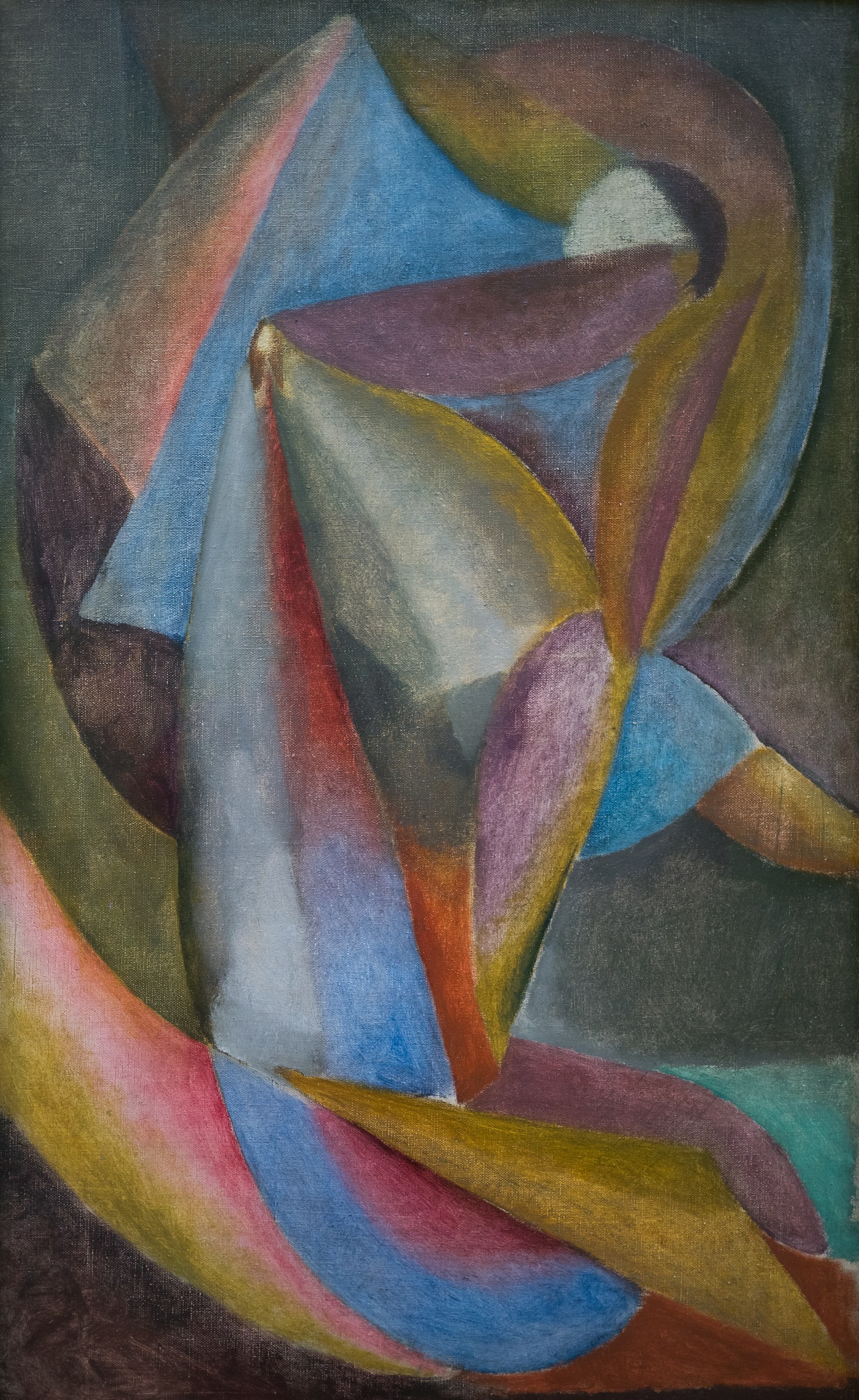
The work shows how modernist painters used dance as a laboratory for new ways of representing the body and movement. It is evidence of the deep intersection between Cubism and theatrical dance in the early 1910s, a moment when artists and dancers were collaborating to imagine the body differently. The painting asks: what does abstraction allow you to see about dance that naturalism cannot?
What you are looking at
A single figure dominates the canvas, rendered in fragmented, rotating planes of deep color—blues, purples, ochres, browns, and warm flesh tones. The body appears caught mid-motion, torso twisted and limbs articulated across overlapping geometric forms that suggest simultaneous rotation and extension. The composition is vertical and tightly compressed; the figure seems to spiral within itself, the planes of the torso and limbs creating a sense of dynamic instability. The background is a muted dark field with ochre and green tones bleeding through, and the figure's form occupies nearly the full height of the canvas. There is no setting beyond abstraction: no stage, no floor, no other dancers—only the body as a site of formal invention.
The dancing
A single dancer, viewed from roughly the front but fragmented into rotating sections that suggest a body twisting powerfully through space. The torso rotates one direction; the limbs suggest extension and counter-movement. The arms and legs read as simplified planes rather than naturalistic limbs, yet their arrangement suggests reach and lift. The head is small and appears to turn away from the body's axis. The weight is ambiguous by design—these abstract planes do not sit or ground, but float and interpenetrate, creating an impression of weightlessness and centrifugal force.
The dance depicted
This is a modernist abstraction of dance, not a naturalistic record of it. The work engages the problem of representing movement in a static medium by fragmenting the dancer's body into simultaneously visible aspects—a Cubist strategy applied to the moving human form. The catalog record offers no identifying information about the dancer or specific dance form. The abstraction is too radical to identify a particular style or technique, but the vertical compression, the sense of rotation and lift, and the early 20th-century modernist approach suggest engagement with theatrical dance of the period—possibly influenced by Diaghilev's Ballets Russes, whose dancers and productions were documented and reimagined by avant-garde artists across Europe in this era.
How it was made
Oil painting on canvas, executed in a Cubist idiom. The artist builds form through interpenetrating facets of local color, with minimal perspective and no illusionistic depth. The brushwork is relatively direct and the paint application even; the forms are defined by color boundary and plane rather than by chiaroscuro or line. This technique allows the artist to show the dancer's body from multiple viewpoints at once—a strategy of modernist painting adapted to the representation of movement. The work circulated as a painting in a private or institutional collection, not as a print or reproduction, suggesting an audience of educated collectors and critics.
About this work
This is an oil painting that brings Cubist abstraction to bear on the representation of a dancer in motion. Made in 1910, during the height of European modernism and at the moment when the Ballets Russes was reshaping what theatrical dance could mean, the work experiments with fragmenting the human body to capture the experience of movement in space. The figure is not a naturalistic record but a formal problem: how can paint represent the simultaneity and rotation of a dancing body? The answer—overlapping planes, multiple viewpoints, and a suppression of narrative context—marks this as a work invested in modernist formal innovation as much as in the subject of dance itself. For historians and dancers, the painting is a document of how avant-garde artists engaged with dance as a site of formal experiment in the early 20th century.
How to look at it
Attend to the rotation of the body: the artist has chosen a moment of extreme twist, and represented it by showing the torso, limbs, and head as if each occupies a different rotational plane. Follow the color boundaries—blue, purple, ochre, white—as they define and separate the facets. Notice that the figure does not sit still; the interpenetrating planes create a sense of centrifugal motion, as though the dancer is still spinning on the canvas. The abstraction is not arbitrary: it is a translation of the body's actual behavior under extreme movement. The artist has dissolved anatomy to capture the essence of rotation and lift.
The artist
Wladimir Burliuk (1886–1938) was a Ukrainian-born modernist painter active in European avant-garde circles in the early 20th century. He worked in a Cubist idiom and exhibited with progressive groups including the Russian avant-garde. His work often combined formal abstraction with social or figurative content, and he engaged with contemporary subjects including dance, theater, and urban life. He was part of the broad European modernist moment that included Futurism, Cubism, and Expressionism, and his practice was marked by a synthesis of these influences.
The period
In 1910, European modernism was in ferment. Picasso and Braque had only recently developed Cubism; the movement was reshaping how artists thought about representation and the body. Simultaneously, Diaghilev's Ballets Russes—founded in 1909—was introducing European audiences to radical new approaches to choreography, design, and the dancer's role. Artists including Picasso, Matisse, and many others were collaborating with the company, designing costumes and sets. The theatrical avant-garde and the visual avant-garde were in close dialogue. For modernist painters, the dancer's body—in motion, fragmentary, and radically modern—became a subject through which to explore the formal innovations of Cubism and abstraction. This painting sits squarely at that intersection.
Where it lives
The work is recorded in Wikimedia Commons. No collection or institutional holding is recorded in the catalog.
Dance in this work
Questions about this work
Is this a real dancer or a made-up figure?
The catalog record offers no name or identification, and the abstraction is too radical to identify a specific person. But the painting is clearly made from observation or imagination of an actual dancer in motion. The rhythms and tensions in the composition—the rotation, the lift, the reach—come from watching dance. Modernist artists did not invent movement from nothing; they abstracted from what they saw.
What dance form is this?
The abstraction is so complete that no specific technique or style can be named with confidence. But the vertical orientation, the emphasis on lift and rotation, and the date (1910) suggest engagement with contemporary theatrical dance—possibly ballet, possibly the more experimental forms being pioneered by the Ballets Russes at that moment. The painting is interested in the formal properties of movement, not in documenting a particular style.
Why would a painter break the dancer into pieces like this?
This is Cubism: a strategy of showing an object from multiple viewpoints at once, and trusting the viewer to assemble a sense of the whole. Applied to a moving body, Cubism allows the artist to represent simultaneity—to show the dancer's arms, legs, and torso in their full range of motion at once, as if the viewer were seeing the movement unfold across time and space in a single image. It is a way of painting movement without animation.
Was the Ballets Russes an influence on this painting?
Almost certainly. The company premiered in 1909; by 1910, when this work was made, they were already reshaping European ideas about dance and design. Many avant-garde painters, including Picasso and others, were collaborating with the company. Burliuk's engagement with abstraction and dance is consistent with that moment of radical experiment and cross-pollination between visual art and theater.
More dance artwork