49 works in this view — arrow keys or swipe to move between them.
Dance in Art · 1919
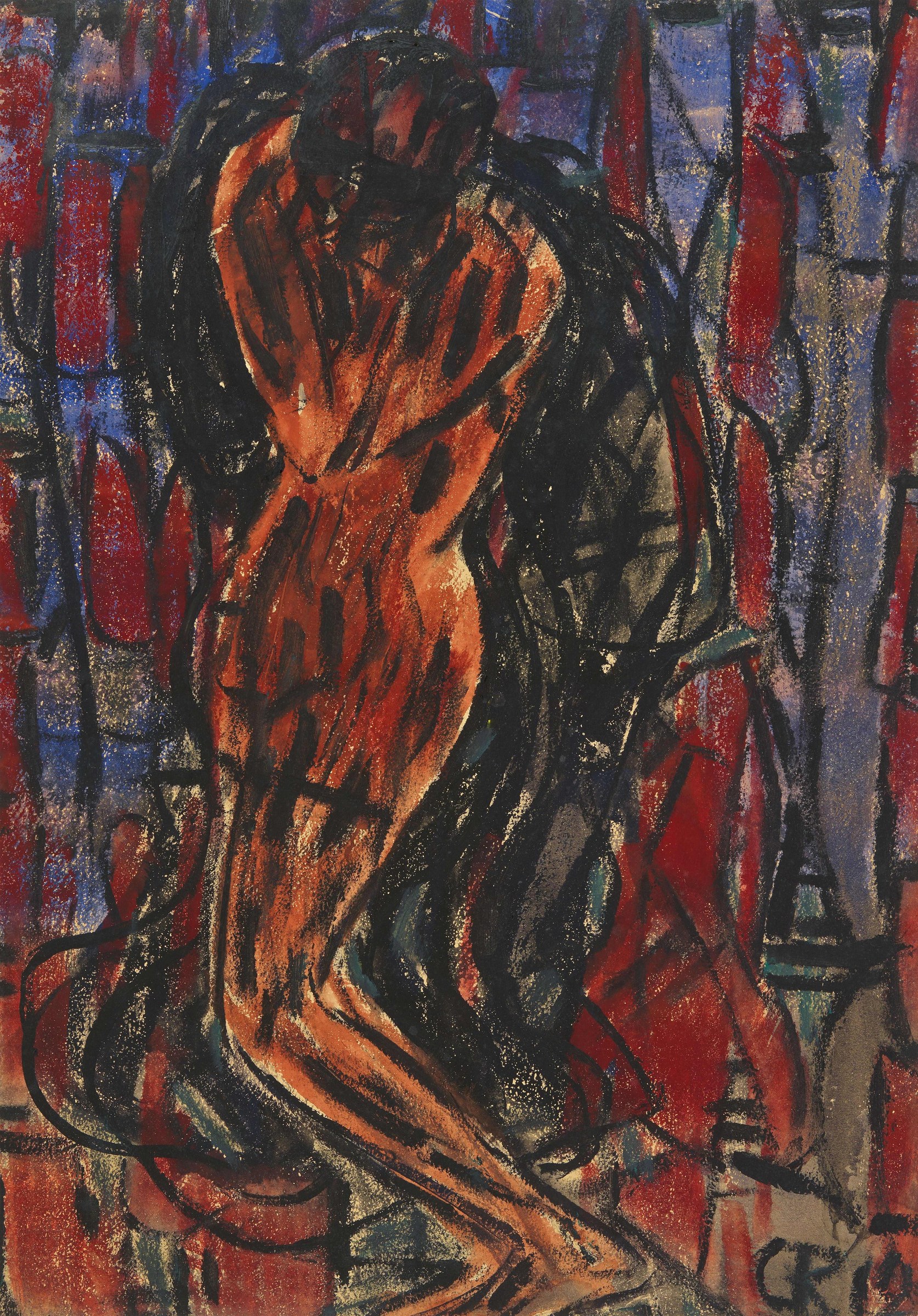
Christian Rohlfs Tänzerin 1919 269-24
Christian Rohlfs
- Medium:
- Tempera
- Era:
- 1900-1920 (Ragtime/Early Jazz)
- Source:
- Wikimedia Commons
- Rights:
- Public domain — free to use, share and adapt.
- Recorded as:
- Public Domain
The work documents a pivotal moment when visual artists and choreographers across Germany were converging on the idea that the body could express emotion and ideas without reference to classical technique or social convention. Rohlfs's *Tänzerin* shows how modern dance shaped modernist visual art: the distorted, expressive body was not a defect but a tool. For dancers and historians, the image records how this vocabulary—twisted spines, open gestures, emotional urgency—was understood and valued by the avant-garde.
What you are looking at
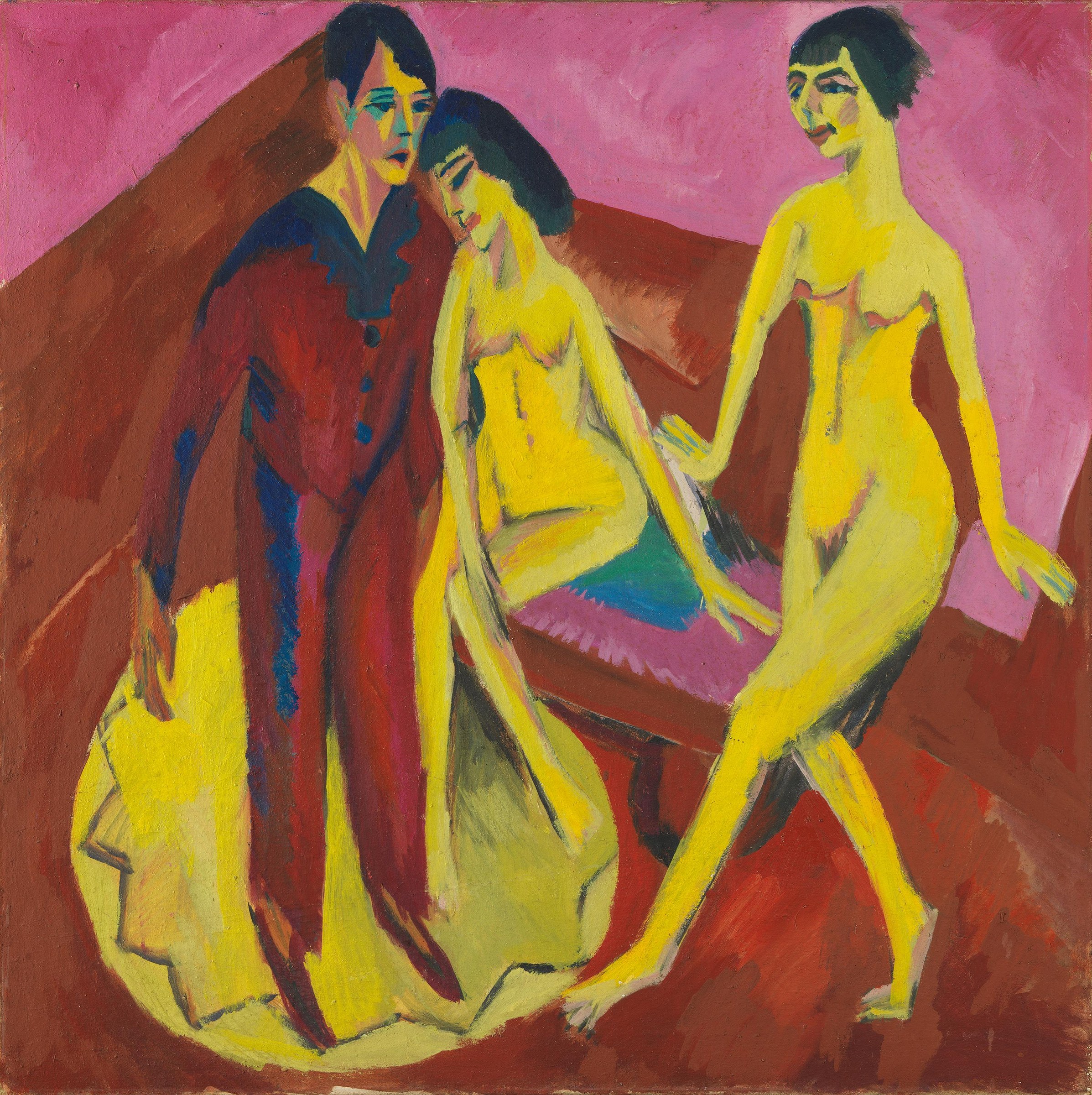
A solitary figure dominates this expressionist composition, rendered in tempera with a luminous orange and gold palette set against a fragmented background of deep blues, reds, and blacks. The dancer is captured mid-movement, the body twisted and elongated, with the torso arched backward and limbs extended in a fluid, undulating gesture. The figure wears what appears to be a draped garment or costume in warm tones that seems to move with the body rather than constrain it. The background is fractured into vertical strokes and angular forms—perhaps suggestive of curtains, stage architecture, or an abstracted interior space—creating visual energy and psychological intensity around the solitary dancer. The brushwork is gestural and non-naturalistic; the artist has prioritized emotional and kinetic expression over anatomical precision.
The dancing
The single dancer's body is remarkably fluid and sinuous, with the spine sharply curved and the arms extended in an open, expressive gesture that suggests both freedom and vulnerability. The weight appears to shift through the torso; the legs are compressed or gathered, while the upper body reaches backward and outward. The posture suggests a moment of intense feeling rather than technical control—the kind of movement associated with modern expressionist or free dance of the early twentieth century. There is no visible rigid frame or closed hold; instead, the body moves as an emotional instrument.
The dance depicted
This appears to document modern expressive or free dance rather than classical ballet or ballroom forms. The abandonment of formal technique, the emphasis on the torso and spine rather than turned-out legs, and the emotional intensity of the gesture are consistent with the Ausdruckstanz (German expressionist dance) movement that emerged in the early 1900s and was prominent in Germany during and after World War I. The work titled *Tänzerin* (Dancer) does not identify a specific choreography or dancer, but the vocabulary—the twisted spine, the open arms, the sense of inner turbulence made visible—belongs to that movement and its emphasis on authentic emotional expression through the body.
How it was made
The work is tempera (watercolor-based pigment) on cardboard, a technique that allows for rapid, expressive application and produces the luminous, almost glowing quality visible here, particularly in the dancer's golden form against darker passages. Tempera dries quickly and suits gestural, emotionally-charged work; it permits both detailed layering and bold, loose brushstrokes. On cardboard rather than paper or canvas, the work has a provisional, urgent quality—appropriate to an avant-garde practice concerned with immediacy of expression. The technique is also economical and portable, consistent with early twentieth-century German modernism's embrace of accessible materials over academic tradition.
About this work
This is a tempera study of a solitary dancer, created in 1919 by Christian Rohlfs, a German Expressionist painter working at a moment when modern dance was radically reimagining the body on stage. The work captures a moment of inner emotional expression rather than technical virtuosity: the dancer's spine twisted, the gesture open and raw, the color hot and urgent. The fragmented background and gestural brushwork make no attempt at naturalistic representation; instead, the artist uses form and color to convey the psychological and kinetic intensity of the dancer's movement. This is a work about dance as a vehicle for modern feeling—dance not as spectacle or courtship, but as the visible form of an inner state.
How to look at it
Attend first to the spine and the open, reaching gesture of the arms—this is the core of the movement the artist has frozen. The torso is not held upright or controlled; it is pliant, responsive, almost surrendered to feeling. The color temperature matters: the golden, warm dancer against the cool and fragmented background creates psychological distance and emotional intensity. Notice too how the brushwork itself is gestural—the paint is applied loosely and expressively, mirroring the freedom and urgency of the dancer's body. This is not a work of anatomical study or technical display; it is a record of a moment of feeling made visible.
The artist
Christian Rohlfs (1849–1938) was a German Expressionist painter and printmaker who worked across multiple media and experienced a dramatic stylistic shift in midlife. He initially trained in academic tradition but from around 1900 onward embraced Expressionism, with its emphasis on emotional intensity, bold color, and distorted form. He was associated with German Expressionist groups including Die Brücke and exhibited widely in avant-garde circles. By 1919, when this work was created, Rohlfs was in his seventies but remained engaged with modernist innovation. His subjects included landscapes, portraits, and scenes of modern life; the dancer as subject reflects both his interest in capturing psychological states and the cultural prominence of modern dance in Weimar Germany.
The period
In 1919, Germany was emerging from World War I and entering the Weimar period—a time of radical cultural experimentation and social upheaval. Modern dance had flourished in Germany since the early 1900s through the work of figures like Isadora Duncan, Mary Wigman, and Rudolf von Laban. German Expressionism in visual art and performance was at its height, with artists and dancers alike committed to the idea that distortion and emotional intensity were paths to authenticity. The year 1919 saw the founding of the Bauhaus, which would profoundly influence how artists and choreographers thought about the moving body. In this context, Rohlfs's tempera study of a solitary, expressively-contorted dancer is representative of a broader conviction that modern art and modern dance were connected practices, both committed to expressing inner truth through visible form.
Where it lives
The work is recorded in the Christian Rohlfs Archive as CRA 269/24. It is a tempera study on cardboard, a sketch or independent work rather than a preparatory study for a larger painting. The source provided here is Wikimedia Commons; current holding collection is not recorded in the catalogue.
Dance in this work
Questions about this work
What dance is this dancer performing?
The work does not depict a named choreography or a specific known dancer. Instead, it captures the vocabulary of modern expressive dance as practiced in Germany in the early twentieth century—what was called Ausdruckstanz or German Expressionist dance. The twisted spine, open arms, and emotional intensity are hallmarks of that movement, which rejected classical ballet technique in favor of authentic emotional expression.
Why is the dancer so distorted?
The distortion is not accidental or inexpert; it is intentional and reflects both the artist's Expressionist aesthetic and the actual practice of modern dance of the period. Expressionist artists believed that formal beauty and anatomical accuracy were less important than the communication of feeling. Similarly, dancers like Mary Wigman and others were deliberately abandoning the turned-out legs and upright carriage of classical ballet in favor of a more plastic, expressive use of the spine and torso.
Why did Christian Rohlfs paint dancers?
By 1919, the dancer had become a central subject in modernist visual art, particularly in Germany. Rohlfs and his contemporaries saw in modern dance a practice that aligned with their own artistic goals: the use of distortion, color, and gesture to express psychological and emotional states. The dancer was a subject through which painters could explore how the body—real, moving, alive—could be a vehicle for modernist expression.
More dance artwork