49 works in this view — arrow keys or swipe to move between them.
Dance in Art · 1897
Edwin Austin Abbey - A Pavane
Edwin Austin Abbey
- Medium:
- Oil Painting
- Era:
- Late 1800s (Victorian Ballroom)
- Source:
- Wikimedia Commons
- Rights:
- Public domain — free to use, share and adapt.
- Recorded as:
- Public Domain
This painting is valuable primary evidence for how educated artists and audiences of the 1890s understood and visualized Renaissance court dance—as ceremonial, restrained, and aesthetically ordered. It also demonstrates the persistent academic tradition of historical reconstruction through painting, a tradition that shaped how the public encountered dance history long before film or notation. Finally, the discrepancy between the catalogue record and the image itself teaches a lesson about archival caution: attribution and dating are reliable only when scrutinized against visual evidence.
What you are looking at
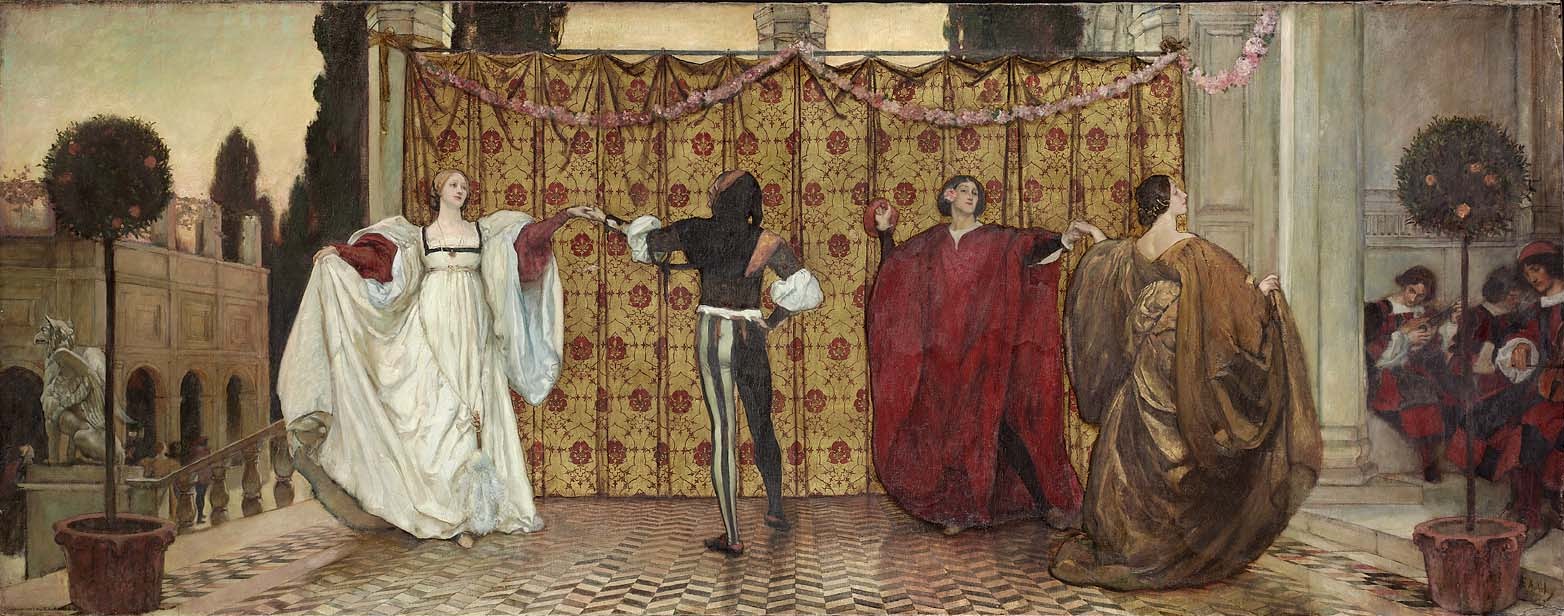
A formal interior court or ballroom scene with pale Classical architecture. A group of elegantly dressed figures stands in a stately grouping before a large decorative curtain patterned in gold and crimson. The composition is staged and ceremonial rather than dynamic—figures are arranged in a line or loose gathering, their postures upright and formal. To the left, a woman in a white gown with red-lined cape stands with arms gracefully positioned; nearby, a figure in black appears to gesture or attend to the others. On the right, figures in rich burgundy and ochre-toned garments create a chromatic balance. The lighting is soft and even, typical of the studio tradition. In the background through the right doorway, smaller figures suggest attendants or observers. The patterned floor, draped garlands, and Classical urns establish a setting of ceremonial courtly life. The overall mood is pageantry—this is a formal moment, possibly a greeting or presentation, rather than active dance.
The dancing
The figures maintain an upright, symmetrical deportment characteristic of Renaissance and early modern court protocol. Arms are extended with controlled grace—the woman in white on the left has her arms raised in a gentle arc, neither stretched nor held tightly. No couple is in a closed ballroom hold; instead, figures stand independently or in loose association, their bodies vertical and their weight settled. The nearest male figure in black wears a sword and appears to address or acknowledge the woman in white. The arrangement suggests formal acknowledgment or courtly presentation rather than the continuous partner contact of later ballroom dance.
The dance depicted
This appears to depict a pavane or a moment within a formal processional court dance, most likely from the Renaissance period rather than the 1890s. The pavane was a slow, stately dance of high ceremonial function in Renaissance courts, performed in procession with dignified steps and elaborate bows or courtly exchanges. The upright carriage, the lack of close partnering, and the formal grouping are consistent with the pavane's character. However, the catalogue record dates this work to 1897 and labels it 'Victorian Ballroom,' which creates a chronological disjunction: the dress, the architectural vocabulary, and the ceremonial etiquette all point to Renaissance or early modern court dance, not the 1890s. The title alone—'A Pavane'—strongly indicates the artist's subject was historical, not contemporary.
How it was made
This is an oil painting, likely large-scale and exhibition work given its finish and detail. The medium allows Abbey to render texture and light subtly—the luminosity of the white gown, the depth of the draped fabrics, and the gilded ornament of the curtain are effects oil paint executed with precision. Abbey was a late-19th-century American painter trained in the academic tradition, and this work exemplifies academic historical painting: meticulous reconstruction of costume and architecture, a composed arrangement of figures, and technical control of light and atmosphere. The scale and finish suggest this was a finished salon painting, likely created for exhibition and meant to appeal to a cultivated audience interested in historical narrative and aesthetic refinement.
About this work
This is Edwin Austin Abbey's 'A Pavane,' an oil painting from 1897 that depicts a formal moment from Renaissance court life—most likely a scene from one of the stately processional dances that animated courtly ceremony. Rather than showing active steps or vigorous movement, Abbey freezes a moment of formal greeting or presentation: upright figures in historically accurate dress arranged before a richly decorated interior. The work sits within the academic historical painting tradition of the late 19th century, where artists reconstructed scenes of past courtly life with scholarly attention to costume, architecture, and social ritual. For scholars of dance history, this work offers valuable evidence of how the late-Victorian imagination reconstructed Renaissance dance—formal, ceremonious, and utterly devoid of the energy associated with later ballroom forms.
The catalogue record's labeling of this work as 'Victorian Ballroom' appears to be an error: the subject, dress, and architectural setting unambiguously indicate Renaissance court dance, not 1890s society dancing. The title 'A Pavane' itself anchors the work to a specific historical dance form. Abbey's choice to depict dance as courtly ceremony rather than as entertainment or athletic skill reflects both scholarly interest in historical dance and the late-Victorian enthusiasm for aestheticized representations of the past.
How to look at it
Look at the painting as a freeze-frame of courtly etiquette rather than a moment of active dance. Abbey has chosen not a turning or stepping moment, but a moment of formal arrangement and acknowledgment—a pause in ceremony. Notice how the figures relate to one another through proximity and gaze rather than through physical contact or synchronized movement. The painting demonstrates the Academic assumption that Renaissance dance was primarily a vehicle for social order and courtly display, not physical exertion. Pay attention to Abbey's rendering of fabric and light: the white gown's soft folds, the deep jewel tones of the attendants' cloaks, and the metallic gleam of the curtain work together to convey luxury and formal occasion.
The artist
Edwin Austin Abbey (1852–1911) was an American painter and illustrator of considerable repute, trained at the Pennsylvania Academy of Fine Arts and later in London, where he spent much of his career. He was known for large-scale historical and literary subjects, often executed with meticulous attention to period detail and narrative composition. Abbey was part of the academic tradition that flourished in the late 19th century—a tradition that valued historical accuracy, literary or allegorical content, and technical virtuosity. His works, including mural commissions and book illustrations, were celebrated on both sides of the Atlantic. 'A Pavane' exemplifies his interest in historical narrative and his capacity to render luxurious textiles, architectural settings, and human figures with controlled elegance.
The period
In the 1890s, the academic historical painting tradition was still dominant in salon and exhibition culture, though modernism was beginning to challenge it. The late-Victorian period saw a strong antiquarian interest in the Renaissance—a fascination with courtly life, Renaissance aesthetics, and the arts of the past. Dance history was not yet a formal academic discipline, but educated people encountered historical dances primarily through painting, literature, and the theater. The pavane itself had been revived and studied by musicologists and dance historians in the late 19th century as scholars worked to reconstruct early European music and dance from primary sources. Abbey's choice of subject reflects this broader cultural moment: a moment when the past was understood as noble, orderly, and beautiful—a counterpoint to the industrial present.
Where it lives
The work is recorded as sourced from Wikimedia Commons, with no holding collection currently documented in the available catalogue record. It was exhibited or acquired as a salon painting in the late 19th-century exhibition circuit.
Dance in this work
Questions about this work
Is this really a 'Victorian Ballroom' scene as the record says?
No. The title, dress, architectural setting, and compositional logic all indicate Renaissance court dance, likely the pavane. The catalogue tag appears to be a mislabeling. Abbey was deliberately depicting a historical dance, not contemporary ballroom practice. The 1897 date refers to when Abbey painted it, not when the scene is set.
What is a pavane, and how do you recognize it in this painting?
A pavane was a slow, stately, processional dance performed in Renaissance courts as a ceremony of courtly etiquette. It was danced in procession, with dignified bearing and formal bows or exchanges. You recognize it in this work through the upright posture of the figures, the formal arrangement rather than dynamic partnering, the rich dress, and the ceremonial setting. Abbey's title confirms the identification.
Does this painting show actual Renaissance dance steps?
Not precisely. Abbey was working from historical sources and his imagination, and he has prioritized courtly dignity and visual beauty over anatomical accuracy of footwork. The painting shows the ethos and formality of Renaissance court dance—the bearing, the dress, the ritual—rather than specific choreographic content. It is a historical interpretation, not a documentary record.
Why did a Victorian painter choose to paint a Renaissance dance?
In the late 19th century, the Renaissance was idealized as an age of aesthetic refinement, courtly order, and humanistic beauty. Historical painting was a prestigious academic genre, and Abbey was part of a cultured elite that valued the past as a source of ideal form. Depicting dance as a ceremonial, aesthetic practice—rather than as entertainment—also appealed to late-Victorian taste for the refined and orderly.
More dance artwork