49 works in this view — arrow keys or swipe to move between them.
Dance in Art · 1911
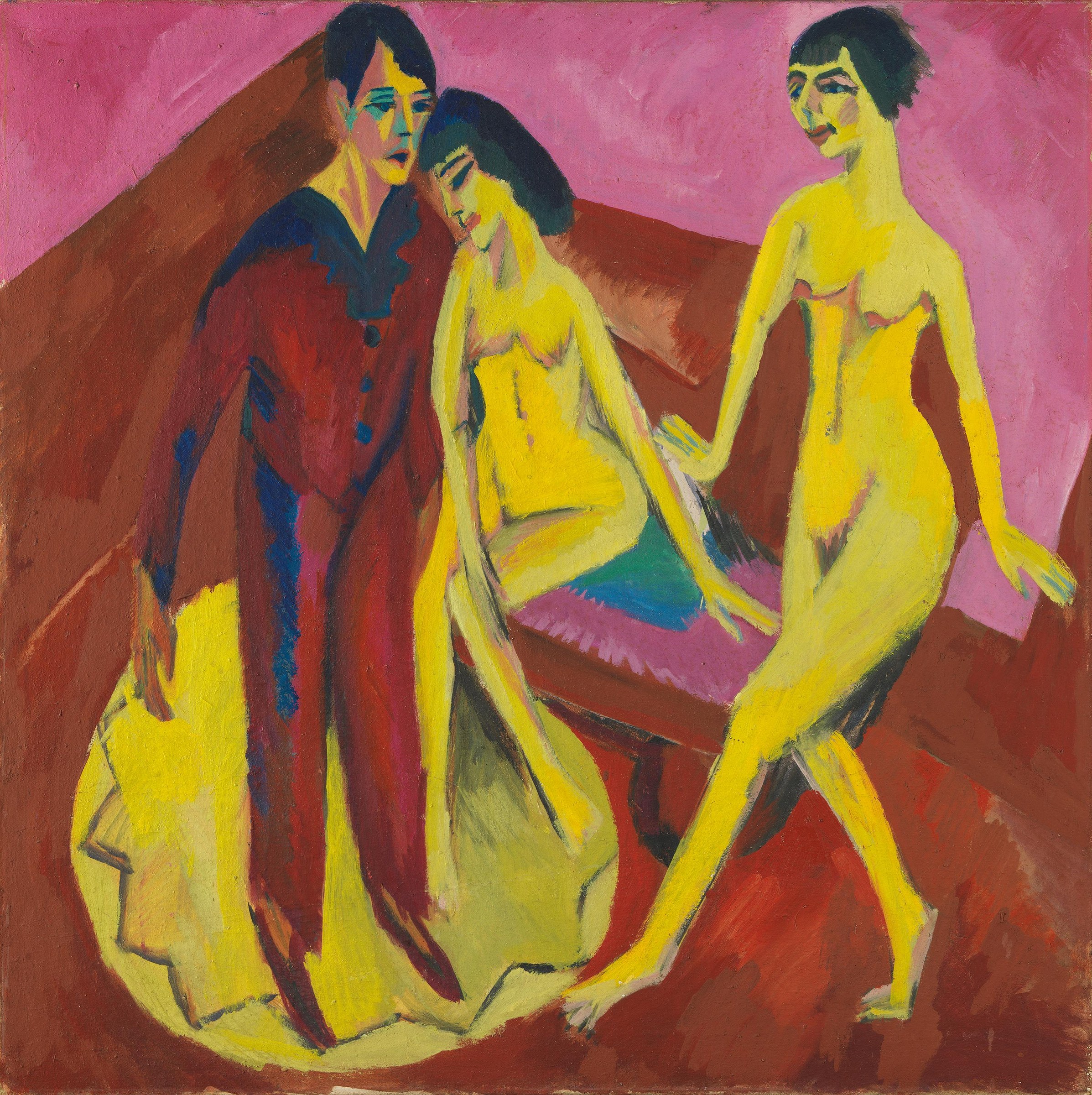
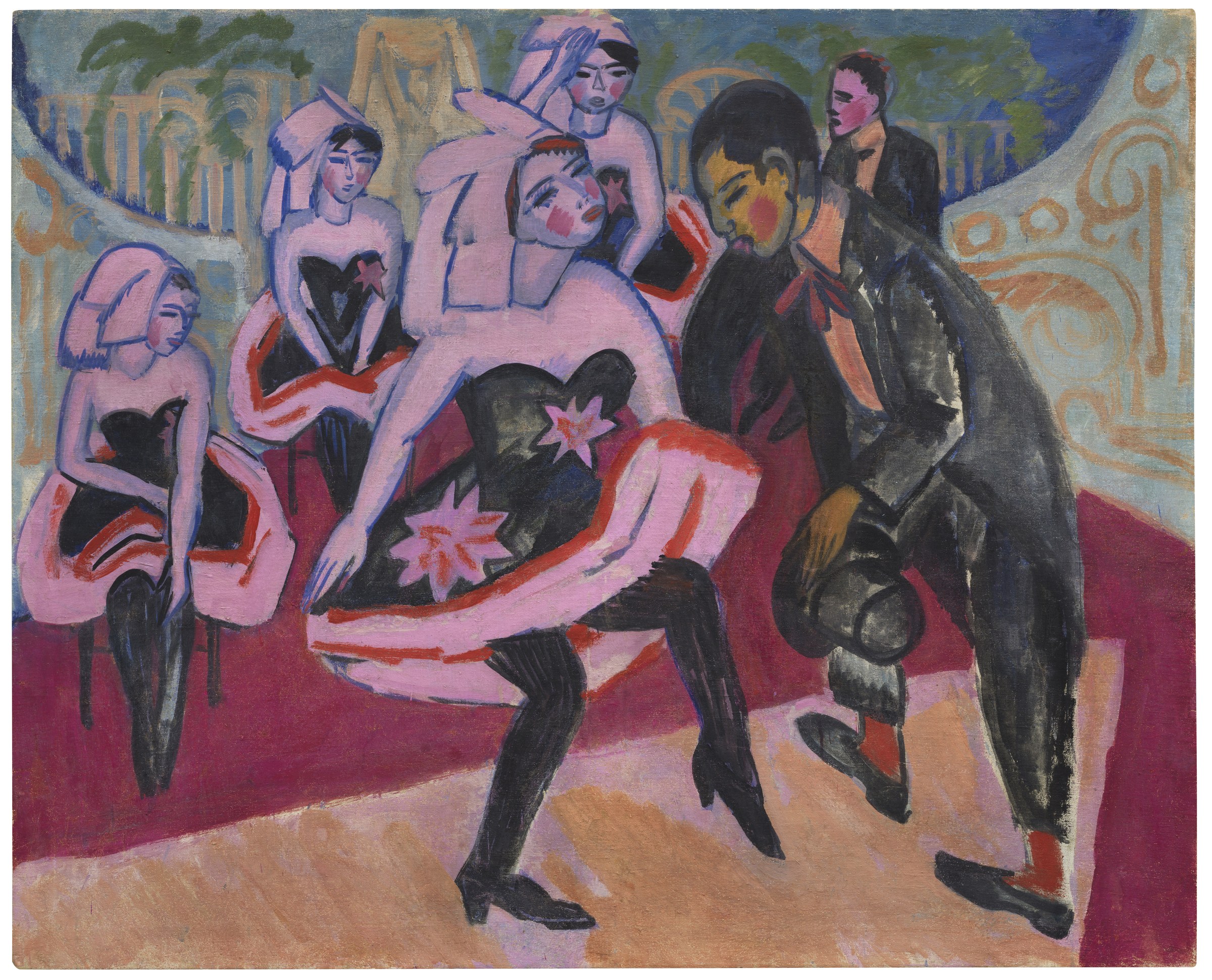
Ernst Ludwig Kirchner Tanz im Varieté 1911
Ernst Ludwig Kirchner
- Medium:
- Oil Painting
- Era:
- 1900-1920 (Ragtime/Early Jazz)
- Source:
- Wikimedia Commons
- Rights:
- Public domain — free to use, share and adapt.
- Recorded as:
- Public Domain
The painting shows dance not as an autonomous art form but as a social and commercial practice caught up in questions of power, display, and desire. Kirchner's style—the acidic colour, the crude simplification, the expressionist distortion—refuses to glamorise the scene; instead it registers a kind of moral horror at what it depicts. For historians of dance and gender, it is an essential document of how early 20th-century art registered the shift toward professional, commodified performance and the body as spectacle.
What you are looking at
A cabaret or variety theatre scene rendered in lurid pinks, blues, and blacks. Multiple figures occupy a shallow interior space with ornamental architectural details visible in the background—scrollwork and geometric patterns suggesting a decorated stage or nightclub. A central female dancer in black stockings and heeled shoes holds a pose with one leg extended, her nude-pink torso upright, surrounded by four or five other figures in various states of undress or theatrical costume. Two watch from the left; two clothed men in dark jackets observe from the right. The figure in the foreground wears what appears to be a decorated fabric or garment with starburst motifs in red and pink. The composition is crowded and intimate, the paint applied in bold, simplified masses with strong contour lines, characteristic of German Expressionism. The colour palette is acid and heightened, far from naturalistic—flesh rendered in violet and sickly pink, creating an atmosphere of artifice and transgression.
The dancing
The central dancer stands with weight on one leg, the other raised and bent, her posture upright but with a twist of the torso suggesting mid-movement. Her pose is neither a classical ballet attitude nor a recognisable ballroom hold. The surrounding figures are static or seated, framing the performer; none touch her or form a partnership. The clothed observers on the right are positioned as though watching a performance or transaction. The brushwork simplifies anatomy into planes, with limbs and torsos constructed from broad strokes rather than anatomical observation. This is gestural abstraction, not documentary representation of technique.
The dance depicted
This is a scene of cabaret or variety theatre entertainment, likely depicting the kind of nude or semi-nude performance dances that became popular in Berlin's nightclub culture in the early 20th century. The pose of the central figure—isolated, exhibitionist, weightless—is consistent with theatrical display rather than participatory social dance. The presence of clothed observers and the performer's raised leg suggest a performance context: this is entertainment staged for an audience, not social dancing. The specific style cannot be identified from the gesture alone; it is more important as an image of the commercialised, sexualised dance culture of Weimar-era cabarets.
How it was made
Oil painting, executed in the Expressionist style with simplified forms, bold contour lines, and colour used for emotional effect rather than naturalism. The paint is applied in relatively flat areas and gestural marks; the brushwork is visible and energetic. This technique was suited to the rapid production and exhibition of works in early 20th-century avant-garde circles, and the style—vivid colour, distorted perspective, subject matter drawn from modern urban life—places the work within German Expressionist practice. Oil on canvas allowed for the bold, saturated tones and the layering of forms that give the scene its claustrophobic, feverish quality.
About this work
Kirchner's *Tanz im Varieté* (Dance in the Variety Theatre) captures the transgressive energy of Berlin's cabaret scene through the lens of Expressionist formal language. The work is not primarily about dance technique or ballroom culture, but about the visual and social drama of commercial entertainment: the exposure of the body, the play of desire and display, the artist's own ambivalent fascination with modernity. The painting sits at the intersection of art history and social history—it documents a real cultural phenomenon (the rise of cabaret performance in Weimar Germany) while using painterly distortion to express psychological and moral anxiety about it. For a gallery of dance in art, the work is significant not as an accurate record of how people danced, but as evidence of how dance—or the idea of dance—functioned as a screen for anxieties about gender, sexuality, commercialisation, and modernity itself.
How to look at it
Attend to the centralised pose of the performer and the way Kirchner has isolated her from the other figures, even while crowding the composition. The raised leg and twisted torso are frozen mid-gesture, but not in a way that suggests technique or training; instead the pose reads as exhibitionist, offered to an implied viewer. Look at the colour: the way flesh is rendered in sickly pink and the surrounding figures in blues and blacks creates psychological distance and unease. The ornamental background—barely sketched in—suggests a stage set but does not establish spatial depth; everything flattens toward the picture plane, intensifying the sense of claustrophobia and display. The painting is not interested in capturing the flow of movement, but in freezing a moment of transgressive visibility.
The artist
Ernst Ludwig Kirchner (1880–1938) was a co-founder of Die Brücke, the German Expressionist movement, and spent much of the 1910s and 1920s in Berlin, where he was fascinated and appalled by the city's nightlife, cabaret culture, and street scenes. His work from this period frequently depicts entertainers, prostitutes, and performers—subjects that allowed him to explore the alienation and energy of metropolitan life. Kirchner's painterly language—violent colour, distorted perspective, emotional intensity—was designed to convey psychological states rather than optical appearance. After a mental breakdown in 1915, his work became even more introspective, though he continued to paint scenes of modern urban life.
The period
In the 1910s, Berlin's cabaret and variety theatre culture was at its height, especially after World War I, when the economic and social dislocations of defeat created new forms of entertainment and transgressive performance. Dance in these venues was often separable from ballroom culture or concert dance; it was performance art, frequently involving nudity or semi-nudity, and directed at commercial audiences in smoke-filled clubs. Simultaneously, German Expressionism was the dominant avant-garde movement, using distorted form and heightened colour to express interior emotional states. Artists like Kirchner, Otto Dix, and George Grosz turned to cabaret and street life as subjects through which to register the psychological and moral texture of modernity. The painting thus sits at the intersection of a specific urban entertainment culture and a broader artistic movement grappling with modernisation, urbanisation, and the dissolution of traditional social forms.
Where it lives
The work is recorded in the catalogue as sourced from Wikimedia Commons, with no current holding collection specified. It is an oil painting from 1911, an important date within Kirchner's practice and within the development of German Expressionism.
Dance in this work
Questions about this work
Is this a ballroom dance?
No. This is cabaret or variety theatre performance, a commercial entertainment form distinct from ballroom or concert dance. The performer is isolated and watched, not partnered; the pose is exhibitionist rather than technical. The setting and the clothed observers make clear this is staged performance for an audience, not participatory social dancing.
Why does Kirchner use such ugly, acidic colour?
The colour is expressionist: it is meant to convey psychological and moral intensity rather than beauty or accurate representation. The sickly pinks and blues express Kirchner's ambivalence toward the scene—fascination mixed with moral unease about commodified bodies, commercial sexuality, and urban modernity.
What does the painting tell us about how people actually danced in cabarets?
Very little about technique or steps. What it does show is the performative context: the isolation of the dancer, the presence of clothed observers, the theatrical staging, the use of the body as display. It suggests that cabaret dance was about spectacle and desire, not trained movement.
Is this a finished work or a sketch?
It is a finished oil painting, but painted in the Expressionist style, which prioritises emotional intensity and gestural mark-making over illusionistic detail. The simplified forms and bold brushwork are intentional choices, not signs of incompleteness.
More dance artwork