49 works in this view — arrow keys or swipe to move between them.
Dance in Art · 1953
Karl Hofer Varietétänzerinnen 1953
Karl Hofer
- Medium:
- Oil Painting
- Source:
- Wikimedia Commons
- Rights:
- Public domain — free to use, share and adapt.
- Recorded as:
- Public Domain
Hofer's sculpture challenges the convention that performance dancers—especially cabaret performers—should be depicted as glamorous, controlled, or sexually displayed. Instead, it presents the dancer as psychologically present and physically vulnerable, suggesting that the artist understood variety performance not as mere entertainment but as a serious human endeavor. For historians of twentieth-century German art and dance, this work documents how modernist sculptors engaged with lowbrow performance traditions.
What you are looking at
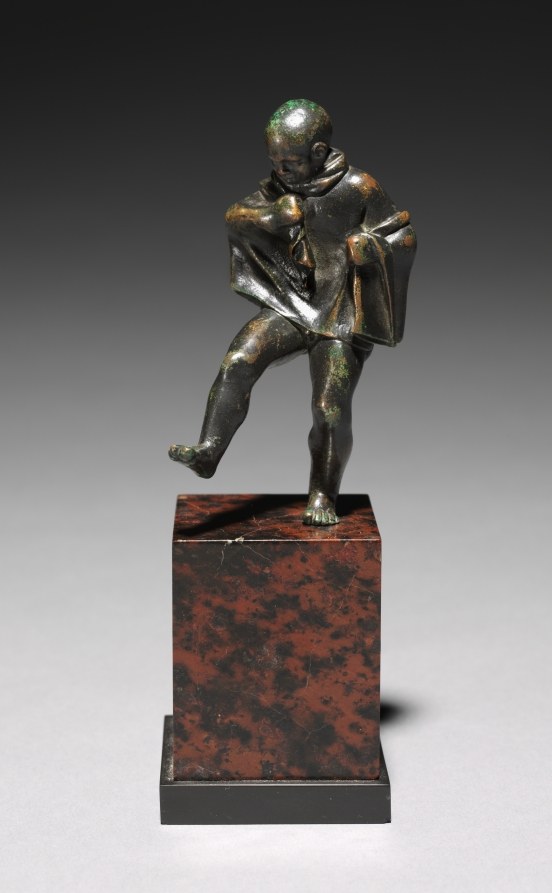
This bronze figurine depicts a single nude male dancer in a dynamic, twisted pose balanced on one leg. The figure is captured mid-movement, with the supporting leg planted firmly while the other leg is bent sharply upward. His torso is arched and compressed, arms wrapped protectively around himself, and his head is bowed in a posture of introspection or strain. The compressed, almost fetal-like upper body contrasts sharply with the extended lower body—the figure appears to be caught in a moment of athletic exertion or emotional intensity. The bronze has a warm, golden patina with areas of weathering that suggest age. The figure stands on a substantial plinth of red-brown marble or similar material, mounted on a black base, presenting the dancer as a formal sculptural subject worthy of sustained viewing.
The dancing
The dancer's weight is entirely committed to the right leg, which is planted vertically beneath the body; the left leg is drawn up with the knee pointing outward and upward, creating a sharp diagonal line. The arms are not extended in an open or classical gesture; instead, both are wrapped inward across the torso in a guarded or self-protective position. The spine is visibly curved and twisted, the shoulders compressed forward. The head is inclined downward with the chin nearly touching the chest. This is not a symmetrical or balanced pose—every line of the body expresses tension, compression, and an inward focus rather than outward display.
The dance depicted
This sculpture does not appear to depict a recognizable classical dance idiom. The pose—dynamic, angular, contorted, and emotionally introspective—suggests modern dance or contemporary movement language, or possibly a stylized representation of a cabaret or music-hall performer in an acrobatic or provocative moment. The title *Varietétänzerinnen* (variety dancers) indicates performance in the cabaret or vaudeville tradition, which flourished in Weimar Germany and was associated with both athletic virtuosity and sensual provocation. However, the compressed, defensive posture here is unusual for typical cabaret performance imagery, which more often celebrates display and exposure. The sculpture may instead represent a moment of strain, vulnerability, or emotional intensity within performance.
How it was made
This is a bronze casting, likely made by the lost-wax process or direct casting. The surface shows warm golden and dark patinated areas consistent with age and oxidation of bronze. The artist has used the three-dimensional medium to full effect, creating a figure that demands to be viewed from multiple angles—the twisted spine, wrapped arms, and lifted knee are all significantly more legible in the round than in profile or front view. The work is mounted on a substantial marble plinth and black base, presenting it as a gallery-worthy art object rather than a functional or decorative piece. The scale (roughly life-sized in the torso) and formal presentation suggest this was created for display and serious aesthetic consideration.
About this work
This is a bronze sculpture of a male dancer by Karl Hofer, titled *Varietétänzerinnen*, dated to 1953. The work depicts a single figure in a dynamic, controrted pose that captures a moment of movement with emotional intensity. Rather than celebrating the virtuosity or glamour of cabaret dance, Hofer presents the dancer's body as a site of compression, strain, and introspection—a meditation on the human form in motion that sits between realism and expressionism.
The work belongs to a mid-twentieth-century tradition of artists using the male nude in motion as a vehicle for exploring the body's expressive possibilities beyond classical ideals. Hofer's approach—emphasizing awkward angles, psychological depth, and the weight of gravity rather than weightlessness—reflects modernist concerns with authenticity and the body's vulnerability.
How to look at it
Look first at where the dancer's weight actually is—it is entirely on one leg, creating an unstable, precarious balance that the artist emphasizes by the angle of the torso. Notice that the dancer is not 'on display' in the classical sense; the wrapped arms and bowed head suggest introspection rather than showmanship. The compression of the upper body against the vertical line of the supporting leg creates a visual and kinetic tension. The sculpture is most fully understood when viewed from the side and rear, where the twist of the spine and the relationship between the legs becomes clear. Consider whether this pose reads as acrobatic skill, emotional distress, intimate vulnerability, or all three simultaneously.
The artist
Karl Hofer (1878–1955) was a German expressionist painter and sculptor associated with the *Neue Sachlichkeit* (New Objectivity) movement. Working primarily in Berlin, Hofer developed a distinctive style marked by distorted forms, muted colour, and psychological intensity. He was deeply engaged with themes of human vulnerability, eroticism, and social observation. Though best known for painting, Hofer worked in sculpture throughout his career, often using similar expressionistic language to explore the human body. His interest in variety dancers and cabaret scenes reflects the wider engagement of Weimar and post-Weimar artists with popular entertainment as a subject worthy of serious artistic attention.
The period
In 1953, when this sculpture was made, Hofer was in the final years of his life and working in a style that had been forged during the Weimar period but refined through the trauma of Nazism and World War II. The immediate post-war period saw renewed interest in expressionism and figuration as a means of exploring human experience and vulnerability. Cabaret and variety performance, which had been central to Weimar culture, remained a subject of artistic interest even as the political and cultural context had utterly changed. By 1953, such imagery carried historical weight and could be read as both nostalgia and critique.
Where it lives
The work is documented in the Hofer catalogue raisonné (WVZ Wohlert 2604) with the title, date, and dimensions recorded. The museum source is not recorded in the available data. The sculpture is signed with Hofer's monogram and dated on the lower right, and titled on the verso of the plinth.
Dance in this work
Questions about this work
Who were variety dancers and why did artists paint and sculpt them?
Variety performers—acrobats, dancers, singers, and comedians—were central to popular entertainment in early twentieth-century Europe, especially Berlin. Expressionist and modern artists were drawn to their performances because they offered an alternative to academic high culture and because the variety stage was a place where bodies were displayed, manipulated, and pushed to extremes. For artists interested in the human form's expressive possibilities, variety performance was far more interesting than classical ballet.
Why does this dancer look so uncomfortable or strained?
Hofer's expressionist style emphasizes psychological and physical truth over glamour. Rather than depicting a moment of triumph or seduction, he captures a moment of effort, concentration, or perhaps even suffering. This approach challenges the viewer to see the performer not as an object of entertainment but as a thinking, feeling human being.
Is this a male or female dancer?
The figure is anatomically male and depicted in full nudity. The German title *Varietétänzerinnen* is the plural feminine form, but refers to variety dancers as a category; this particular sculpture shows a male figure. Male variety dancers, acrobats, and performers were common and appear frequently in art of the period.
What is the plinth made of?
The sculpture is mounted on a plinth of red-brown or reddish marble or similar stone, set on a black base. This formal presentation indicates the work was created as a serious art object for gallery or museum display, not as a decorative functional piece.
More dance artwork