49 works in this view — arrow keys or swipe to move between them.
Dance in Art · 1910
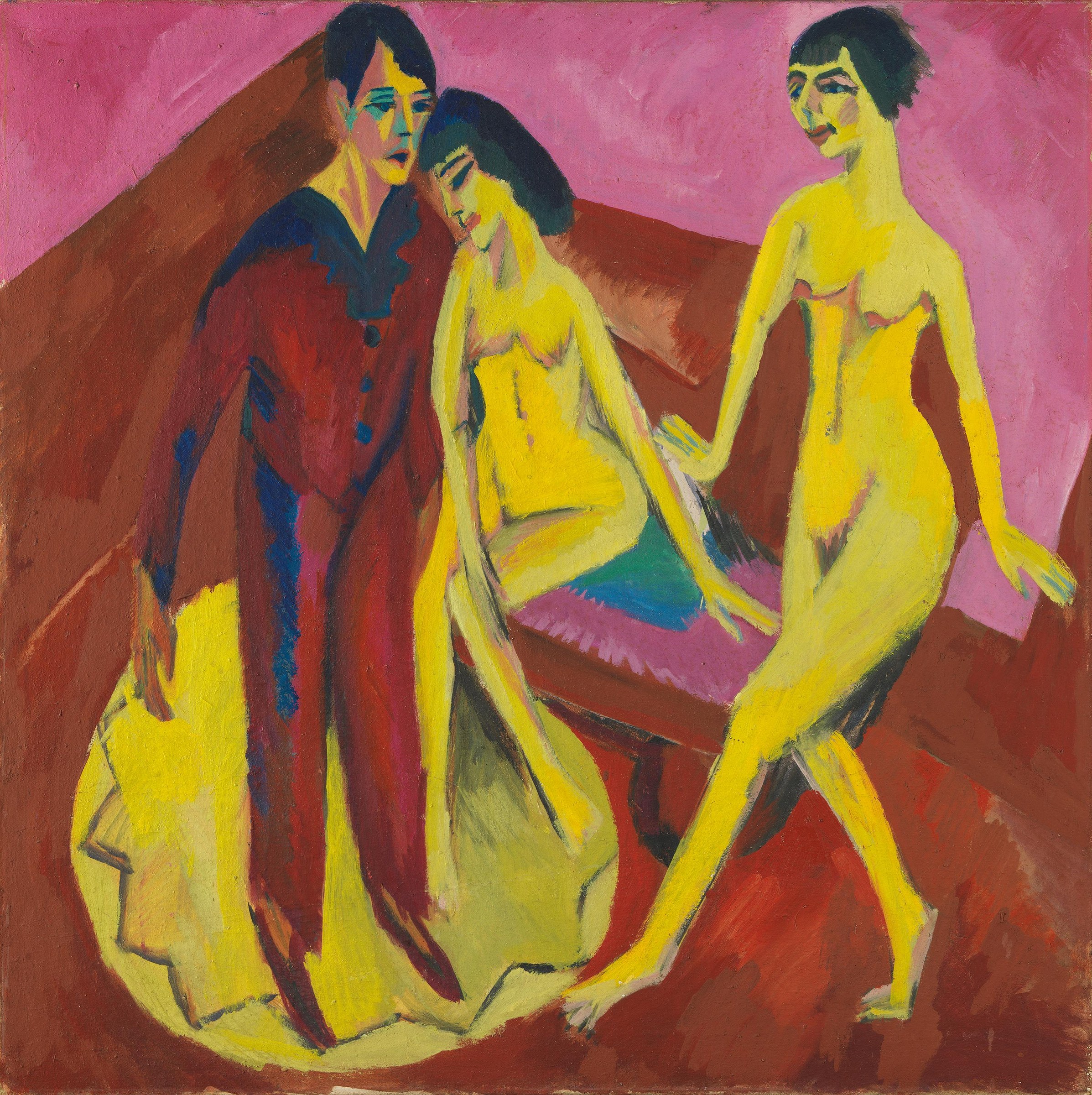
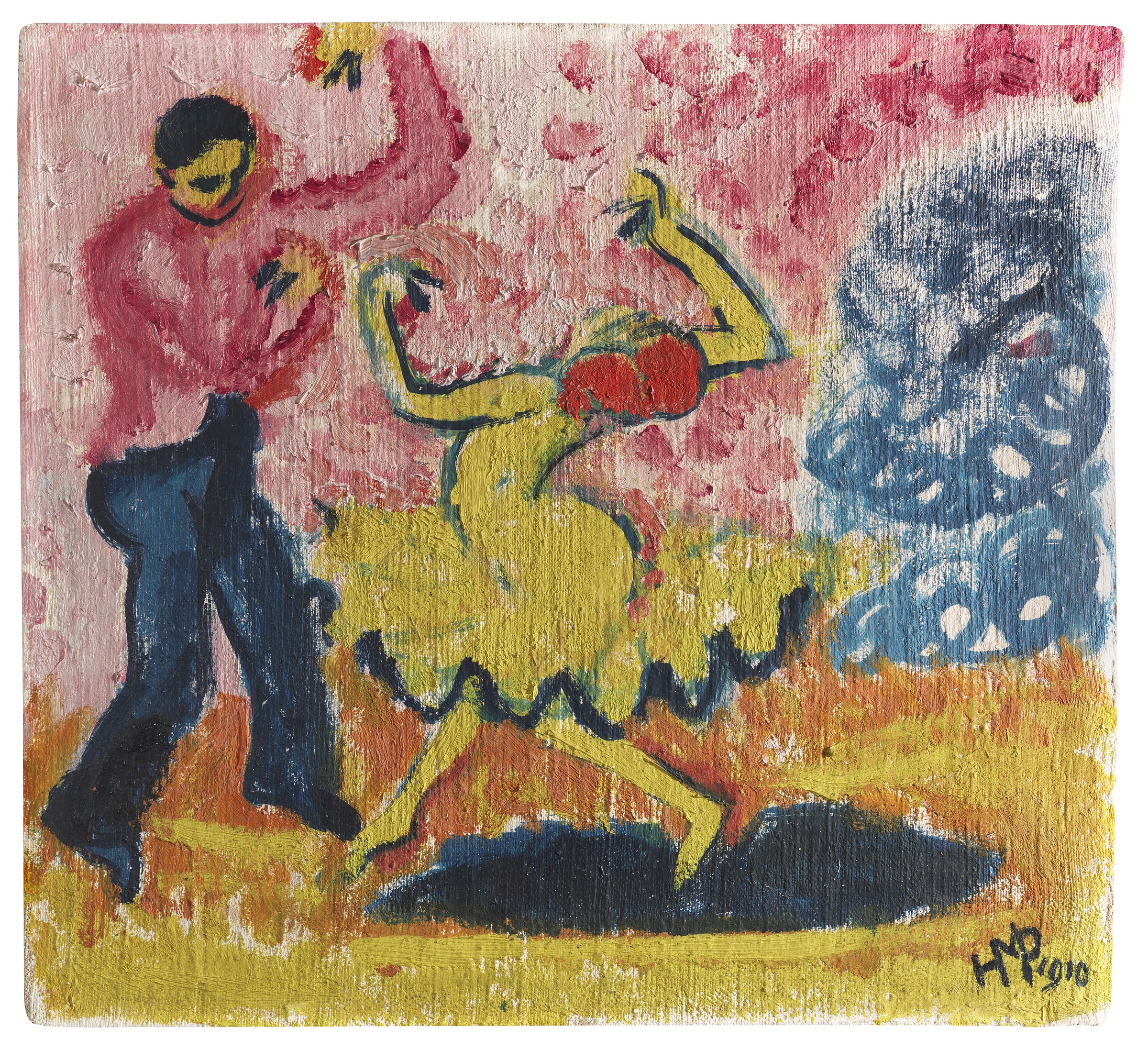
Max Pechstein Tänzer 1910
Max Pechstein
- Medium:
- Oil Painting
- Era:
- 1900-1920 (Ragtime/Early Jazz)
- Source:
- Wikimedia Commons
- Rights:
- Public domain — free to use, share and adapt.
- Recorded as:
- Public Domain
This work testifies to the centrality of dance to German Expressionism. For Pechstein and his contemporaries, the dancing body—spontaneous, emotional, unadorned—was a metaphor for artistic authenticity and liberation. Dancers and art historians should see this as evidence of how modernist painting engaged with contemporaneous innovations in movement practice.
What you are looking at
A vivid, expressionist composition shows three figures in dynamic movement against a landscape divided into bold color zones. The central figure, painted in bright yellow, lunges forward with arms raised in an exuberant gesture, one leg extended high. To the left, a dark blue figure in profile appears to be in mid-leap or stride. Above, a third figure with a yellow face outlined in black reaches upward. The background is divided: a pink-mauve area at top transitions through terra cotta and mustard yellows to a foreground of dark tones, creating spatial depth. The paint is applied with loose, confident brushwork; the canvas shows signs of age and previous work underneath (noted in the catalogue as a repainted composition).
The dancing
Three figures occupy the composition at different scales and depths. The yellow-bodied central dancer is the focal point, captured mid-leap with high extension and raised arms suggesting celebration or wild exuberance. The dark blue figure to the left appears grounded or diving, creating a counterpoint. The third figure above, shown as a head with yellow features, may represent a spectator or a moment of arrival. The poses suggest free, uninhibited movement rather than codified technique—weight distributed through the legs, limbs extended in open, radiating gestures. No classical frame or hold is visible.
The dance depicted
This appears to be a study of modern, expressionist dance rather than a specific codified style. The uninhibited postures, the emphasis on emotional rather than technical display, and the informal grouping suggest German Expressionist modern dance of the early 20th century, which valued freedom of movement and raw physicality over classical form. The image captures the spirit of Ausdruckstanz (expressive dance), a movement that emerged from Eurythmy and other modern practices. Without costume or narrative detail, it is the kinetic impulse itself—the liberation of the body—that is the subject.
How it was made
Oil painting on canvas, executed with expressionist technique: broad, visible brushstrokes and non-naturalistic color applied to create emotional intensity rather than descriptive accuracy. The loose handling allows rapid notation of gesture and energy. The painting has been executed over a previous composition (a portrait with foliage, now visible in areas of thinner paint), suggesting this was either a studio study or a work created through creative reuse of support. The small scale and intimate execution suggest this was a personal exploration rather than a commissioned work.
About this work
This work belongs to the early 20th-century avant-garde project of liberating dance from narrative and classical convention. Pechstein captures a moment of pure physical exuberance—three figures in a landscape, freed from costume or storytelling, their bodies articulating joy or vitality through extension and leap. The painting is simultaneously a document of how modernist artists understood movement and an argument for dance as a subject worthy of serious artistic attention. It sits at the intersection of Expressionism and the broader early-20th-century fascination with the expressive body.
How to look at it
Attend to the asymmetry of the composition and the isolation of each figure: they do not form a unified group or narrative, but rather three separate moments or impulses. The high perspective—looking down at the figures—gives them theatrical scale. Notice how color carries meaning: the yellow body at the center is not naturalistic but communicates energy and attention. The painting style itself is a gesture: rapid brushwork mimics the fluidity of movement. The viewer should ask what moment Pechstein has chosen to freeze, and the answer is: not a moment of classical balance, but one of dynamic, exuberant release.
The artist
Max Pechstein (1881–1955) was a German Expressionist painter and printmaker, co-founder of Die Brücke (The Bridge), one of the most influential avant-garde movements of early 20th-century Europe. Pechstein worked across painting, woodcut, lithography, and other media. He was deeply engaged with questions of formal innovation and emotional authenticity. His practice encompassed landscapes, figures, and ethnographic subjects, often treated with bold color and simplified form. Dance and the human figure in motion appear across his oeuvre, particularly in works from the 1910s–1920s exploring modern movement and expressive physicality.
The period
In the 1910s, German Expressionism was at its height, and modern dance was experiencing a parallel revolution. Isadora Duncan had already transformed European attitudes to movement; Rudolf Laban was developing his comprehensive system of dance notation and teaching. The Ballets Russes, though primarily Russian, had profound influence on European visual culture. In Germany specifically, Ausdruckstanz (expressive dance) was emerging as a distinct practice, valued for its psychological and spiritual dimensions. Visual artists were increasingly attracted to dance as a subject because it offered a way to represent the internal and emotional rather than the external and descriptive. The painting's non-naturalistic color and emotional intensity reflect the broader Expressionist conviction that art should convey feeling over observation.
Where it lives
The work is recorded in the Soika catalogue (WVZ 1910/50). It was acquired directly from the artist circa 1910 by Felix Hollaender in Berlin, and subsequently held in the Hollaender family collection in Berlin, England, and Hamburg until 1957. It has since remained in private collections in Switzerland and Germany. The source here is Wikimedia Commons.
Dance in this work
Questions about this work
Is this ballet?
No. The movement vocabulary, the absence of formal costume, the emotional rather than technical focus, and the period all point to modern or expressionist dance rather than classical ballet. Pechstein is representing the new, liberated movement practice that emerged in early 20th-century Germany.
What is the yellow figure doing?
The central figure is captured mid-leap or lunge, with arms raised high in an open, celebratory gesture. The exact step cannot be identified, but the pose conveys exuberance, freedom, and a release of the body into space—qualities central to expressionist modern dance.
Why is this painting so distorted and unnatural?
The non-naturalistic color and loose handling are deliberate choices of Expressionism. Pechstein was not trying to create a photographic record but rather to convey the emotional and spiritual essence of movement and joy. The distortion is the point: it communicates feeling.
Can you tell what kind of dance is shown?
Not precisely. The work is too general in its approach to be mapped to a specific dance form. It represents the spirit of modern, expressive movement practice in early 20th-century Germany—Ausdruckstanz—rather than documenting a particular technique or step.
More dance artwork