49 works in this view — arrow keys or swipe to move between them.
Dance in Art · 1920
Taenzerin Scheiber H
Hugo Scheiber
- Medium:
- Oil Painting
- Era:
- 1920-1950 (Swing Era)
- Source:
- Wikimedia Commons
- Rights:
- Public domain — free to use, share and adapt.
- Recorded as:
- Public Domain
This work documents the visual language of 1920s avant-garde dance, when painters and dancers were collaborating to invent new modes of expression outside ballet. For dance historians, it is evidence of how artists understood and valued non-narrative, emotionally direct movement in that period—not virtuosity, but interiority and formal abstraction.
What you are looking at
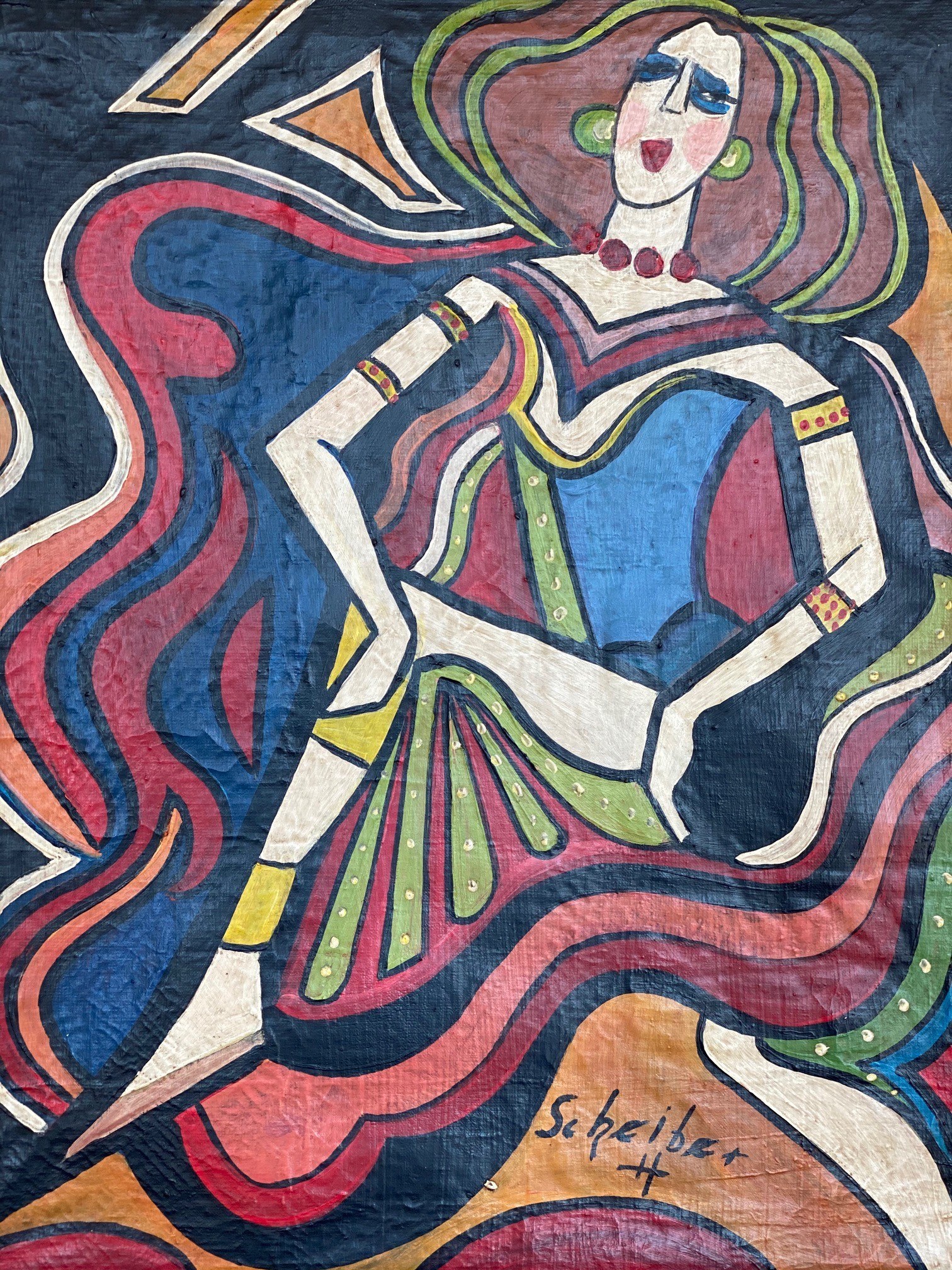
A woman in dynamic motion dominates the composition, rendered in Hugo Scheiber's characteristic Expressionist style. Her body twists in a spiral pose, weight shifted onto one leg, the other extended. She wears a vibrant blue sleeveless dress or tunic with a deep V-neckline and white or cream-coloured trim, paired with white leggings or tights that extend to mid-calf, and white wrist cuffs with decorative gold and coloured bands. Her pale face is sharply profiled, eyes closed or downcast, mouth open as if singing or crying out. Her shoulder-length hair is rendered in bands of mauve, green, and burgundy, flowing outward with the movement.
The setting is abstract, defined by bold curving lines in red, blue, orange, and green that suggest drapery, waves, or pure formal rhythm rather than literal space. These arabesques frame the figure without anchoring her to a ground; she floats within them. The palette is hot and saturated—deep navy background, sharp reds, acid yellows, forest greens—creating visual energy that matches the figure's apparent intensity. Scheiber has signed the work in the lower right corner.
The dancing
A single female dancer, twisted at the torso with knees slightly bent and arms positioned asymmetrically—one arm extended or akimbo, the other lower or crossed. Her pose suggests rotation, possibly a turn or pivot captured mid-motion. The elongated neck, tensed shoulders, and open mouth convey emotional intensity rather than virtuosic control. Her weight appears to shift dynamically through the lower body, while the upper body spirals independently, creating a sense of internal tension rather than flowing classical extension.
The dance depicted
The image shows a stylized female dancer, likely a professional performer of the early 20th century. The costume and pose do not correspond to a specific identifiable dance form—this appears to be theatrical or concert dance of the 1920s avant-garde rather than folk, ballroom, or academic ballet. The emphasis on expressive, twisting movement and emotional intensity aligns with the modern dance and Expressionist performance of that period, when artists like Mary Wigman and others pioneered movement away from classical ballet toward more subjective, body-centred expression. The formal, non-narrative quality of the pose suggests the dancer's gesture is meant to convey feeling or psychological state rather than tell a story.
How it was made
Oil painting on canvas, as recorded. Scheiber's technique here combines Expressionist distortion with Art Deco linearity—bold black outlines separate colours that are applied flatly or with minimal modelling, and the composition is structured through assertive curving lines rather than perspective or chiaroscuro. The style allowed rapid, gestural working suited to capturing movement and emotion; it also made the work reproducible as a design or pattern, reflecting the period's interest in design for modern life. The painting's energy and colour saturation suggest it was made for exhibition in avant-garde galleries or collectors' homes.
About this work
Hugo Scheiber's *Tänzerin* (Dancer) is an Expressionist portrait of a performer in motion, made circa 1920. The work captures not a specific choreography but a moment of emotional and physical intensity—a woman mid-turn, her face expressive and inward, her costume suggesting theatrical modernity rather than classical convention. Scheiber, a Hungarian-born painter active in Berlin and Vienna during the 1920s, was part of a circle of artists fascinated by performance, nightlife, and the emotional possibilities of the human body in movement. This painting belongs to the broader modernist engagement with dance as a subject that could express psychological and formal innovation simultaneously.
How to look at it
Attend to the diagonal spine and twisted torso—this is not a classical pose held in stable balance, but a moment of rotation or spiral, suggesting the dancer is mid-phrase rather than 'performing' for an audience. Notice how Scheiber has closed or averted the dancer's eyes and opened the mouth, introducing vulnerability or introspection into what might otherwise read as a display. The surrounding curves of colour do not represent stage or scenery but function as formal elements that amplify the sense of motion and emotional turbulence. The painting asks viewers to read movement and feeling, not narrative.
The artist
Hugo Scheiber (1880–1926) was a Hungarian painter and graphic artist associated with Expressionism and the Berlin modern art scene of the 1920s. He was known for his dynamic compositions, often featuring figures in performance, motion, or nightlife settings, rendered in bold colour and outline. His style bridges Expressionism and early Art Deco, employing flattened space, saturated colour, and black contour lines. Scheiber's work appeared in galleries and exhibitions across Central Europe and was influenced by his observation of contemporary dance, theatre, and cabaret culture.
The period
In 1920, modern dance was emerging as a vital artistic form, particularly in Germany. Mary Wigman and other choreographers were creating movement systems based on personal expression and formal exploration rather than ballet vocabulary. Simultaneously, painters and graphic artists were becoming fascinated by dance as a subject capable of expressing modernist ideas about abstraction, emotion, and the body. Scheiber's painting coincides with this moment when dance was transitioning from entertainment or academic discipline into avant-garde art, and when artists across media were collaborating to imagine new possibilities for performance and visual representation.
Where it lives
The work is recorded as oil on canvas, 52 × 43 cm, signed, dating to circa 1920. According to the catalogue record, it is in private collection and was displayed in a business office (Wirtschaftskanzlei) in Hamburg. The source of this information is Wikimedia Commons.
Dance in this work
Questions about this work
What dance is the woman performing?
This is not a recognizable dance form in the traditional sense—not ballet, not folk dance, not ballroom. The painting captures an expressive, modern movement vocabulary typical of early 20th-century avant-garde dance in Germany. The twisted, spiralling pose and intense facial expression suggest the artist is interested in the dancer's inner emotional state and formal invention rather than a specific choreography. Many painters of this period were fascinated by dancers who rejected classical technique in favour of more personal, emotionally direct movement.
Why is the painting so colorful and abstract around the figure?
The curving lines and saturated colours are not meant to represent a literal stage or setting. Instead, Scheiber uses them as formal elements that reinforce the sense of motion and emotional intensity. This approach was typical of Expressionist art, which prioritized the artist's subjective response and formal impact over realistic representation. The colours and lines amplify the energy and turbulence the painter perceived in the dancer's movement and expression.
Who was Hugo Scheiber?
Scheiber (1880–1926) was a Hungarian painter and graphic artist working primarily in Berlin and Vienna during the 1920s. He was part of the Expressionist movement and was particularly drawn to subjects of modern life—performance, nightlife, and the human body. He worked in both oil and graphic media, and was known for his bold colour, dynamic composition, and interest in capturing movement and emotion rather than literal detail.
What does the signature tell us?
The signature 'Scheiber' in the lower right corner identifies the artist and confirms the work as an original, signed painting. For works of this period and type, a signature typically indicates a finished work intended for exhibition or sale, rather than a sketch or study. It asserts the artist's authorship and often increases the work's market and historical value.
More dance artwork