49 works in this view — arrow keys or swipe to move between them.
Dance in Art · 2014
Victor Gabriel Gilbert - spectacle de danse
Victor Gilbert
- Medium:
- Oil Painting
- Source:
- Wikimedia Commons
- Rights:
- Public domain — free to use, share and adapt.
- Recorded as:
- Public Domain
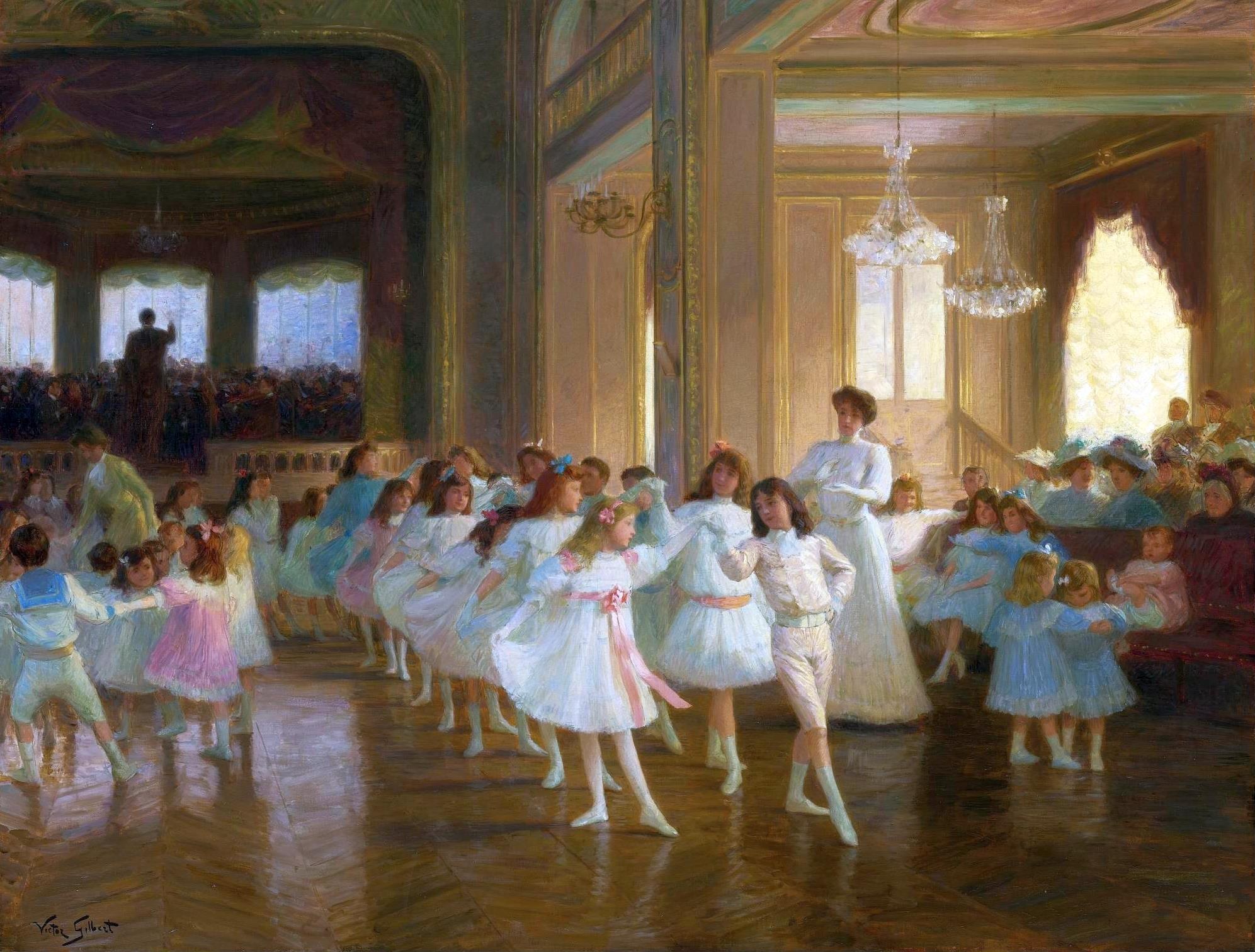
This work is rare visual evidence of ballet pedagogy and daily practice in the Romantic era, showing not a performance but a training session or demonstration—the unglamorous reality behind theatrical spectacle. It documents the professionalization and feminization of ballet training in the 19th century and the role of aristocratic patronage in supporting dance institutions. For dancers and teachers, it offers concrete visual information about class organization, dress, and the relationship between instructors and students in the period when modern ballet technique was being codified.
What you are looking at
A formal dance class or demonstration in a grand aristocratic hall, rendered in oil with luminous naturalism. Dozens of young dancers, predominantly female, in white and pastel dresses fill the gilded interior, arranged in loose clusters across the polished floor. The space opens to the right through tall arched doorways flooded with bright daylight, creating a strong light gradient across the composition. Adults—likely instructors or chaperones—in darker street dress observe from the sides and background. Crystal chandeliers hang overhead. The left side shows deeper shadow and a raised platform or balcony where figures in formal dress are gathered, possibly an audience or additional supervisors. The scene captures a moment of active instruction or display: children are mid-movement, some standing, others in various positions of attention, creating the sense of a carefully orchestrated class rather than an unstructured gathering. The palette is warm and soft—creams, pale blues, flesh tones, with touches of pink ribbon—and the diffuse light suggests morning or afternoon in a well-lit palace room.
The dancing
The young dancers stand and move with upright posture appropriate to classical training, many with arms at their sides or lightly positioned. Several are turned to face different directions, suggesting they are following instruction. The majority wear simple white or pale blue dresses suitable for exercise and practice; older women and men in the background and periphery wear darker, street-level clothing. The spatial arrangement—scattered but not chaotic—suggests this is a structured session with children waiting their turn or responding to direction. No partnering or closed holds are visible; the scale and informality of the grouping indicates a class or demonstration for children rather than social ballroom dancing.
The dance depicted
This appears to be a 19th-century Romantic-era children's ballet class or exhibition, most likely in a European aristocratic or institutional setting. The white dress, youth of the dancers, and formal interior setting all point to theatrical ballet training in the academic tradition that emerged during the Romantic period. The formal arrangement and presence of what appear to be instructors suggests this may document a lesson or public demonstration of a dance academy, possibly operated by or attached to a royal or wealthy household. The scale and style are consistent with the expanding institutionalization of ballet training in the mid-to-late 19th century, when such classes became more formalized and sometimes were displayed to patrons or the public.
How it was made
Oil on canvas, executed with fluid brushwork and sophisticated control of light and atmosphere. The artist has used impasto and glazing to capture the quality of daylit interiors; the bright window passages and the jewel-like effect of the chandeliers are achieved through careful layering and highlight work. This is a finished studio work, not a sketch, and its scale and technique suggest it was commissioned or created for exhibition. The painterly approach allows for a large cast of figures to be suggested through abbreviated rendering of faces and hands while maintaining compositional coherence—a technique well suited to crowd scenes and class or gathering subjects.
About this work
This oil painting documents a moment of formal ballet training or exhibition in a grand European interior, likely from the mid-to-late 19th century. The work captures the Romantic era's expansion of ballet from an elite court entertainment into an institutionalized academic practice with dedicated schools and trained instructors. The scene is populated with young students in practice dress, supervised by adults in formal clothing, gathered in a palace-like room lit by daylight and chandeliers. It is both a document of pedagogical practice and an image of refined leisure and cultivation for the aristocracy or wealthy urban class who patronized such establishments.
The painting sits at the intersection of social history, art-historical documentation, and cultural practice. It shows ballet as lived practice rather than theatrical spectacle—the unglamorous, repetitive, supervised work of learning rather than the finished performance. For historians and dancers, it offers visual evidence of how the ballet body was made, how classes were organized and witnessed, and how ballet training fit into the lives and spaces of the privileged classes in 19th-century Europe.
How to look at it
Attend first to the light: the painter has created a dramatic contrast between the bright daylit space on the right and the deeper shadows on the left, using light to organize the composition and direct attention. Notice how the children's white dresses capture and reflect this light, making them luminous against the gold and darker tones of the interior. Look at the postures and positioning of the figures—they are informal but not chaotic, scattered across the floor in ways that suggest they are awaiting direction or have just ceased moving. The presence of watching adults and the formal setting (not a stage, but a private hall) asks you to read this as instruction or display rather than performance. Finally, note the artist's technique: despite the large number of figures, many faces are suggested rather than detailed, and hands are abbreviated—the painter prioritizes the overall effect of light, color, and spatial arrangement over narrative drama or individual portraiture.
The artist
Victor Gabriel Gilbert (1847–1933) was a French academic painter specializing in interior genre scenes and social observation. He is known for large-scale paintings of domestic and institutional interiors populated with numerous figures, rendered in warm light with careful attention to period costume and furnishing. His work often documented the refined social rituals and educational practices of the French bourgeoisie and aristocracy. This painting exemplifies his interest in formal spaces, gathered figures, and the subtle documentation of social practice through highly finished oil technique.
The period
By the mid-to-late 19th century, ballet had transformed from an aristocratic court spectacle into a professionalized theatrical art with formalized training institutions across Europe. The founding and expansion of academies and state ballet schools created a new class of professional dancers (predominantly female) and shifted the work of ballet training from private court choreographers to dedicated instructors and pedagogues. This period saw the development of standardized techniques—particularly the Russian Imperial Ballet system codified by Agrippina Vaganova and others—and the expansion of ballet's audience beyond the court to urban theaters. Simultaneously, bourgeois and aristocratic families began enrolling children in ballet as part of refined education, creating markets for private ballet masters and classes. Gilbert's painting documents this social expansion of ballet training and the new visibility of ballet pedagogy within elite domestic and institutional spaces.
Where it lives
The work is documented on Wikimedia Commons as a Victor Gabriel Gilbert painting in oil. No current collection, accession number, or detailed provenance is recorded in the catalogue entry.
Dance in this work
Questions about this work
Is this a real ballet class or an idealized scene?
It is almost certainly idealized. The lighting is exceptionally beautiful and the arrangement carefully composed for pictorial effect. However, the scale and type of class depicted—children in practice clothes being supervised by instructors in a formal interior—reflects real pedagogical practice in 19th-century European academies and private schools. The painter has documented a real social practice but enhanced it aesthetically.
What is the date of this work?
The catalogue record gives 2014, which is clearly an error—Gilbert lived 1847–1933, and the style, dress, and interior design are unmistakably 19th-century. The painting was likely created between 1880 and 1920, during the period of Gilbert's most active exhibition and commissions, but the precise date is not recorded.
Where would a class like this have taken place?
The palatial interior—with its gilded ornament, parquet floor, chandeliers, and tall arched windows—suggests either a royal palace with attached ballet school, a wealthy aristocratic household, or a prestigious private academy. By the late 19th century, such spaces existed in Paris, London, and other European capitals where ballet training was available to children of the wealthy and aspiring middle classes.
Why are almost all the dancers female?
By the Romantic era, ballet had become increasingly feminized as a profession and educational pursuit. Male dancers, though essential in professional companies, were less common in amateur or private training. This painting likely reflects the actual demographics of such classes, where girls vastly outnumbered boys.
More dance artwork