49 works in this view — arrow keys or swipe to move between them.
Dance in Art · 1700
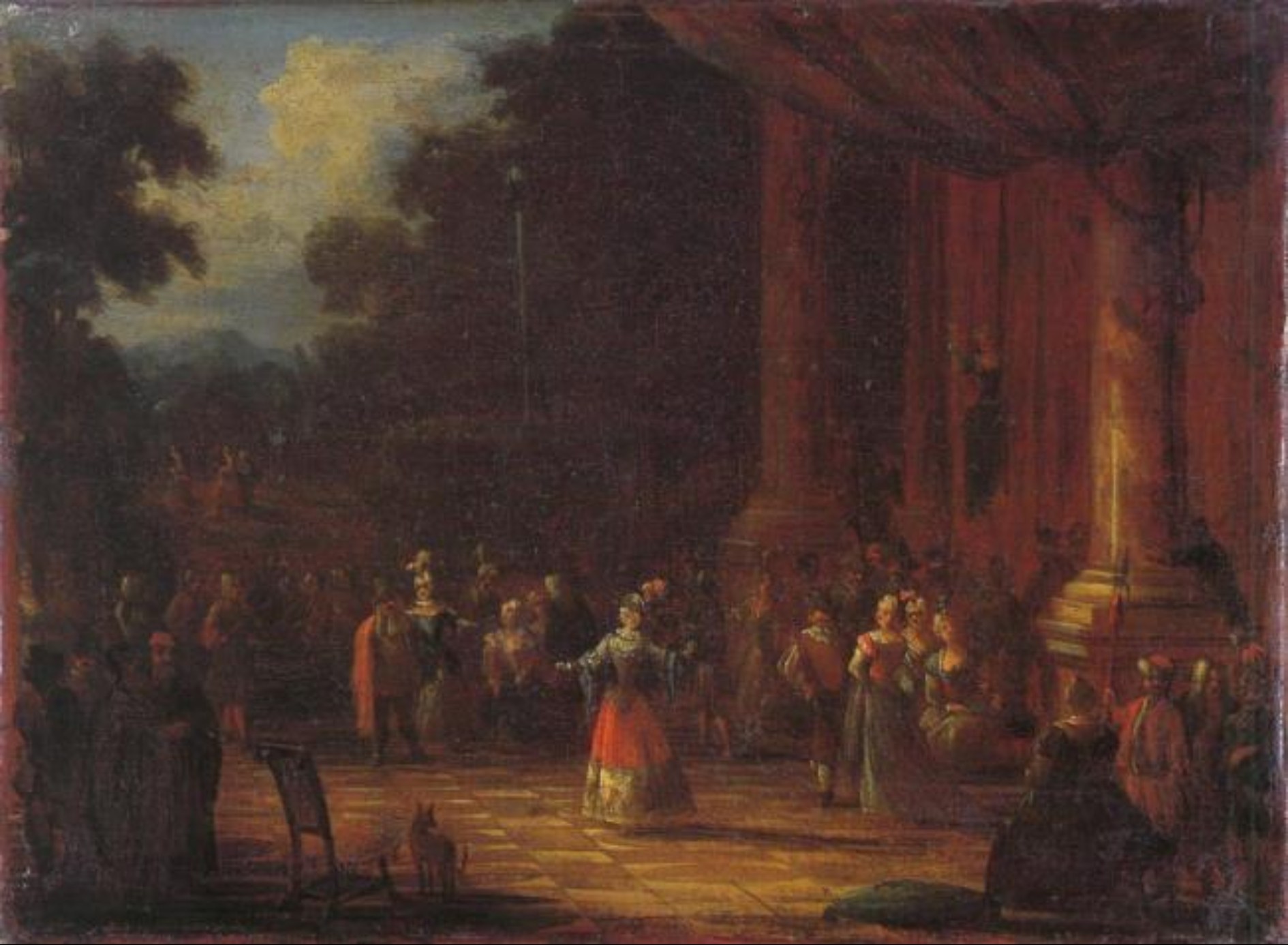
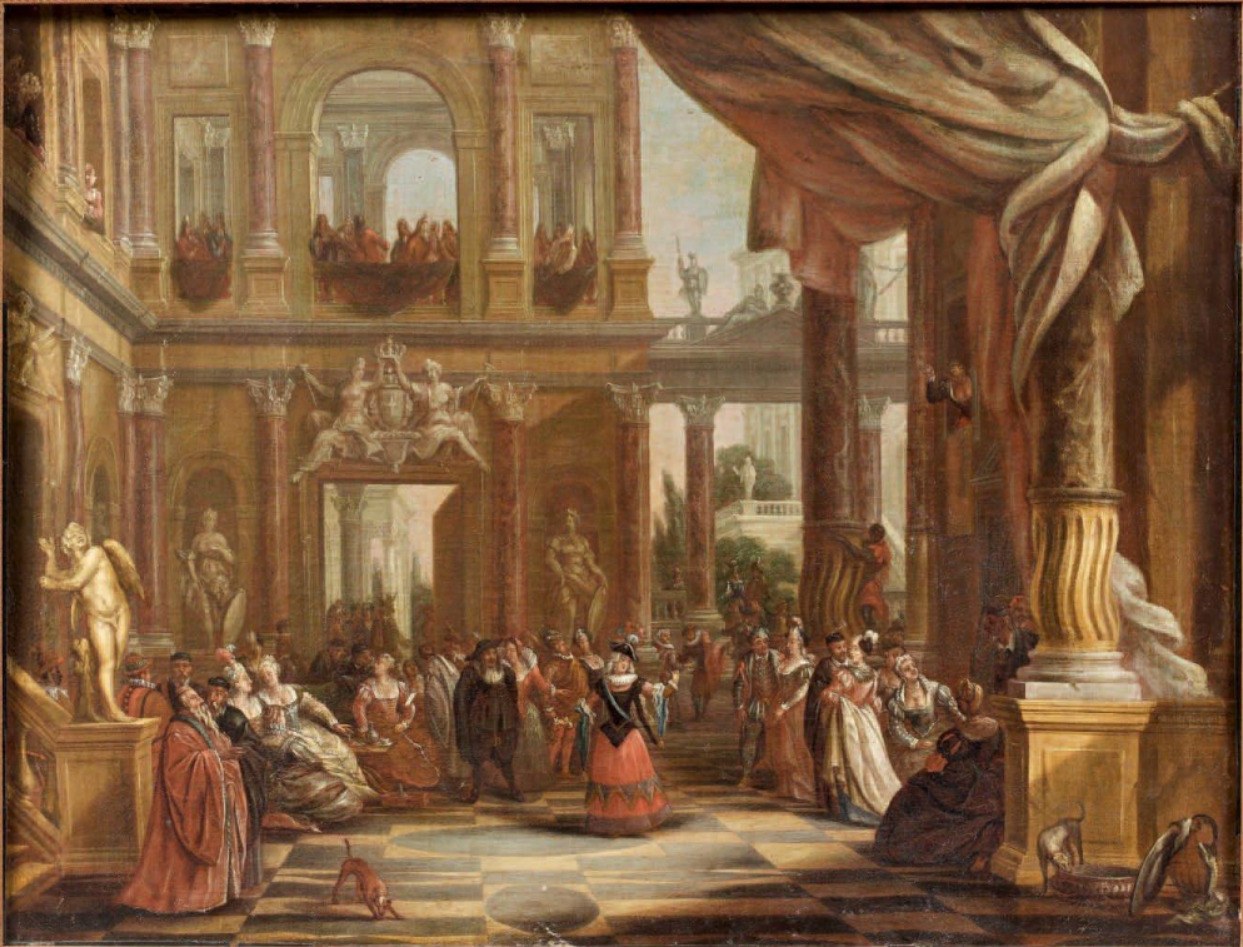
Willem Augustin van Minderhout - A ball outside a palace
Willem Augustin van Minderhout
- Medium:
- Oil Painting
- Era:
- 1700s (Enlightenment/Minuet Era)
- Source:
- Wikimedia Commons
- Rights:
- Public domain — free to use, share and adapt.
- Recorded as:
- Public Domain
This work documents the Minuet as lived social practice in the court setting, not as a technical form reduced to choreography or notation. It shows the costume, architecture, lighting, and social distance that framed the dance and made it meaningful. For anyone studying the relationship between dance and power in the Baroque, or the integration of dance into courtly ritual, this painting is direct evidence.
What you are looking at
A grand palatial interior animated by figures in formal early 18th-century dress. The space is defined by massive fluted columns, soaring arches, and sumptuous drapery in ochres and russets. Through the colonnade, a distant upper gallery holds spectators. The foreground occupies a broad floor where dozens of courtiers in rich silks—women in deep crimsons and golds, men in contrasting robes—cluster and move in small groups. The composition draws the eye through the arcade toward the back, where light floods from an opening onto a terrace and gardens beyond. The palette is uniformly warm and muted, and the artist has used the recession of space and the repetition of columns to create both intimacy and grandeur. The gathering has the character of a formal social assembly rather than a performance: no stage, no orchestra visible, no audience facing in one direction. Instead, guests circulate, converse, and move in the manner of a court ball or fête.
The dancing
Dancers and courtiers are depicted in pairs and small clusters, many at standing distance from one another rather than in closed holds. Several figures appear to be in the preliminary stages of movement—turning, stepping, inclining toward partners—but few show the extended forms or lifted frames characteristic of later ballroom positions. Women's skirts are full and voluminous, constraining legwork and favouring body rotation and gliding. A few couples suggest turning or processional movement; one woman in red in the center foreground appears to be leading or directing attention. The overall impression is of an unhurried assembly, with social interaction and conversation as significant as dancing itself.
The dance depicted
This appears to be a court ball or aristocratic fête galante of the early 18th century, most consistent with the French baroque court tradition and the minuet era. The setting, dress, and social organization suggest the formal assemblies of the Baroque period in which dancing was one among several courtly accomplishments. The dance is not dramatically posed or visibly virtuosic; instead, the artist has chosen to show the integrative moment—the dance as part of the fabric of court life. The Minuet was the dominant court dance of this period, characterized by controlled stepping, turning, and processional geometry. While specific steps cannot be read from the painting, the formal dress, columned palace setting, and the leisurely, composed nature of the movement are entirely consistent with historic-baroque court dancing. The image captures the social rather than technical dimension.
How it was made
Oil on canvas, executed in a decorative manner typical of Baroque interior painting. The artist has used warm tonalities and soft modeling to unify the crowded composition. Light enters from the architectural openings and is distributed across fabrics and flesh tones, creating a sense of opulence and ceremony. The technique—layered glazes, warm underpainting, and careful attention to the reflection of light on silk and velvet—suggests this was painted for a patron familiar with grand interiors and court spectacle. The scale and refinement indicate a work intended for a noble or royal collection, circulating among the educated elite rather than the public.
About this work
This oil painting documents the social world of the Baroque aristocratic ball, rendering the minuet era not as a performance or sequence of steps but as an ambient courtly accomplishment. The palette of warm golds and crimsons, the monumental architecture, and the composed gestures of the figures all belong to the early 18th-century court tradition. The work belongs in a gallery of dance imagery because it captures the inseparability of dance from court ceremony, display, and social hierarchy. It shows not a moment of peak athleticism or technical mastery, but the integration of dance into the rituals by which an aristocratic society defined itself.
The painting is valuable as an index of what dancing meant in the Baroque court: not entertainment external to the gathering, but an expression of grace, fashion, and social standing. The artist has understood the minuet as decorum made visible, and has rendered it as such.
How to look at it
Attend to the architectural framing: the columns and arches do not isolate the dancers but knit them into a social space. Notice how few figures are in direct physical contact, and how many stand or gesture rather than leap or spin. The artist has chosen the moment of assembly and gentle movement rather than a peak of the dance. Observe the fall of the women's skirts and the constraint they place on footwork. Look at the faces and postures: the dance is being conducted with restraint, courtesy, and awareness of those watching. This is not a depiction of technical mastery but of courtly decorum.
The artist
Willem Augustin van Minderhout (1689–1757) was a Flemish or Dutch painter who specialized in architectural interiors and court scenes. He was active in the early 18th century and produced works for the European nobility, particularly those with interests in grand interiors, collections, and court ceremony. His work is consistent with the Flemish tradition of densely populated interior views pioneered by artists like Peter Neefs, and reflects the baroque interest in perspective, light, and the rendering of luxury materials. Little is securely known of his biography or training, but his technical facility and the scale of his commissions suggest he was well-established and well-regarded.
The period
The early 18th century was the apex of the Minuet as the dominant court dance of Western Europe. The minuet had evolved from a popular French dance of the 17th century into a slow, formal, processional dance taught to all aristocratic children and performed at every court assembly. It was codified in dance manuals by Feuillet and Raoul-Auger Feuillet and circulated in notation. Simultaneously, the Baroque interior—with its columns, drapery, and dramatic light—was at its height as a setting for court ceremony. Painting of court scenes flourished as a way of commemorating and celebrating aristocratic identity. The work sits at the intersection of this dance history and the visual culture of power.
Where it lives
The work is recorded as sourced from Wikimedia Commons. No holding collection, accession number, or current location is recorded in the catalogue.
Dance in this work
Questions about this work
What dance is being shown?
The formal court assembly and the dress, architecture, and leisurely pacing strongly suggest the Minuet, the dominant dance of the Baroque court and the early 18th century. However, the painting does not isolate a single dance or frozen moment of technique; instead it shows the Minuet as part of the broader social life of the court ball. The specific steps cannot be read from the image.
Why are there so many people and so much architecture?
The painting is documenting the Minuet not in isolation but in context: as one element of court ceremony, display, and social gathering. The grand interior, with its columns and drapery, is itself part of what the dance meant. The size and formality of the space, and the presence of spectators above, underscore that this was a public, hierarchical social event.
Are the people actually dancing or just standing around?
Both. The artist has rendered the moment of assembly and preparation as much as active dancing. Some figures are clearly turning or stepping; others are conversing or watching. This reflects the reality of the court ball, where dancing was intermittent and integrated with socializing. The painting captures the social and ceremonial dimension as much as the technical.
What was the purpose of the Minuet?
The Minuet served multiple purposes: it was a display of training, grace, and social polish; it was a way of structuring social interaction and hierarchy; and it was an occasion for courtship and the performance of aristocratic identity. It was obligatory for anyone of rank to dance it well, and to refuse to dance or to dance poorly was a social failure.
More dance artwork