39 works in this view — arrow keys or swipe to move between them.
Dance in Art · 1929
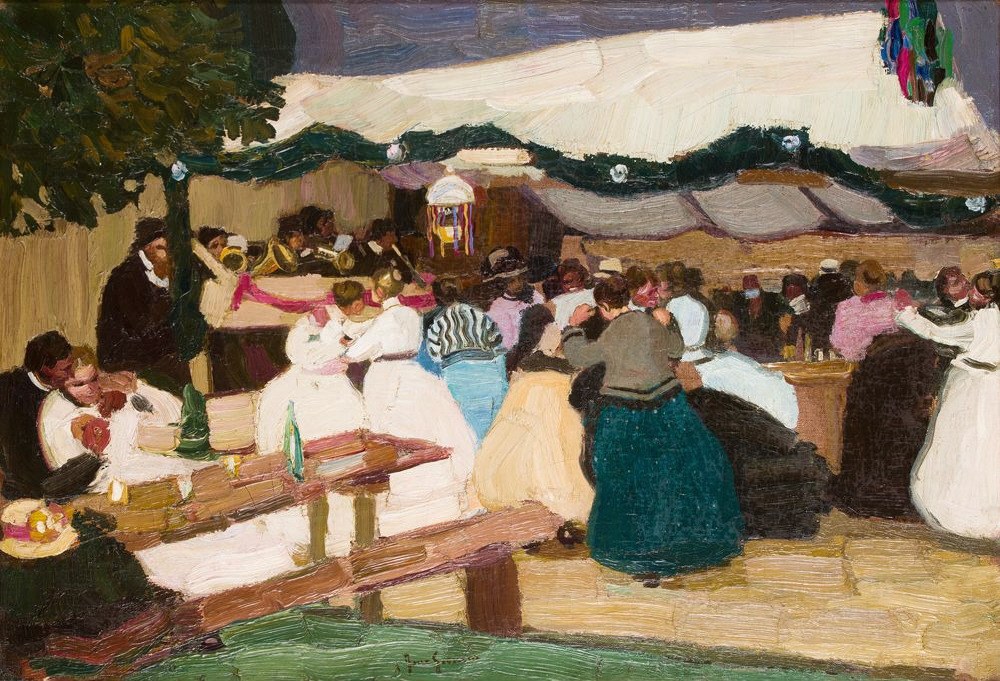
Josse Goossens Tanz auf der Festwiese
Josse Goossens
- Medium:
- Oil Painting
- Dance:
- Folk/Country
- Era:
- 1920-1950 (Swing Era)
- Source:
- Wikimedia Commons
- Rights:
- Public domain — free to use, share and adapt.
- Recorded as:
- Public Domain
This work preserves visual evidence of a form of public social dancing that has largely disappeared from European culture. For historians of ballroom dance and popular leisure, it documents the dress, setting, band composition, and social context of early twentieth-century festival dancing in a way that written sources cannot. The painting's casual, observational tone—treating dance as one element of a larger celebration—captures something essential about how dance functioned in everyday life, not as performance but as participation.
What you are looking at
An outdoor festival or garden party in full swing, painted in loose, expressive brushwork. A large white tent or marquee dominates the background, decorated with dark green garland swags. The foreground is crowded with figures in early twentieth-century dress—men in dark suits and women in white blouses, pastel skirts, and hats—scattered across a wooden floor or platform. A brass band occupies the left side, their instruments catching light. The crowd is in motion: some dancing, some seated at tables with drinks and food, others standing in conversation. The composition is lively and informal, with overlapping figures and warm earth tones punctuated by the white dresses and the pale sky above. The light is natural and bright, suggesting an afternoon celebration.
The dancing
The dancers visible in the crowd show couples in close embrace or facing positions typical of early twentieth-century social dancing. Several pairs appear to be waltzing or performing a similar partner dance, with men's arms around women's waists and women's skirts caught in motion. The postures are relaxed and social rather than formally staged; bodies lean into one another, and the overall impression is of people enjoying themselves without rigid technique. Weight appears distributed for smooth traveling movement across the wooden floor. The variety of body positions—some couples upright, others leaning, some figures seated—creates a sense of continuous, unscripted social interaction.
The dance depicted
This appears to document a popular social dance venue, likely a village festival or garden dance hall (Festwiese suggests a festival meadow or green), where working and middle-class people gathered to dance to live music in the early 1900s. The dances are most consistent with the waltz, foxtrot, or other ballroom social dances of the period, performed by couples in close hold in a mixed public setting. The painting captures the informality and pleasure of popular dance culture—neither concert nor theatrical performance, but the everyday celebration of people dancing together. The presence of the full band and the scale of the gathering suggest this was a significant social institution, a public space where dance was central to community life.
How it was made
Oil painting on canvas, worked in a loose, gestural style that prioritizes the atmosphere and social energy of the scene over precise detail. The artist has used broken brushwork and a warm palette of ochres, browns, and whites, with darker greens and blues for contrast. This technique—impressionistic in its handling of light and movement—allows the viewer to read the scene quickly as a living, dynamic event rather than a still moment. The style was well suited to early twentieth-century European modernism and suggests the work was intended for exhibition rather than documentary record.
About this work
Josse Goossens has painted a snapshot of popular social dance culture in early twentieth-century Europe, capturing not the technique or artistry of trained dancers but the collective pleasure and ritual of public dancing. The work documents a now-vanished world of outdoor festival halls and brass-band dances, where ballroom dancing was a core expression of community and leisure. It belongs in a gallery of dance imagery because it treats dance not as a specialized art but as a central social practice—the reason people gather, the reason the band plays, the reason the festival happens. The painting's value lies in its honest record of how ordinary people danced together.
How to look at it
Attend to the relationship between the band and the dancers: the painting emphasizes that the music is the organizing principle of the gathering, the thing that draws and holds the crowd. Notice how the artist has scattered the figures—no formal line or arrangement, but a continuous flow of people moving and pausing. The brushwork itself is energetic and loose, which conveys the motion and informal pleasure of the scene better than precise detail would. The pale dress of the women and the dark suits of the men create a visual rhythm across the canvas that mirrors the rhythm of the music.
The artist
Josse Goossens (1890–1968) was a Belgian painter associated with Expressionism and the broader modernist movements of early twentieth-century Europe. He was known for genre scenes and social subjects, often depicting leisure, labor, and communal gathering. His loose, energetic brushwork and interest in contemporary life placed him within the orbit of early European modernism, though he remained focused on accessible social subjects rather than pure abstraction.
The period
This painting dates to 1929, a moment when ballroom dancing dominated popular culture across Europe and America. The 1920s and early 1930s saw the waltz, foxtrot, and other partner dances at the height of their popularity in public halls, gardens, and dance floors. The painting captures the end of an era: within a decade, economic collapse and war would disrupt these gathering places, and recorded music would begin to replace live brass bands. Artistically, the early twentieth century saw a growing interest in depicting modern leisure and social life, particularly the activities of working and middle-class people—a shift from academic history painting toward contemporary social observation.
Where it lives
Source: Wikimedia Commons. The catalogue record does not specify the current holding institution or collection.
Dance in this work
Questions about this work
What kind of dance is this?
The couples appear to be waltzing or performing other partner dances popular in early twentieth-century ballroom and garden settings. The close hold and upright postures are consistent with formal ballroom technique, but the casual dress and outdoor setting indicate this was popular social dancing rather than professional performance. Without more specific evidence (such as a visible poster or dated archive), we cannot name a single dance.
Who would have attended a 'Festwiese'?
A festival meadow or garden dance venue would have been open to the general public—working people, servants, young people of modest means, anyone who could pay the modest admission. These were not exclusive clubs but popular entertainment, and they played a crucial social role in communities before radio and cinema became dominant.
Why paint this subject?
By 1929, European artists were increasingly interested in depicting contemporary life and popular culture. Goossens's choice of a public dance hall reflects a modernist interest in ordinary people and modern leisure. The painting records a way of life without sentimentality or mockery—simply as it was.
Do we know when and where this took place?
No. The title indicates a festival meadow, but the catalogue record does not specify a location or date beyond the year of the painting. The dress and setting are consistent with early twentieth-century northern Europe, but that is all we can say with certainty.
More Folk/Country artwork