41 works in this view — arrow keys or swipe to move between them.
Dance in Art · 1906
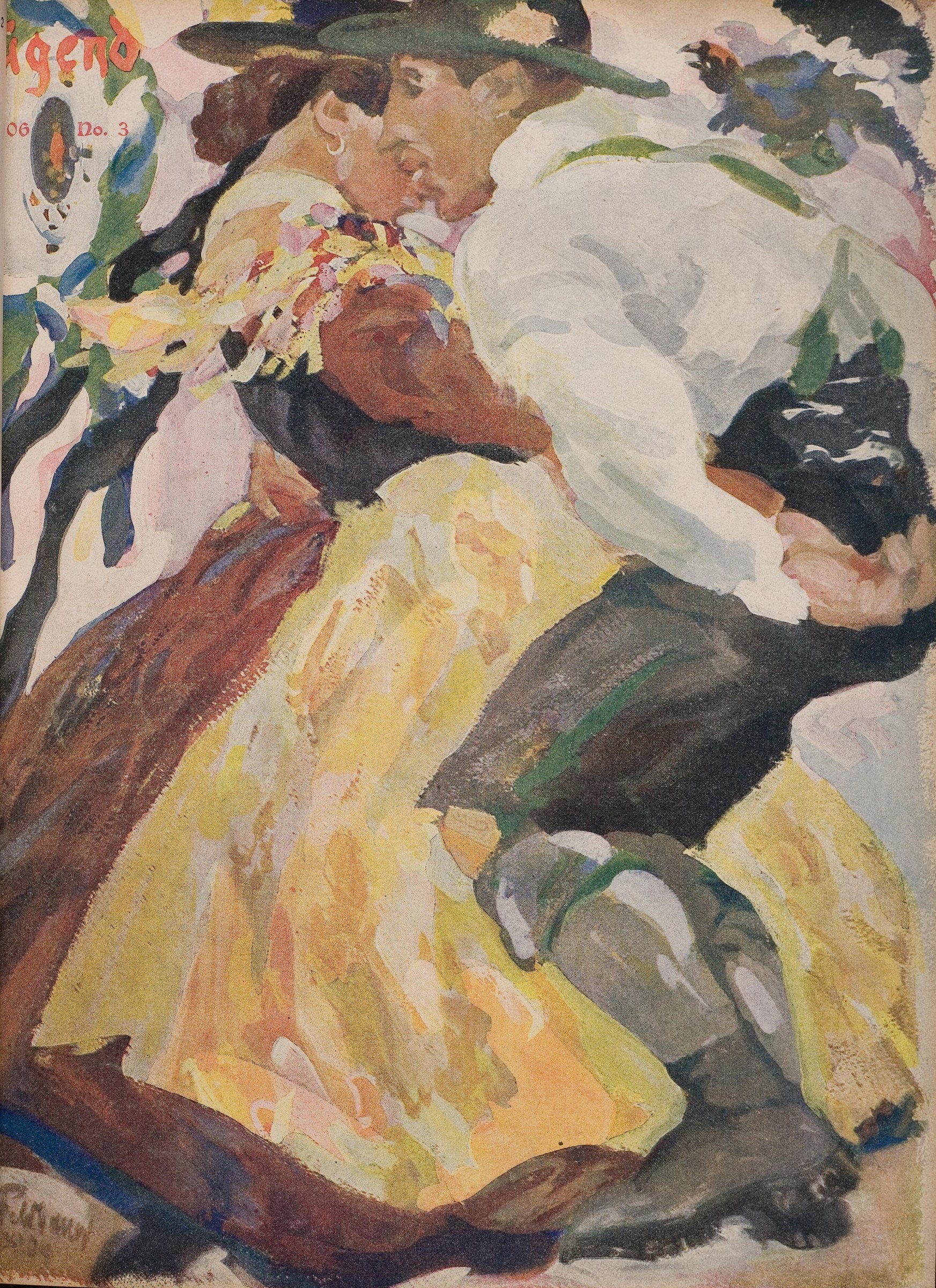
Max Feldbauer - Jugend Nr. 03, 1906
Max Feldbauer
- Medium:
- Oil Painting
- Dance:
- Folk/Country
- Era:
- 1900-1920 (Ragtime/Early Jazz)
- Source:
- Wikimedia Commons
- Rights:
- Public domain — free to use, share and adapt.
- Recorded as:
- Public Domain
This illustration documents a pivotal moment in European social-dance history: the moment when modern, energetic social dances became fashionable and respectable subjects for serious artistic treatment. It shows how dance was understood as emblematic of contemporary life and youth culture in the early 1900s, and how visual artists engaged with choreography as a vehicle for exploring modernism itself.
What you are looking at
A woman in a flowing yellow dress dances with a man in formal attire (dark jacket, green hat) in what appears to be an interior or theatrical setting. The woman's voluminous skirt is caught mid-movement, with layers of pale yellow, cream, and orange creating a sense of swirling motion. Her posture is dynamic and forward-leaning, suggesting vigorous, exuberant movement. The man leans toward her, his body angled to match her trajectory. In the upper right, a small figure in blue appears to be playing music or observing. The composition is energetic and informal, with loose brushwork and a color palette dominated by yellows, flesh tones, and dark accents. This is a cover illustration for the German art and literary journal *Jugend* (Youth), dated 1906, which explains both the modernist treatment of the subject and the magazine's title visible in red lettering at the upper left.
The dancing
The woman's weight is shifted forward onto her right leg, her body angled dynamically in what appears to be an open or semi-open ballroom frame. The man maintains a close partnering position, his posture matching hers as they move together. Her arms suggest an unsupported hold typical of social dance, with her left arm extended. The movement captured is rapid and exuberant rather than controlled; both figures convey a sense of abandon and joyful energy rather than the precision of formal technique.
The dance depicted
This appears to depict social ballroom or popular social dance of the early 1900s—likely a waltz, one-step, or another partner dance of the Ragtime era. The catalogue tags it as folk/country dance, but the urban setting, contemporary formal dress, and magazine context suggest this is more accurately a fashionable social dance of the urban middle classes. The energy and informality suggest the new popular dances emerging during the Belle Époque and early 20th century, when dance was becoming more animated and less strictly codified. The illustration captures the moment of enthusiastic, unguarded movement that characterized the modern social dances of this period.
How it was made
This is an oil painting, rendered with bold, expressive brushwork that was characteristic of early modernist illustration. The loose handling of paint, particularly in the woman's skirt, conveys movement through technique rather than mere description. As a cover for *Jugend*, a leading journal of Jugendstil (Art Nouveau) design, this work exemplifies how fine-art techniques were deployed in commercial publishing to capture contemporary subjects with aesthetic sophistication. The painting's informal energy and modern palette reflect both the journal's commitment to contemporary life and the modernist rejection of academic restraint.
About this work
This is a cover illustration for *Jugend*, a Munich-based art and literary journal, showing two figures engaged in lively social dance in 1906. The work captures a moment of popular urban leisure during the Belle Époque, when new forms of social dancing—faster, more informal, and more physically exuberant than the formal dances of the 19th century—were emerging from both African-American and Latin-American traditions and being enthusiastically adopted by European urban society. The painting's modernist technique, with its dynamic composition and loose brushwork, mirrors the energy of the dance itself and reflects the journal's mission to represent contemporary life through advanced aesthetic practice.
The image belongs in a gallery of dance not merely as a document of what people danced, but as evidence of how artists of the period understood social dance as a marker of modernity. The work celebrates dance as a site of liberation and joy, aligned with the Jugendstil movement's embrace of contemporary experience and its rejection of historicism.
How to look at it
Attend to the painting's capture of a single instant of kinetic energy: the moment when the woman's skirt is billowed by motion, when both figures are leaning into the dance. The artist has chosen not to depict a balanced, controlled pose but rather a fleeting, exuberant moment. Notice how the brushwork itself—loose, gestural, almost abstract in the rendering of fabric—conveys the sense of motion. The color harmony of yellows, creams, and flesh tones against darker accents creates visual vibrancy that mirrors the energy of the dance.
The artist
Max Feldbauer was a German painter and illustrator active in Munich during the Jugendstil period. He contributed regularly to *Jugend*, the journal founded in 1896 that became the leading publication of Art Nouveau in Germany. Feldbauer's style combined fine-art technique with commercial illustration, capturing contemporary subjects—social gatherings, leisure activities, urban life—with a modernist sensibility. His work exemplifies the Jugendstil commitment to elevating everyday experience and contemporary culture to the level of fine art.
The period
In 1906, European social dance was undergoing rapid transformation. The tango, ragtime-influenced dances, and one-steps were beginning to displace the formal quadrilles and waltzes of the 19th century. These new dances were faster, more physically intimate, and more openly expressive of pleasure and sexuality, and they caused considerable social anxiety among conservative observers. Simultaneously, the Jugendstil movement (German Art Nouveau) was at its height, committed to representing modern life and rejecting academic convention. In visual art, the period saw increasing experimentation with color, gesture, and composition as means of conveying psychological and physical energy. The marriage of modernist aesthetics and contemporary dance in this illustration reflects the broader cultural project of the era.
Where it lives
This work is a cover illustration for *Jugend* magazine, No. 3, 1906. It was sourced from Wikimedia Commons and is part of the broader archive of the journal, which documented contemporary culture and art across multiple issues and decades.
Dance in this work
Questions about this work
What dance are they doing?
The specific style cannot be definitively identified from the image alone, but the energetic, informal posture and contemporary urban setting suggest one of the new social dances emerging around 1906—possibly a waltz variant, one-step, or ragtime-influenced dance. The loose frame and physical freedom are consistent with the modern social dances that were beginning to replace the formal quadrilles and cotillions of earlier decades.
Why is this on a magazine cover?
*Jugend* was a leading German art journal dedicated to contemporary culture and modern design. Dance, as a marker of urban leisure and modernity, was a natural subject for the journal. Using a fine-art painting as a cover elevated the subject and demonstrated the journal's commitment to finding artistic value in everyday contemporary life.
What does Jugendstil have to do with dance?
Jugendstil (Art Nouveau) was a movement that rejected historical styles and embraced contemporary experience. Dance, particularly the new, energetic social dances of the era, was emblematic of modernity, youth, and liberation from 19th-century convention. By depicting dance with modernist aesthetics, artists like Feldbauer were making a statement about the alignment between artistic innovation and social change.
More Folk/Country artwork