34 works in this view — arrow keys or swipe to move between them.
Dance in Art · 1876
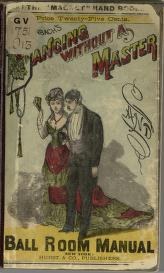
Offenbach's dancing without a master; and ball-room manual. A complete self-instructor in the art of
Unknown artist
- Era:
- Late 1800s (Victorian Ballroom)
- Source:
- Library of Congress
- Rights:
- Public domain — free to use, share and adapt.
- Recorded as:
- public_domain
This is a primary source for understanding how ballroom dancing was taught and standardized in the 1870s. The manual's promise to teach dancing "without a master" reveals the aspirations and anxieties of its audience: people who wanted social accomplishment but could not afford or access elite instruction. The image itself, though schematic, records the exact posture, frame, and formal deportment expected of properly trained ballroom dancers of the period.
What you are looking at
This is the cover of an instructional dance manual published in 1876, printed in the wood-engraved or lithographic style typical of popular instruction books of the Victorian era. The composition centers on a couple in ballroom dress: a man in dark formal attire (tailcoat and trousers) and a woman in a full-skirted dress with what appears to be a fitted bodice, posed in a dancing embrace. Their posture suggests the upright, formal frame characteristic of mid-to-late Victorian ballroom dancing. The background is minimal and atmospheric, rendered in muted tones that suggest an interior space—perhaps a ballroom or dance hall. The title "Offenbach's Dancing Without a Master" appears prominently at the top in bold lettering, with "Ball Room Manual" and "A Complete Self-Instructor in the Art of" printed below the central image. The overall design is functional and direct: this is not a fine art representation but a commercial object designed to sell instruction to the growing urban middle class.
The dancing
The couple stands in a closed ballroom hold with the man's right hand on the woman's back and her left hand on his shoulder; their free hands are joined at roughly shoulder height. Both figures are upright and formal, with no exaggerated extension or theatrical reach. The woman's full skirt fans outward, suggesting either mid-movement or the natural drape of heavy Victorian textile. The man's frame is square and controlled. Neither figure shows the relaxation or social informality of a sketch from life; instead, they present the standardized, instructional posture that a manual would teach—correct, dignified, reproducible.
The dance depicted
This is a ballroom dancing manual for the social dances of the Victorian era, most likely covering waltzes, quadrilles, polkas, and other dances of the 1860s–1870s. The reference to Offenbach (the French composer famous for operettas and popular music) suggests the manual may have included dances to his melodies or reflected the fashionable musical context of the moment. The title's promise of dancing "without a master" indicates the book was marketed to people who could not afford private instruction—a significant market among the Victorian middle class. The image itself contains no evidence of specific footwork or the particular hold that would distinguish one dance from another; it serves instead as a generic sign of "ballroom propriety" and the correct deportment expected of dancers.
How it was made
The catalogue record does not specify the medium. From the image, this appears to be a wood engraving or lithograph—the technique of choice for popular printed instruction books in the 1870s. The style of the figure rendering, the crisp outlines, the tonal modeling achieved through fine parallel lines, and the overall composition are consistent with commercial chromolithography or wood-engraved reproduction, both capable of large print runs at low cost. This was not an oil painting or fine art print; it was a mass-produced object for wide circulation among people who could afford a few shillings for a self-help manual. The technique allowed for rapid, economical production and broad distribution, making dance instruction accessible to audiences far beyond the drawing rooms of the wealthy.
About this work
This is a commercial instructional manual for Victorian ballroom dancing, published in 1876, showing a formally posed couple in the closed ballroom hold standard to the era. The work documents both the dances themselves and the cultural aspiration they represented: the desire of the urban middle class to acquire the bodily discipline and social refinement associated with polite society. As a printed object, it belongs to the history of dance democratization—the moment when dance instruction began to move from private masters and aristocratic circles into the homes and ambitions of ordinary people. The image is not artistically ambitious; its value lies entirely in what it shows about how Victorians moved, what they wore, how they held their bodies, and what they were willing to learn.
How to look at it
Note the formality of the pose: both figures are still, upright, and composed. This is not a moment of movement but a diagram of correct position—the frame that a beginner should adopt before beginning to dance. The closed hold shown here, with the woman's left hand resting on the man's shoulder and his right hand placed firmly on her back, was the standard for most Victorian ballroom dances. The full skirt of the woman's dress, typical of the 1870s, would have created a visual and physical spectacle during the waltz or polka; the engraver has captured it in a neutral stance that suggests potential movement rather than capturing movement itself. This is instruction rendered as image: a still life of correct dancing posture.
The period
By the 1870s, ballroom dancing had become a central ritual of middle-class social life in Britain and America. The waltz, polka, quadrille, and galop were the dominant forms, and mastery of their correct execution—including proper frame, line, and floor craft—was a marker of gentility. The rise of commercial instruction manuals reflects the expansion of the middle class and the desire to acquire cultural capital through dance. Offenbach's music had swept through Europe and America in the 1860s, making him a recognizable name to publishers seeking to capitalize on fashionable taste. The manual market itself was booming: instruction books for dancing, deportment, courtship, and household management were among the most popular printed goods of the Victorian era, reflecting both anxiety about social position and genuine enthusiasm for self-improvement.
Where it lives
This is a cover or title page from a commercial instructional manual, held by the Library of Congress. It is a printed object of the kind distributed commercially to middle-class households; its value as a cultural artifact lies in its mass availability and its evidence of how dance instruction was marketed and standardized during the Victorian era.
Dance in this work
Questions about this work
Who was Offenbach and why is his name on a dancing manual?
Jacques Offenbach was a French composer (1819–1880) famous for operettas and popular orchestral music. His melodies and the dance forms associated with his stage works were fashionable throughout the 1860s and 1870s. Dance manuals of the era often referenced popular composers to signal that the dances and music within were current and stylish.
What does 'without a master' mean?
It is a marketing promise: that a reader could learn to dance correctly from the manual alone, without hiring a private dancing master—a service that was expensive and available mainly to wealthy families. For the growing middle class, this was revolutionary. The phrase signals both aspiration and anxiety: the desire for accomplishment, and the acknowledgment that not everyone could afford formal instruction.
What dances would this manual have taught?
Most likely the waltz, polka, quadrille, galop, and lancers—the dominant social dances of the 1870s. The manual may also have included schottische, mazurka, and other popular ballroom forms of the era. Without access to the full text, we cannot be certain, but these were the dances that any respectable Victorian dancing manual would cover.
How was this printed?
Almost certainly by wood engraving or chromolithography—the standard commercial printing techniques of the 1870s for illustrated books. Both allowed for fast, economical production and broad distribution, making manuals like this affordable for ordinary households. The technique also allowed for multiple copies to be printed from a single prepared surface, which is how instruction manuals reached their wide audience.
More dance artwork