49 works in this view — arrow keys or swipe to move between them.
Dance in Art · 1863
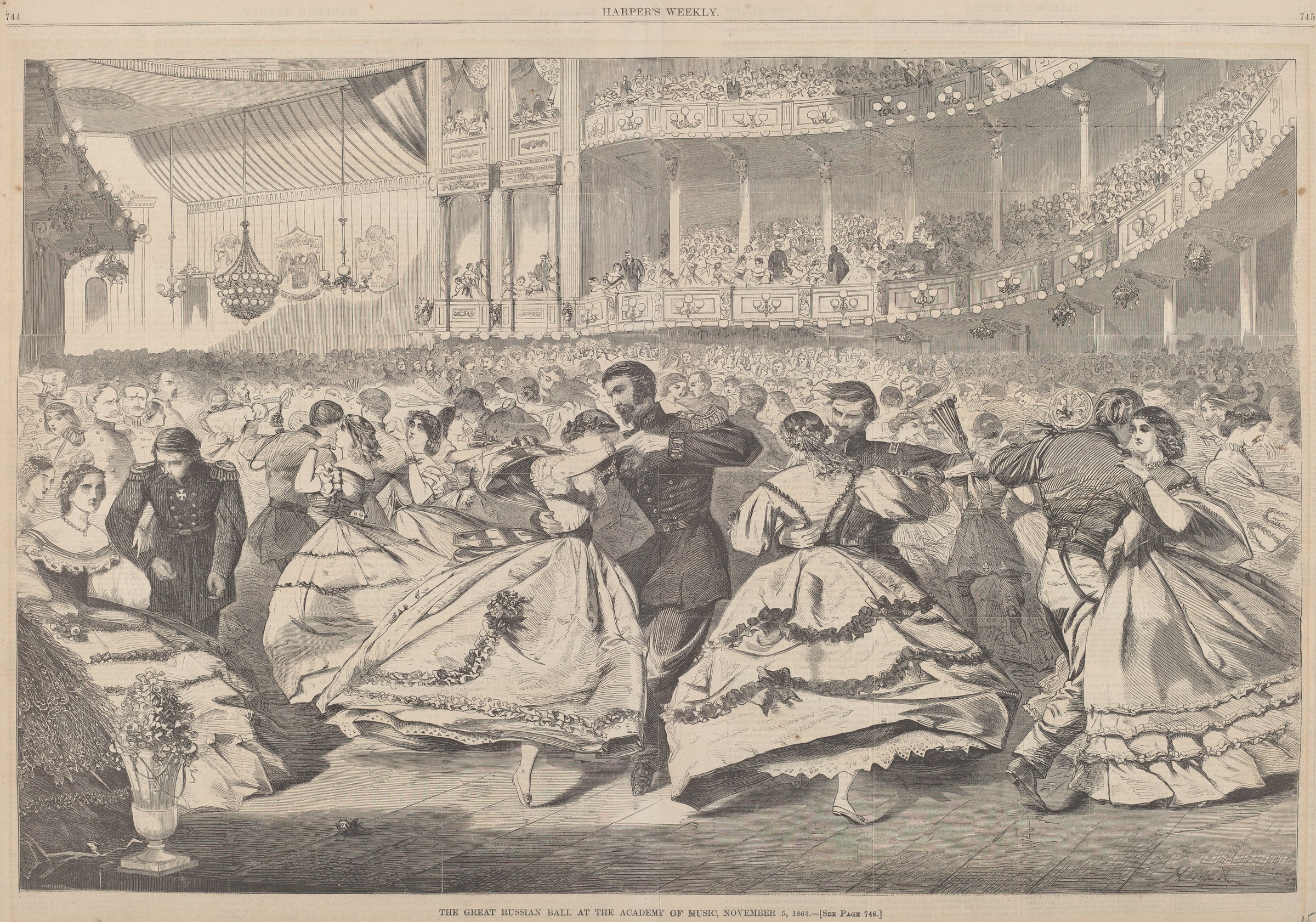
After Winslow Homer, The Great Russian Ball at the Academy of Music, November 5, 1863, published 1863, NGA 45637
Winslow Homer
- Medium:
- Oil Painting
- Era:
- Mid 1800s (Polka Era)
- Source:
- Wikimedia Commons
- Rights:
- Public domain — free to use, share and adapt.
- Recorded as:
- CC0
This is one of the most detailed visual records of mid-nineteenth-century American ballroom dance in a real social setting. The specificity of date, location, and event makes it a primary document for costume history, architectural history of ballrooms, and the social codes of Gilded Age dancing. For dancers studying the aesthetics of nineteenth-century waltz, quadrille, and cotillion, this engraving shows the actual bodies, holds, and spatial formations in which these dances were performed.
What you are looking at
A grand ballroom scene during an evening ball, rendered in wood engraving. The composition stretches across the page from left to right, showing a densely packed assembly of elegantly dressed couples and groups dancing and socializing on a polished floor. The architectural setting is palatial: an ornate proscenium with decorative gilt panels rises above the dancers, and a broad horseshoe balcony lines the upper portion of the space, packed with standing spectators. Massive columns support the structure, and elaborate chandeliers hang from an ornamental ceiling. The dancers occupy the foreground in sharp focus, while the crowd in the balconies recedes in softer detail. The scene captures multiple moments of the ball simultaneously: in the center foreground, a woman in a white gown with a full skirt dances; nearby, couples stand in conversation and clusters of military officers in dress uniforms intersperse with women in elaborate ball gowns. The crowd extends back into the middle distance, creating a sense of fashionable throng.
The dancing
The dancers are shown in the upright, formal posture characteristic of mid-nineteenth-century ballroom dancing. Several couples are captured in dance position—officers in dark dress uniforms with ornamental epaulettes partnering women whose skirts are voluminous and elaborately trimmed. The women's arms are raised and extended in the proper frame of the period; their bodies face their partners in the closed or semi-closed holds of formal ballroom dance. The men stand tall and commanding. In the foreground, the skirts of the dancing women create dynamic diagonal lines as they turn, suggesting the rotational movement of waltzes. Other figures stand in conversation groups, suggesting the pause-and-promenade rhythm of ball etiquette rather than continuous dancing.
The dance depicted
This image depicts the cotillion or formal quadrille-based ball culture of the 1860s American elite, in which structured social dances alternated with walking promenades and conversation. The primary dances shown are likely the waltz (suggested by the rotating couples and flowing skirts) and possibly the polka or galop. The ballroom setting and the mix of military dress (suggesting this was an official or patriotic occasion) indicates a formal institutional ball rather than a private assembly. The title specifies this as the Great Russian Ball, held at the Academy of Music in New York on November 5, 1863, which was a major public event likely organized as a diplomatic or charitable function. The dancers are New York society figures, and the spectacle of the ball itself—not the virtuosity of the dancers—is the subject.
How it was made
This is a wood engraving, a technique that produces fine halftone effects through closely spaced parallel lines and cross-hatching. The medium allowed for mass reproduction in newspapers and weekly magazines (this was published in Harper's Weekly), making it a form of illustrated journalism rather than fine art. The engraver has used the tonal range available in wood engraving to differentiate the lit ballroom floor from the shadowed architectural elements, and to create atmosphere in the crowded balconies. The technique's precision enables rendering of fine detail in costume and setting, but the overall composition is designed for legibility at small scale and rapid viewing, which shaped the choice to show multiple simultaneous moments rather than a single decisive gesture.
About this work
This wood engraving documents an actual historical event—the Great Russian Ball held at New York's Academy of Music in November 1863—through the practice of illustrated journalism that was central to Harper's Weekly's visual culture. The work is simultaneously a record of 1860s ballroom practice, a celebration of civic grandeur and social hierarchy, and a piece of urban visual culture made for mass circulation. It belongs in a gallery of dance art because it captures the formal ballroom dance world of its era with documentary specificity: the dress codes, the architectural theater of the ball, the prescribed holds and postures, and the social mixing of military and civilian elite that characterized this particular moment in American upper-class life.
The image is also visually sophisticated as an engraving: the composition manages to show hundreds of figures across multiple spatial planes while maintaining legibility, and the cross-hatching technique conveys the atmosphere and volume of the crowded ballroom. For historians and dancers, this is primary source material about how American ballroom culture looked and operated in the early 1860s.
How to look at it
Notice the variety of moments captured within a single scene: some couples are actively dancing (the rotating women's skirts are the key sign), while others stand in conversation. The artist has frozen the ball at a moment of activity rather than stillness, choosing to show the dynamic swirl of skirts and the interpenetration of military and civilian dress as the defining visual content. Attend to the architectural framing—the balcony and columns create a theatrical proscenium around the dancers, emphasizing that this is a formally staged social performance. The density of the crowd is essential to the meaning: this is a fashionable throng, a demonstration of belonging to a defined social circle.
The artist
Winslow Homer (1836–1910) was a dominant figure in American illustration and fine art. He worked extensively as an illustrator and correspondent for Harper's Weekly during the 1860s, covering the Civil War and major social events. While Homer is primarily remembered today for his later seascapes and landscapes, his work as a graphic journalist—including illustrations of balls, theatrical events, and social life—was central to the emergence of wood-engraved visual journalism in America. This piece exemplifies his skill in composing complex social scenes with documentary clarity and formal balance.
The period
In 1863, the waltz, polka, and quadrille were the dominant ballroom dances of the American and European upper classes, having displaced earlier court dances. The formal closed-couple waltz was now well established and socially acceptable, despite earlier moral opposition. The ball itself as a public spectacle—especially one with patriotic or diplomatic significance—was a major form of elite social display. The Civil War was ongoing in November 1863, making this ball (apparently a benefit or diplomatic gesture related to Russia) newsworthy as a sign of normalcy and civilian social life continuing amid war. The illustration medium of Harper's Weekly had become central to how Americans visualized their own society.
Where it lives
The work is recorded in the National Gallery of Art collection (NGA 45637) and sourced from Wikimedia Commons. It is part of the published record of Harper's Weekly, a major illustrated newspaper that documented American social and political life.
Dance in this work
Questions about this work
What is the Great Russian Ball?
This was a real event held on November 5, 1863, at the Academy of Music in New York City. It was likely a benefit or diplomatic event related to Russia during the Civil War period. The ballroom was one of the largest and most fashionable venues in America.
Who would have seen this image?
This engraving was published in Harper's Weekly, a magazine read by the educated American middle and upper classes. It circulated within days of the event, making it a form of visual news reporting rather than a historical record made years later.
What dances are shown here?
The rotating couples and flowing skirts suggest waltz, the dominant ballroom dance of the era. Polka and galop were also popular at formal balls, but this image emphasizes the stately waltz as the main dance shown. The occasion would have included quadrilles and cotillions as well.
How accurate is the dance technique shown?
The closed-couple posture, upright frame, and arm positions are consistent with mid-nineteenth-century waltz technique. The women's skirts are shown catching mid-turn, which is accurate to the rotational movement of the waltz. The overall composition suggests the artist observed or was familiar with ballroom practice.
More dance artwork