49 works in this view — arrow keys or swipe to move between them.
Dance in Art · 1859
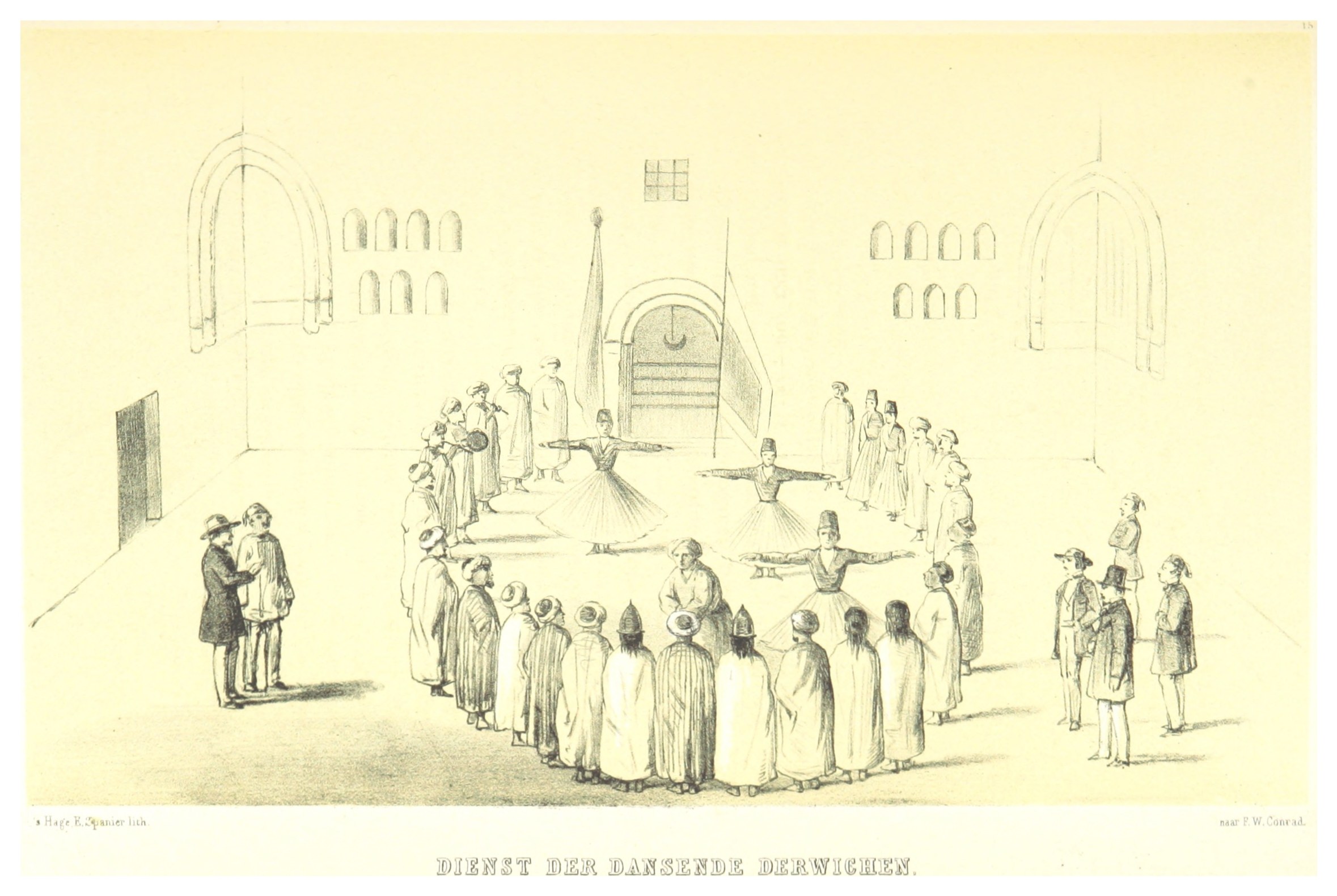
CONRAD(1859) p339 DIENST DER DANSENDE DERVICHEN
Unknown artist
- Medium:
- Oil Painting
- Era:
- Mid 1800s (Polka Era)
- Source:
- Wikimedia Commons
- Rights:
- Public domain — free to use, share and adapt.
- Recorded as:
- Public Domain
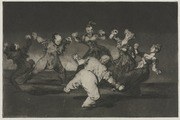
The Mevlevi Sema is one of the world's oldest continuously practiced ritual dances, codified in the fifteenth century and still performed today. This engraving is valuable evidence of how the ceremony appeared and was understood by European observers and publishers in the mid-nineteenth century, before industrial tourism and radical political change transformed Ottoman cultural practice. It is also a rare early visual record of a dance form in which the movement itself—continuous rotation—cannot be shown in a static image, requiring the artist to choose the most recognizable and spiritually significant moment to freeze.
What you are looking at
A large interior hall with arched ceilings and tall windows features a formal gathering of figures arranged in concentric circles around two central dancers. The setting appears institutional or ecclesiastical—possibly a monastery, convent, or large communal building—with austere architectural details. In the center, two figures in light-colored robes perform with arms extended horizontally at shoulder height in a posture of radical openness, their garments billowing. Around them stand roughly thirty figures in white or cream robes, some in profile, others facing outward, arranged in loose circular formations. At the edges of the composition, smaller groups of clothed observers in darker dress—men in coats and hats, women in bonnets—watch from the periphery. The lighting is even and cool, rendered in pale sepia tones with fine cross-hatching to suggest volume and fabric.
The dancing
The two central dancers hold their arms in a perfectly symmetrical, extended horizontal position—the classic posture of the whirling dervish—with their torsos upright and their weight centered. Their robes fall in deep vertical folds that suggest rotation or spiraling motion even in stillness. The surrounding figures stand quietly in place, some with hands clasped or at their sides, arranged as witnesses and participants in a formal religious ceremony rather than social dancers. The contrast between the dynamic, open gesture of the central pair and the contemplative stillness of the circle creates a focal hierarchy.
The dance depicted
This depicts the Mevlevi Sema, the sacred whirling ceremony of the Mevlevi Order (the "Whirling Dervishes"), a Sufi Islamic tradition of ecstatic devotion expressed through spinning meditation. The horizontal arm position—the right palm up to receive divine grace, the left palm down to transmit it to earth—is the characteristic frame of this practice. The robes (the tan or tennure) and the tall brown hat (the sikke) are the ritual garments. The ceremony is both a form of worship and a codified performance, conducted in an architectural setting with witnesses arranged ceremonially, as shown here. The image captures not entertainment but a solemn spiritual act, though by the 1850s Western observers often encountered it as a spectacle.
How it was made
This is a finely detailed engraving or lithograph rendered in sepia ink on cream paper, likely a wood or steel engraving given the precision of the line work and the cross-hatching used to model volume and shadow. The technique allows for crisp architectural detail and clear distinction between the robed figures and clothed observers. The monochromatic palette and the method suggest this was made for reproduction and wide circulation—possibly in a periodical, illustrated book, or travel narrative aimed at a European audience unfamiliar with Ottoman religious practice. The source attribution to Wikimedia Commons indicates it comes from a nineteenth-century printed publication rather than a unique work.
About this work
This is documentary or ethnographic imagery of a sacred Islamic ritual—the Mevlevi Sema or whirling dervish ceremony—rendered in the formal engraving style typical of mid-nineteenth-century European illustrated periodicals. The work captures a moment of spiritual devotion that, though it involves continuous spinning motion, is here frozen in the iconic posture of the ceremony: the horizontally extended arms and upright torso. For Western audiences of the 1850s, the Mevlevi order was often exotic spectacle; this image presents it with sobriety and architectural precision, recording both the ceremony itself and the social structure of its performance—the privileged inner circle of practitioners and the outer ring of clothed observers. The work sits at the intersection of dance documentation, religious ethnography, and nineteenth-century European fascination with the Ottoman Empire.
How to look at it
Attend first to the central pair and their arm position—this is the visual grammar of the Sema, and the artist has rendered it with precision. Then observe how the surrounding figures create a formal geometry of witness and participation; the ceremony is not a spontaneous dance but a ritualized sequence conducted in front of others. Notice the contrast between the elaborate folds and billowing of the robes worn by the practitioners and the fitted, structured dress of the clothed observers at the margins. The engraver has used architectural precision to anchor the sacred geometry of the ceremony within a real, documented space—the tall windows and arched ceilings are not decorative but part of the evidence that this is a specific place, a specific practice, captured from life or from a reliable account.
The artist
The engraving is attributed to "Rüge & Spangenberg" (visible in the lower left margin) and references a source by F. W. Conrad dated 1859, suggesting it was based on an earlier drawing or painting. Spangenberg was a German printmaker and publisher active in producing illustrated travel narratives and ethnographic material in the mid-nineteenth century. The work emerges from a tradition of European artists documenting Ottoman and Islamic religious life, often with a mixture of scholarly curiosity and Orientalist fascination.
The period
The 1850s–1860s mark the peak of European Orientalism in visual culture. Following the Crimean War (1853–1856) and increased European presence in Ottoman territories, illustrated publications on the East proliferated rapidly. The Mevlevi order had been suppressed during Ottoman Reformation efforts and was experiencing a period of reduced public visibility; Western engravings such as this often preserved images of practices that were being marginalized in their places of origin. In European art and literature, the whirling dervish became an icon of exotic spirituality, often depicted with a mixture of reverence and incomprehension. Simultaneously, the ethnographic impulse was rising: artists and publishers sought to document non-Western cultures as if in a museum, before presumed disappearance or change.
Where it lives
The work is sourced from Wikimedia Commons, indicating it is publicly available from a digital collection, likely of nineteenth-century prints and periodicals. The catalogue reference 'CONRAD(1859) p339 DIENST DER DANSENDE DERVICHEN' suggests it appeared as an illustration in a German-language publication, possibly a travel book or encyclopedia entry (Dienst der Dansenden Dervichen = 'Service/Dance of the Dancing Dervishes'). The precise publisher and original context are not recorded, but the format and technique are consistent with mid-century German wood- or steel-engraving production.
Dance in this work
Questions about this work
Is this a dance or a religious ceremony?
Both. The Mevlevi Sema is a sacred Islamic spiritual practice, not entertainment, in which whirling motion is a form of prayer and meditation. However, it is also a codified physical practice with precise movements, timing, and form—in that sense it is a dance. The distinction between 'dance' and 'ritual' is a Western category; the Mevlevi do not separate them.
Why are their arms extended like that?
The horizontal arm position is the central symbolic gesture of the Sema. The right palm faces upward to receive divine grace from heaven; the left palm faces downward to transmit that grace to the earth. The dancer becomes a channel between the sacred and the material world. The extended position is held throughout the spinning motion.
What are they wearing?
The tall brown hat is the sikke, representing the ego's tombstone. The white robe is the tan or tennure, symbolizing a shroud. Together they form a costume of spiritual surrender and rebirth. These garments are not theatrical costume but ritual dress with deep symbolic meaning.
Why is this engraved in sepia and not colored?
Color engraving was more expensive and time-consuming. Sepia or black-and-white engravings were the standard for illustrated periodicals and travel books in the 1850s, allowing for mass production and wide distribution. The fine detail and architectural precision were valued more than color fidelity.
More dance artwork