49 works in this view — arrow keys or swipe to move between them.
Dance in Art · 1912
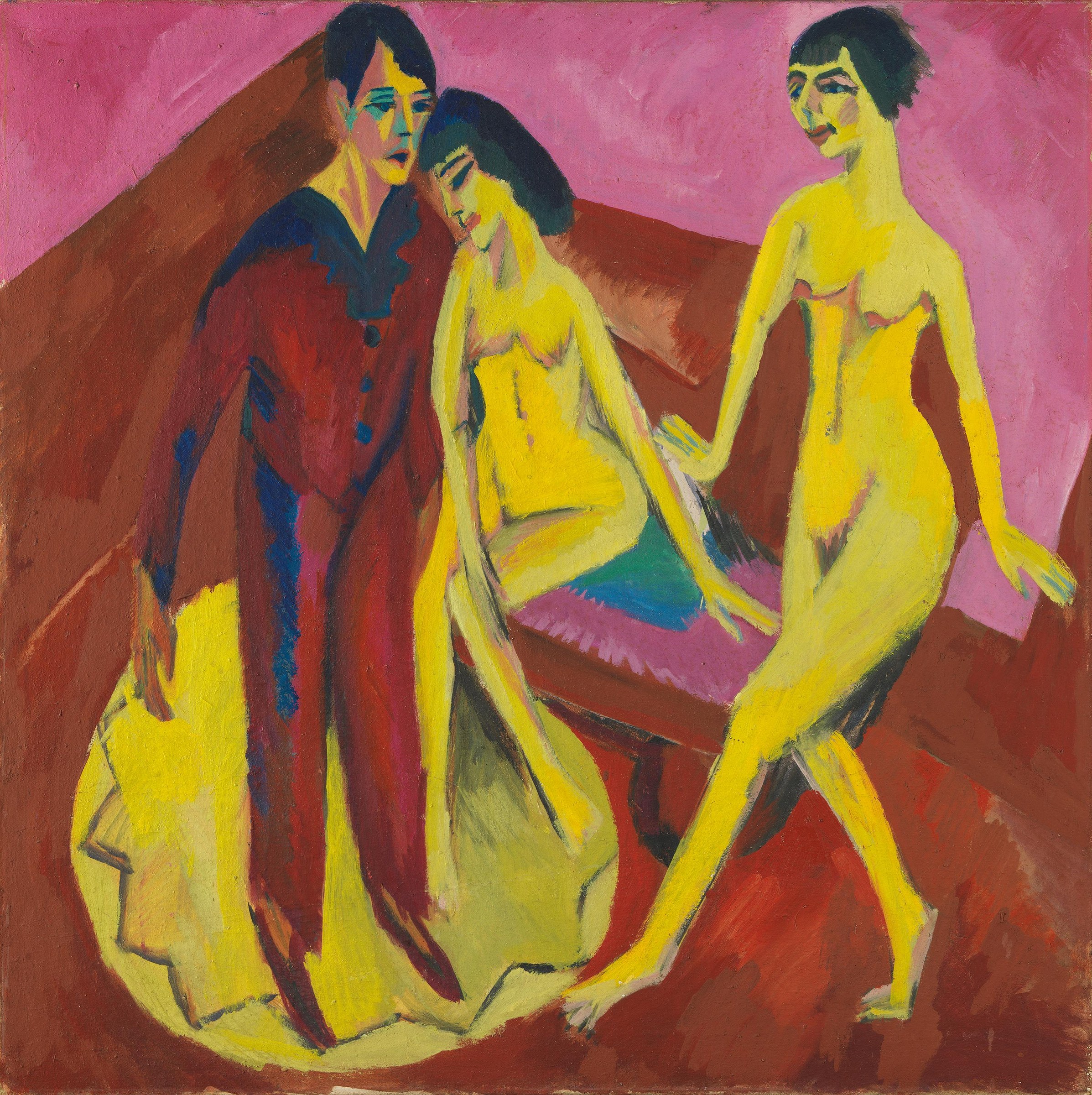
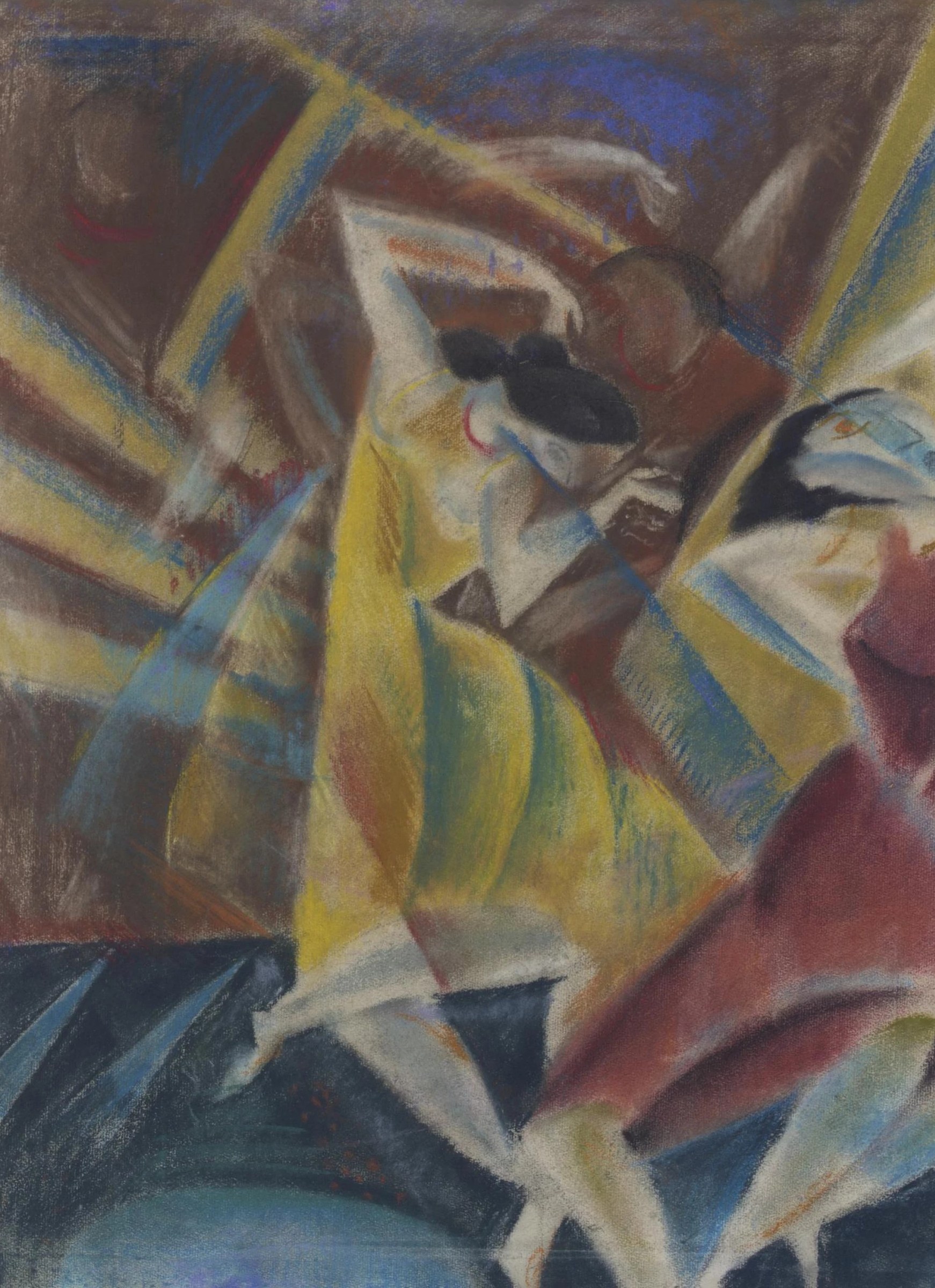
The Dance, by Max Weber
Max Weber
- Medium:
- Oil Painting
- Era:
- 1900-1920 (Ragtime/Early Jazz)
- Source:
- Wikimedia Commons
- Rights:
- Public domain — free to use, share and adapt.
- Recorded as:
- Public Domain
This work is one of the few modernist paintings of its era to take ballroom dance seriously as a subject for cubist analysis, treating it not as folk spectacle or exotic entertainment but as contemporary urban culture worthy of the same formal intensity reserved for still life or portraiture. It offers visual evidence of how early 20th-century artists understood the relationship between mechanical modernity, speed, and bodily movement. For dance historians, it shows how cubism itself—with its multiplication of viewpoints and its emphasis on internal structure—was an almost natural artistic language for representing the physics of turning.
What you are looking at
This cubist composition depicts multiple figures engaged in dynamic movement, their bodies fragmented and reassembled across the canvas in overlapping planes of warm and cool color. The dancers are rendered in shades of cream, ochre, and brown, their forms intersected by bold stripes and bands of yellow, blue, and deep red that structure the composition. The figures appear to be in mid-motion, with limbs extended and torsos twisted, suggesting rapid, energetic movement. The setting is abstracted into geometric planes rather than a literal interior or stage space, though striped bands suggest the architectural framing of a ballroom or dance hall. The overall effect is of motion captured and fractured, the eye moving across the canvas in the rhythm of the dancers themselves rather than settling on any single figure.
The dancing
At least three figures are visible, their bodies interlocking across the composition. The nearest figure, rendered in cream and ochre, displays a dramatically tilted torso and extended limbs suggesting a turn or spin. Adjacent figures share similar dynamic poses. The dancers appear to be in closed or near-closed holds, their forms compressed and elongated by the artist's cubist fragmentation. Limbs extend at acute angles, and the weight of the figures seems to be distributed asymmetrically, capturing the moment of momentum and balance central to ballroom turning.
The dance depicted
Weber depicts ballroom dancers, most likely in the modern social dances of the early 20th century—waltzes, foxtrots, or similar closed-hold partner dances that dominated urban American ballrooms in the 1910s. The fractured, rotational composition itself mirrors the turning action that defines these dances. The paired, interlocking figures and the emphasis on torso rotation support this identification. Weber was documenting a recognizable contemporary leisure activity, but his cubist treatment elevates the ballroom into high modernist subject matter, decomposing the fluid turning action into geometric shards to intensify the viewer's sense of kinetic energy.
How it was made
This is an oil painting on canvas, executed in the cubist vocabulary that Weber had absorbed from European modernism by 1912. The technique allows for simultaneous viewpoints and fractured planes that a photograph or realistic drawing could not achieve. Weber uses warm and cool color relationships and bold directional stripes to guide the eye through the composition rather than relying on linear perspective. The gestural, layered application suggests an artist working rapidly to capture movement itself rather than its static form.
About this work
Weber's *The Dance* is a cubist interpretation of urban American ballroom culture, painted as modernist abstraction at a moment when such social dancing was synonymous with modernity, speed, and jazz-age energy. By 1912, European avant-garde movements had begun to treat everyday subjects—dance included—as worthy of formal experimentation. Weber translates the turning, rotating action of partner dances into a composition that itself seems to turn and fragment before the viewer's eye. The work sits at the intersection of dance history, social history, and art history: it documents a specific dance practice of its moment while using that practice as the vehicle for avant-garde formal innovation. For dancers and historians, it represents an early attempt by a visual artist to capture not the appearance of dance but its internal logic—the momentum, rotation, and counterweight that make ballroom movement possible.
How to look at it
Attend first to the direction of the striped bands—they create a sense of rotational momentum that mirrors the ballroom turn. Notice how no single figure fully occupies the center; the dancers wheel around each other and around the picture plane itself. The artist has chosen not a moment of stillness but the apex of a turn, where weight and balance are most in flux. This is a snapshot of motion, not of repose. The warm and cool color shifts help your eye follow the dancers across the fractured planes, and the geometric language lets you feel the internal structure—the torque, the counterbalance—that makes turning possible.
The artist
Max Weber (1881–1961) was a Russian-born American modernist painter and sculptor who moved to New York in 1891 and became one of the first American artists to fully integrate European cubism and fauvism into his work. He studied in Paris from 1905 to 1908, where he absorbed the innovations of Cézanne, Matisse, and the early cubists. Returning to New York, Weber became a leading figure in American modernism and a fierce advocate for avant-garde practice. He was prolific across painting, sculpture, and printmaking, and his subject matter ranged across Jewish immigrant life, urban landscapes, religious themes, and social scenes like this one. *The Dance* reflects his commitment to finding modernist significance in contemporary American experience.
The period
In 1912, cubism was still a radical and contested innovation in America. Weber was among the vanguard translating it into American art; the Armory Show of 1913 would be the watershed moment for American acceptance of European modernism. Simultaneously, ballroom dancing was at a cultural peak in the United States. Ragtime and early jazz were driving a craze for new social dances—the foxtrot, the one-step, variations on the waltz—and the dance hall was a symbol of modernity, leisure, and social mixing. Weber's decision to paint this subject at this moment reflects both the artistic avant-garde's hunger for contemporary subject matter and the era's fascination with dance as an emblem of speed and machine-age vitality.
Where it lives
The work is recorded as part of an unspecified collection via Wikimedia Commons. The catalogue record provides minimal information beyond title, artist, date, and medium, which is typical of works in distributed digital archives.
Dance in this work
Questions about this work
Is this really a painting of ballroom dancing?
Yes. Weber depicts partnered dancers in the closed or near-closed holds typical of early 20th-century ballroom dances like the waltz and foxtrot. The interlocking bodies and rotational composition capture the turning action that defines these dances. The artist has abstracted the forms using cubism, but the subject is unmistakably social ballroom dance of his own time.
Why would a serious modernist painter choose to paint people dancing?
Because by 1912, dance—especially urban ballroom dancing—was understood as a quintessentially modern phenomenon, emblematic of speed, leisure, and the machine age. The dance hall was a symbol of contemporary life, and the rotating, fractured movements of ballroom dancing offered formal problems that cubism was ideally suited to solve.
What dance style is shown?
The paired, interlocking figures and rotational composition suggest a waltz, foxtrot, or similar standard ballroom turn of the early 1910s. Weber does not depict a specific named choreography but rather the generic movement vocabulary of contemporary American social dancing.
More dance artwork