49 works in this view — arrow keys or swipe to move between them.
Dance in Art · 1850
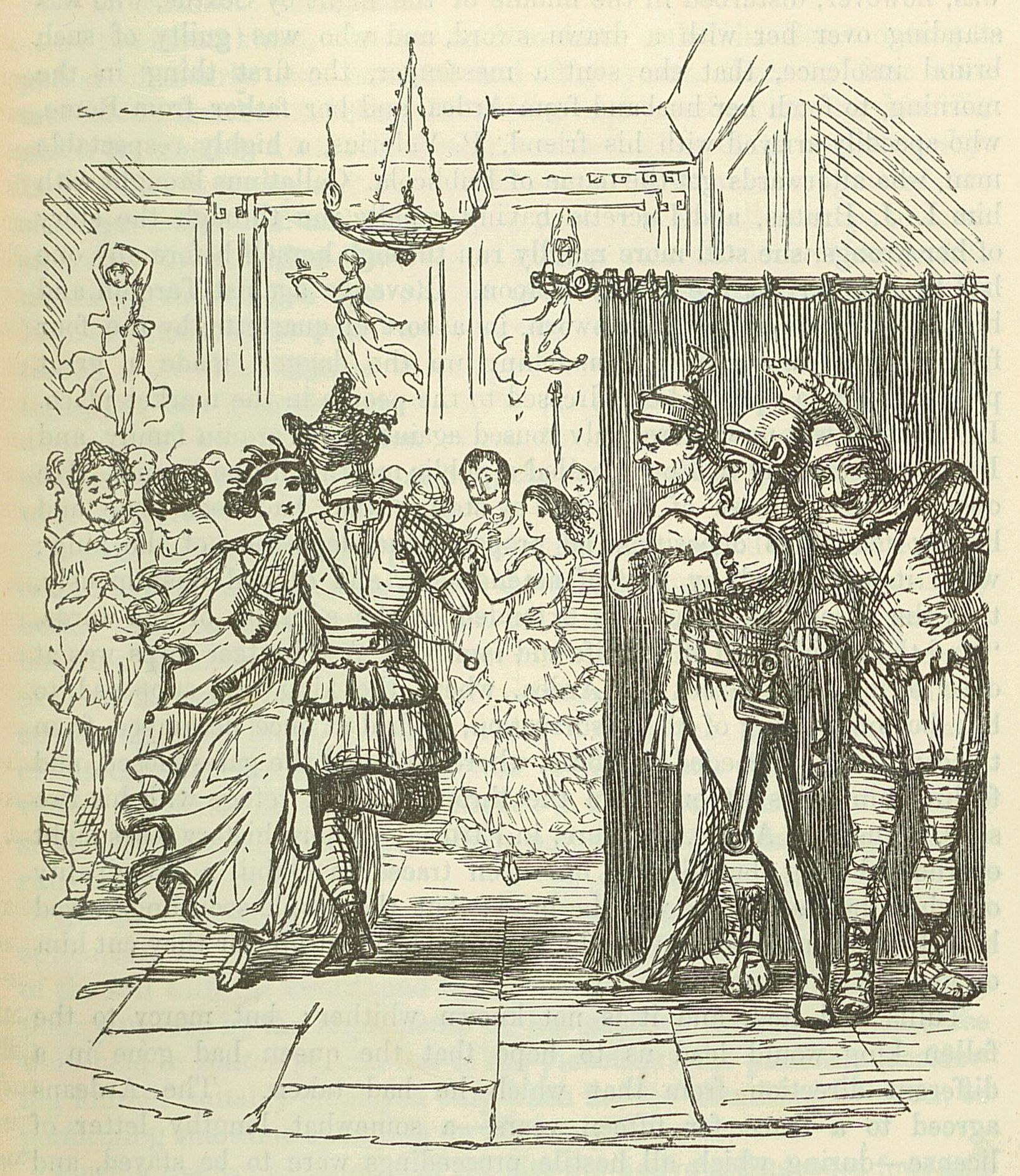
Comic History of Rome p 039 Mrs Sextus consoles herself with a Little Party
John Leech
- Medium:
- Oil Painting
- Era:
- Mid 1800s (Polka Era)
- Source:
- Wikimedia Commons
- Rights:
- Public domain — free to use, share and adapt.
- Recorded as:
- Public Domain
Leech's work documents acrobatic performance in the historical imagination and captures Victorian attitudes toward the theatrical female body. The image shows how Victorian illustrators understood and depicted inverted, extended, and weight-defying poses—skills central to acrobatics and aerial work, yet rarely preserved in the fine art canon.
What you are looking at
A crowded interior scene depicting a Roman banquet or reception in progress. The setting is a columned hall with draped walls, a decorative chandelier overhead, and musicians in the background. In the center foreground, a man in ornate Roman military dress (plumed helmet, decorated breastplate, short skirt) stands among fashionably dressed Roman women in flowing gowns. Several women are executing aerial or acrobatic poses—one suspended upside-down from a rope or apparatus, another arching backward in a dramatic extension. Additional female performers appear mid-leap or in theatrical attitudes. The surrounding guests—men in military dress on the right, women in elaborate period costume on the left—observe the entertainment. The composition is busy and anecdotal, with attention to period detail in costume and architecture.
The dancing
The central focus is on three female performers executing inverted, extended, and aerial poses—bodies arched and suspended in ways that defy ordinary ballroom posture. Their bodies are fully extended, suggesting acrobatic training rather than social dance. The military men to the right stand in static observation, while the fashionable guests maintain upright, formal carriage. The positioning suggests these are trained performers entertaining a stationary audience, not social dancers in reciprocal exchange.
The dance depicted
This is not a social dance scene but an acrobatic or theatrical performance, likely representing Roman circus or entertainment acts. The inverted and aerial poses place this outside the ballroom genres entirely—the women are executing acrobatic feats, possibly on apparatus (ropes, silks, or bars implied by the hanging elements), for entertainment during a banquet. This reflects ancient Roman spectacle culture rather than any codified dance form. The image documents popular entertainment in a historical setting rather than depicting a specific named dance style.
How it was made
This is a wood engraving or steel engraving in black and white, characteristic of Victorian-era book illustration. The fine cross-hatching, precise line work, and capacity for dense detail are typical of engraved reproduction suitable for printing in a bound volume. The technique allowed rapid circulation as a book illustration, making it accessible to middle-class Victorian readers encountering Roman history through humor rather than scholarship.
About this work
This is a satirical engraving from John Leech's *Comic History of Rome*, a mid-19th-century humorous illustrated narrative that presented Roman life through Victorian sensibilities. The scene depicts a social occasion—a lady's entertainment party—interrupted by acrobatic performers, blending historical Roman subject matter with contemporary humor about Victorian social pretension. The work belongs in a dance gallery as evidence of how the 19th century imagined Roman spectacle and entertainment, and as an example of acrobatic performance—a genre rarely documented in fine art but essential to performance history.
How to look at it
Observe the contrast between the static, formally dressed observers and the three suspended, inverted female figures—the artist has frozen a moment of theatrical extremity. Notice how the acrobatic poses are anatomically impossible without training or apparatus, yet are rendered with the same observational precision as the architectural detail and costume. The comic effect depends on recognizing that Victorian audiences found the ancient Roman spectacle both exotic and faintly absurd when filtered through contemporary taste.
The artist
John Leech (1817–1864) was a prolific Victorian satirical illustrator and cartoonist best known for his work in *Punch* magazine. He developed a distinctive style of social commentary through densely detailed, technically assured line work. His collaboration with Gilbert Abbott à Beckett on *The Comic History of Rome* (1847–1852) demonstrated his ability to blend historical subject matter with contemporary social satire, making classical history accessible and entertaining to Victorian readers through visual wit rather than didactic narration.
The period
The 1850s saw growing Victorian interest in classical history, often filtered through comedy and popular entertainment. *The Comic History of Rome* appeared during a period when historical illustration was becoming a major commercial enterprise, and when acrobatic and gymnastic performance was gaining renewed visibility in circuses and music halls. The image reflects both the Victorian appetite for classical spectacle and the contemporary availability of trained acrobats and performers in urban entertainment venues.
Where it lives
This is a page from *The Comic History of Rome by Gilbert Abbott A Beckett*, published by Bradbury, Evans & Co, London, in the 1850s. It is a commercial book illustration, not a unique artwork, and survives in multiple copies. The image reproduced here is sourced from Wikimedia Commons.
Dance in this work
Questions about this work
Is this actually depicting a Roman dance?
No. This depicts acrobatic entertainment during a Roman banquet, not a codified dance form. The inverted and aerial poses are theatrical performance—closer to circus or entertainment acts than to dance. It represents how Victorians imagined Roman spectacle rather than documenting an actual historical practice.
Why would Leech illustrate acrobatic performance in a book about Rome?
Leech's *Comic History of Rome* is a satirical work that uses contemporary Victorian social life as a lens for interpreting classical history. By depicting Roman banquets as opportunities for acrobatic display, Leech is making implicit commentary on Victorian entertainment, fashion, and social performance—using historical setting as a vehicle for social satire.
What does the military dress tell us?
The central figure is dressed as a Roman military officer (identifiable by plumed helmet and decorated cuirass), while the observers include both military men and fashionable civilians. This suggests a scene of high Roman society—a banquet or reception where entertainment was expected—rather than a military context.
More dance artwork