42 works in this view — arrow keys or swipe to move between them.
Dance in Art · 1922
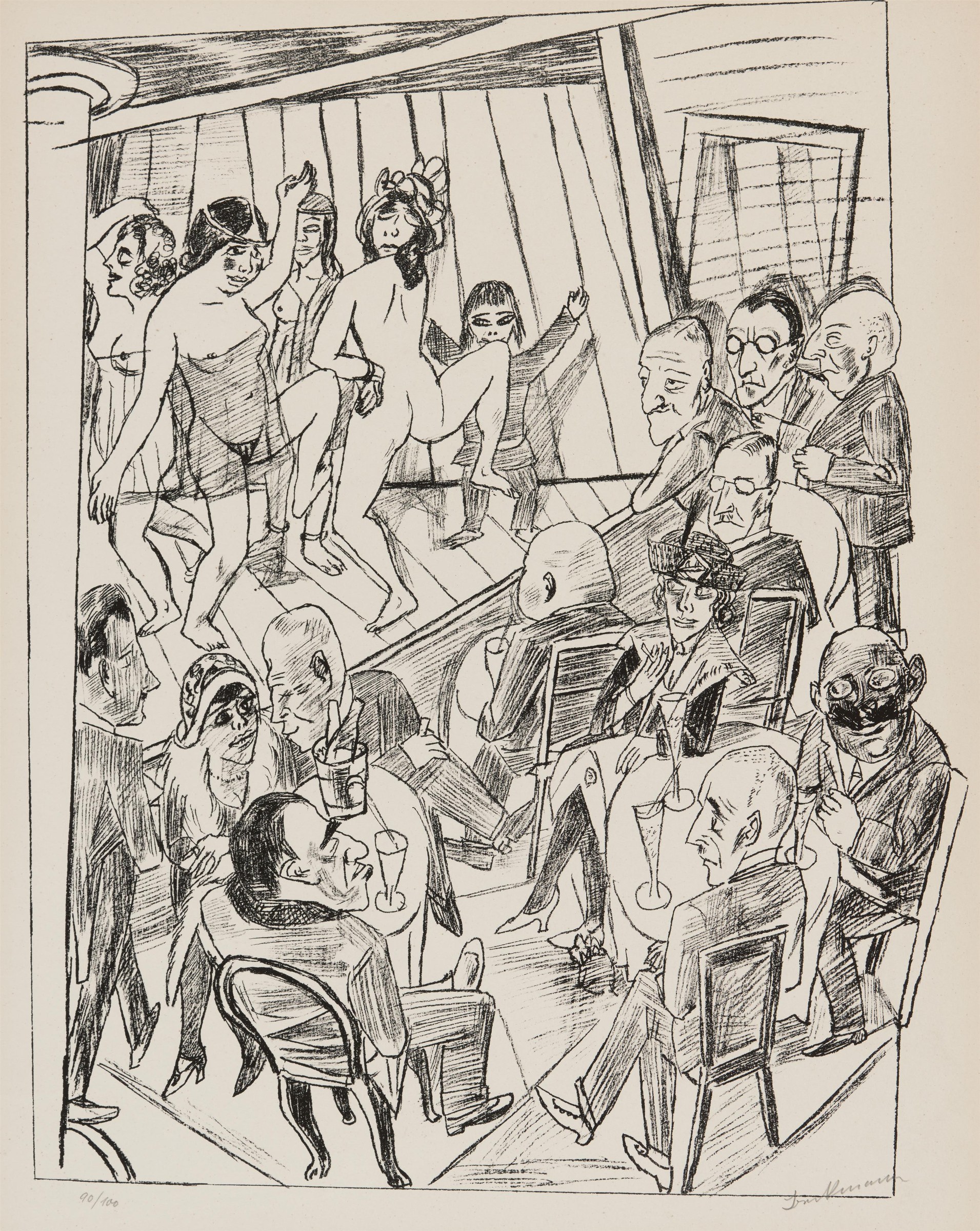
Max Beckmann Striptease 1922
Max Beckmann
- Medium:
- Lithograph
- Era:
- 1920-1950 (Swing Era)
- Source:
- Wikimedia Commons
- Rights:
- Public domain — free to use, share and adapt.
- Recorded as:
- Public Domain
This work is essential for understanding how avant-garde artists engaged with the commercialized female body and the emergence of nude performance as entertainment in the early twentieth century. For historians of dance and performance, it documents a form of spectacle—the Berlin cabaret nude show—that existed outside the categories of 'dance' proper but was nonetheless central to how bodies were displayed, consumed, and moralized in the period. Beckmann's critical distance and formal sophistication elevate what could be mere reportage into a sustained interrogation of spectatorship and commodification.
What you are looking at
This lithograph depicts the interior of a Berlin nightclub or cabaret during the Weimar era, crowded with patrons seated at tables and standing in clusters while nude or near-nude performers occupy a raised platform or stage area suspended by ropes from the ceiling. The composition is densely packed with figures rendered in Beckmann's characteristic angular, expressionistic style—sharp lines, distorted proportions, and flattened perspective create a claustrophobic, morally charged atmosphere. The seated men in suits and hats, some wearing glasses, observe with varying degrees of engagement; their faces register indifference, interest, or discomfort. The performers on stage, rendered with exaggerated anatomies, strike poses or stand passively. Overhead, the stage apparatus—vertical ropes and a horizontal beam—creates a stark geometric framework that formalizes and isolates the performers' bodies. The contrast between the clothed observers and unclothed performers, and between the orderly geometry of the apparatus and the chaotic jumble of bodies below, generates the work's satirical and critical charge.
The dancing
The performers display minimal active movement; they are largely posed or standing stationary, their bodies presented for viewing rather than engaged in balletic or athletic display. Their stances are frontal or three-quarter, with limbs either hanging at rest or raised in simple arm positions. The male observers below sit or stand in the social postures of a nightclub audience—leaning, conversing, gazing upward. The contrast between the static, displayed bodies of the performers and the animated but passive consumption by the audience is the work's compositional core. No dance technique, frame, or partnering is visible; this is presentation and spectatorship, not dance performance.
The dance depicted
This is not a depiction of theatrical or social dance in the traditional sense, but rather a sardonic anatomical display staged as entertainment—specifically, the 'striptease' or 'Nackttanz' (nude dance) that became a commercial spectacle in Berlin cabarets and revue theaters of the 1920s. The title and composition make clear that Beckmann is documenting a form of commercialized eroticism presented under the guise of entertainment. The performers are not executing choreographed movement but rather standing and posing for an audience of paying patrons. This is less a study of dance as technique than of dance as commodified bodily display and the voyeuristic economy surrounding it.
How it was made
This is a lithograph on laid paper from the portfolio *Berliner Reise* (Berlin Journey), a series of ten prints published by I.B. Neumann in Berlin in 1922. Lithography's capacity for bold, gestural line and tonal variation allowed Beckmann to render the scene with both social documentary urgency and expressive distortion. The print medium ensured multiple editions (this is numbered 90/100) and circulation among Berlin's cultured urban audience—viewers who would recognize the venues and social types depicted. Lithography's directness and relative accessibility, compared to painting, positioned it as a medium for contemporary social comment.
About this work
Max Beckmann's *Striptease* is a satirical print documenting the commodification of the female body in Weimar Berlin's entertainment industry. Created as part of a portfolio surveying Berlin's urban landscape in 1922, the work uses expressionist distortion and crowded composition to critique both the commercial nude spectacle and the male voyeurism it stages. While labeled and titled as a dance work, it is better understood as a document of the economic and sexual display economy that had appropriated the language of entertainment—a sharp-eyed record of a specific historical moment and its moral anxieties.
How to look at it
Attend first to the geometric apparatus—the ropes and beam that frame and suspend the performers—and recognize it as the formalized structure that separates display from consumption. Then trace the contrast between the orderly, static bodies of the performers and the animated, individualized faces and postures of the audience below. Look at the faces of the male spectators: Beckmann has rendered them with varied expressions and carefully drawn features, making them psychologically present as viewers in a way the performers are not. The distorted proportions and angular lines create both documentary specificity and moral expressionism—a formal style that conveys the artist's critical perspective. The work is not neutral reportage but ethical commentary embedded in form.
The artist
Max Beckmann (1884–1950) was a German painter, printmaker, and sculptor whose work bridged Expressionism and New Objectivity (Neue Sachlichkeit). He was deeply engaged with contemporary urban life and moral questions about desire, violence, and commerce. The *Berliner Reise* series documents the city's nightlife, street scenes, and theaters with both fascination and critique. Beckmann's prints and paintings from the 1920s frequently depict cabaret scenes, performers, and the demimonde, treating these subjects with formal sophistication and psychological complexity. His work was later condemned by the Nazi regime as 'degenerate' and he emigrated in 1947.
The period
The 1920s in Berlin witnessed an extraordinary explosion of cabaret, revue theater, and popular entertainment, driven by post-war urban energy, commercial expansion, and new freedoms in representation of the body. The 'Nackttanz' (nude dance) and striptease emerged as commercially successful spectacles, often framed as modernist performance or artistic display but functioning primarily as erotic commodities for male audiences. Simultaneously, avant-garde artists and intellectuals were intensely focused on documenting and critiquing this urban culture. Beckmann's lithographs coincide with Otto Dix's similarly sardonic paintings of Berlin nightlife and the broader Weimar cultural moment of simultaneous modernization, eroticism, and social critique. The economic instability of the early 1920s (hyperinflation, 1923) and rising political extremism formed the dark backdrop to this glittering, anxious entertainment culture.
Where it lives
This work is part of the *Berliner Reise* portfolio of ten lithographs published by I.B. Neumann in Berlin in 1922 (Werkverzeichnis Hofmaier 216 B). This is a numbered edition print (90/100), indicating it was intended for circulation among collectors and print enthusiasts. The source is Wikimedia Commons; current holding collection is not recorded.
Dance in this work
Questions about this work
Is this actually a dance?
Not in the technical sense of choreography, technique, or structured movement. It is a depiction of nude performance or display staged as entertainment in a Berlin cabaret. Beckmann is documenting a commercial spectacle that used the language of 'Nackttanz' (nude dance) but functioned primarily as erotic commodification. The work critiques this confusion between art, dance, and commerce by rendering the performers as static, passive bodies on display rather than active dancers.
Why is Beckmann interested in this subject?
Beckmann was committed to documenting Weimar urban culture in all its modernity, contradiction, and moral complexity. The nightclub scene encapsulates key themes of his work: the commodification of the body, the psychology of spectatorship and desire, the relationship between art and commerce, and the social realities beneath Weimar's glittering surface. The *Berliner Reise* portfolio is a systematic inventory of the city's contemporary life.
What was the 'Nackttanz' in 1920s Berlin?
The Nackttanz (nude dance) was a form of commercial entertainment that emerged in Berlin cabarets and revue theaters, particularly after World War I. Performers presented themselves nude or near-nude in poses, tableaux vivants, or minimal choreography, often framed as art or modernist performance but functioning primarily as erotic spectacle for paying audiences. It was part of Berlin's broader culture of sexual liberalism and commercial entertainment that defined the Weimar era.
More dance artwork