49 works in this view — arrow keys or swipe to move between them.
Dance in Art · 1912
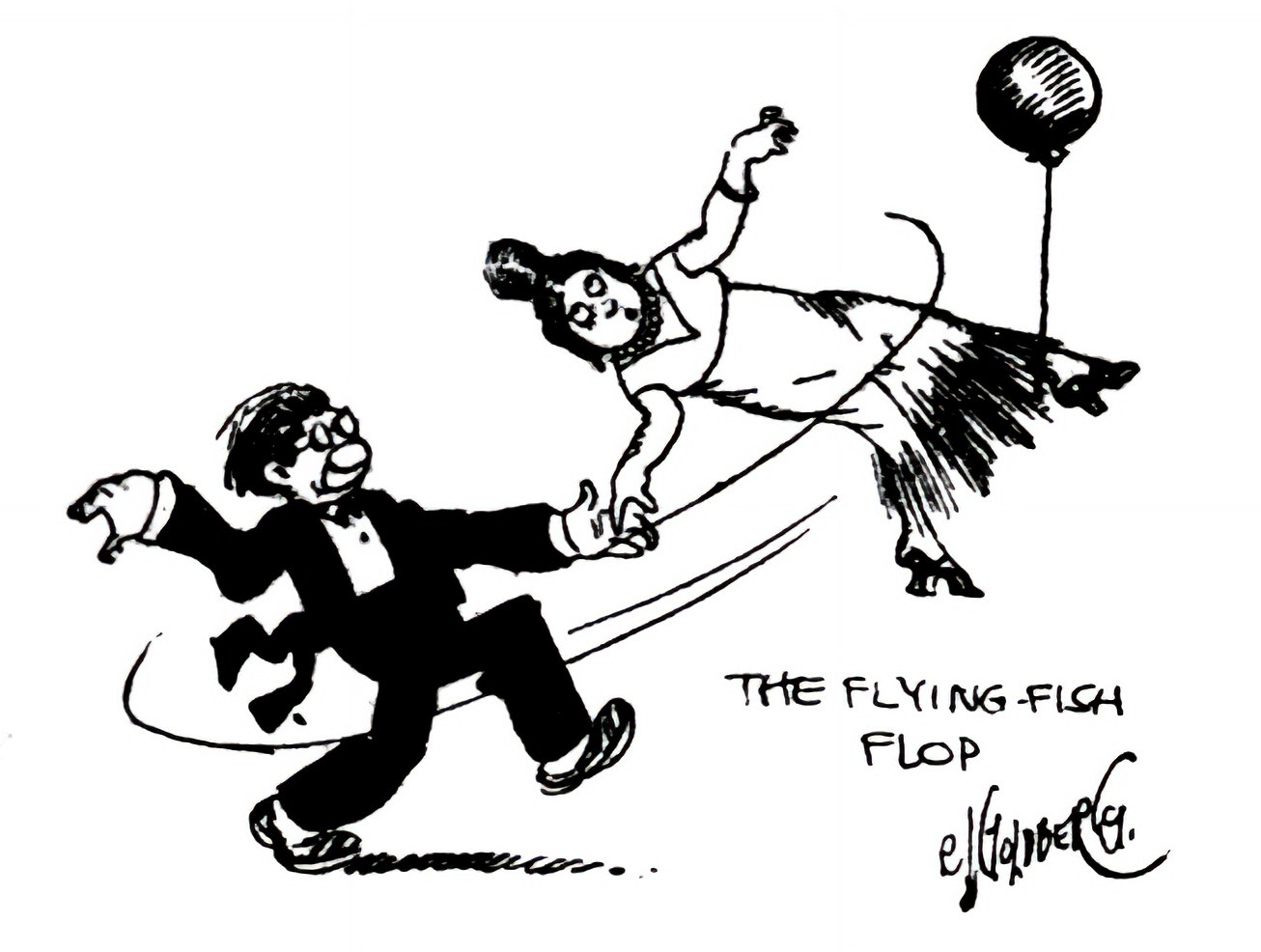
Society Dances to Succeed the Texas Tommy and Dallas Dip - Goldberg 1912 (cropped)
Rube Goldberg
- Medium:
- Oil Painting
- Era:
- 1900-1920 (Ragtime/Early Jazz)
- Source:
- Wikimedia Commons
- Rights:
- Public domain — free to use, share and adapt.
- Recorded as:
- Public Domain
The image is a crucial historical document of press attitudes toward early 20th-century social dance innovations. It shows how dances like the Texas Tommy and Dallas Dip—which were genuine developments in African American and working-class dance culture—were received with mockery and dismissal by mainstream white publications. The cartoon's approach of inventing an even more absurd dance to ridicule real ones reveals the period's discomfort with rapid social change and new forms of cultural expression originating outside elite circles.
What you are looking at
A cartoon illustration shows a man in formal evening dress (tuxedo with white shirt front) being pulled along by a woman in a short, dark, fringed dress suggestive of 1910s fashion. The woman is airborne, leaping dramatically upward with one leg extended and one arm raised toward a balloon held aloft on a stick. The man, drawn with exaggerated features including a prominent nose, is depicted in mid-stride, leaning back slightly as he's dragged forward. The style is sketchy and energetic, with bold black ink lines and cross-hatching for shading. The title "THE FLYING FISH FLOP" appears handwritten at the bottom left, with what appears to be the artist's signature (possibly "E. Hadwiger") below it. The composition captures a moment of wild abandon and absurdist physical comedy.
The dancing
Two figures in a pulling relationship: the woman is suspended in mid-leap, her body stretched vertically with one knee raised and the opposite arm extended upward in an exaggerated reach toward the balloon. The man's posture shows resistance or slack—his knees bent, torso tilted back, suggesting he is being pulled rather than leading. The hold between them is a clasped hand connection. Both figures display the loose-jointed, caricatured anatomy typical of early 20th-century cartoon illustration, with elongated limbs and exaggerated proportions that prioritize graphic impact over anatomical accuracy.
The dance depicted
This is a satirical illustration of novelty dance crazes from 1912. The caption states it shows a dance "supposed to succeed" the Texas Tommy and the Dallas Dip—two vernacular social dances that swept America in the early 1910s. The "Flying Fish Flop" is invented for comic effect: the absurdist title and the impossible physics of the gesture (a woman levitating while clutching a balloon) mock the faddish nature of such crazes. The work documents not an actual dance but the cultural anxiety around rapidly changing social dance styles and their perceived ridiculousness. The Texas Tommy and Dallas Dip were real, low-status social dances associated with working-class African American and cross-racial urban dance halls; this cartoon's exaggeration reflects the mainstream press's satirical treatment of dances it viewed as crude or undignified.
How it was made
The record states "Oil Painting," but the image characteristics strongly suggest this is a cartoon or ink drawing, likely lithographic or printed reproduction. The loose, sketchy line work, the use of solid blacks and cross-hatching rather than modulated paint, the handwritten title and signature, and the publication context (The San Francisco Call, 25 August 1912) all point to a newspaper cartoon format. If an oil painting exists as the original, this image is a reproduction of it, but the visual evidence suggests the work was conceived as a line-based newspaper illustration designed for rapid printing and mass circulation. The technique allowed for broad, legible caricature and permitted the kind of distortion and exaggeration that made the satire effective.
About this work
This is a newspaper cartoon published in the San Francisco Call in August 1912, satirizing the ephemeral social dance crazes of the early 1910s. Rather than depicting an actual dance practice, it invents an absurdist "Flying Fish Flop" to mock the phenomenon of faddish dances and the public's voracious consumption of novelty. The work is a primary source for how mainstream print media portrayed vernacular and social dance of the period—with mockery and caricature rather than respect or understanding. It reveals cultural anxieties about the rapid proliferation of new dances and their association with working-class and African American culture. The exaggerated physicality and impossible gesture capture the satirist's intent: to render these dances ridiculous through hyperbole.
How to look at it
The cartoon freezes a moment of maximum physical distortion and absurdity: the woman at the apex of her leap, the man caught in the drag behind her. The artist has exaggerated the body angles and proportions to make the movement appear ridiculous and impossible. The upward pull toward the balloon serves as the visual punch line—an object with no clear relationship to dance, included only to heighten the sense of arbitrary, pointless motion. Look at how the man's resistance (his bent knees, his backward tilt) reads against the woman's aerial abandon: this relationship of drag and resistance is the core gesture. The sketch style itself—rapid, loose, unpolished compared to fine art traditions—signals that this is ephemeral, topical, meant to be consumed quickly in a newspaper and discarded.
The artist
The work is attributed to Rube Goldberg, the engineer, inventor, and cartoonist best known for his satirical drawings and his elaborate machines designed to perform simple tasks in absurdly complex ways. Goldberg worked as a cartoonist for the San Francisco Call from 1907 to 1917, before gaining national fame through syndicated cartoons. His style combined exaggeration, physical comedy, and social satire. This image is characteristic of his newspaper work during this period: topical, quick-witted, and rooted in contemporary social anxieties. The signature visible in the image supports Goldberg's authorship.
The period
The early 1910s saw an explosive proliferation of new social dances emerging from African American and working-class urban communities, particularly in cities like New York, San Francisco, and New Orleans. The Texas Tommy and Dallas Dip were among the first wave of these dances to achieve mainstream visibility. They coincided with the rise of ragtime and early jazz, the expansion of dance halls and cabarets, and a broader generational rebellion against Victorian propriety in social dancing. Mainstream newspapers and magazines responded with a mixture of fascination and moral panic. Goldberg's 1912 cartoon is part of this discourse of satire—the press simultaneously reported on, mocked, and inadvertently promoted these crazes. The cartoon's appearance in the San Francisco Call reflects the city's role as a center of dance innovation and a site of cultural anxiety about rapid social change.
Where it lives
The work was published in The San Francisco Call on 25 August 1912, a major San Francisco newspaper. This image is a reproduction of that publication, sourced from Wikimedia Commons. As a newspaper cartoon, the original published version is the primary historical artifact; any underlying oil painting (as the record states) may exist but is not the form in which the work circulated or had cultural impact.
Dance in this work
Questions about this work
Did the 'Flying Fish Flop' actually exist as a dance?
No. The "Flying Fish Flop" is an invention of the cartoonist, created to satirize the real dances it names—the Texas Tommy and Dallas Dip. The exaggerated, impossible movement (the woman levitating while pulling a balloon) is deliberate satire, not a record of actual steps or technique.
What were the Texas Tommy and Dallas Dip?
Both were real social dances that emerged in African American and working-class communities in the early 1910s and became briefly fashionable in mainstream American culture. They were energetic, improvised dances associated with ragtime music and urban dance halls. Mainstream newspapers treated them with skepticism and mockery, viewing them as crude or undignified compared to ballroom standards.
Why did Goldberg draw this cartoon?
The cartoon is topical social satire, responding to the real phenomenon of dance crazes. By inventing an even more absurd dance, Goldberg mocked the public's appetite for novelty and the seemingly endless proliferation of new fads. It's a commentary on fashionability, fickleness, and the anxiety that new and unfamiliar social practices provoked in mainstream culture.
Is this a painting or a drawing?
The record lists it as an oil painting, but the visual evidence—the sketch-like line work, the solid blacks, the handwritten title, and its publication in a newspaper—strongly suggests it is a cartoon or ink drawing, likely reproduced in print. Whether an oil painting exists as an underlying original is unclear from the current record.
More dance artwork