49 works in this view — arrow keys or swipe to move between them.
Dance in Art · 1912
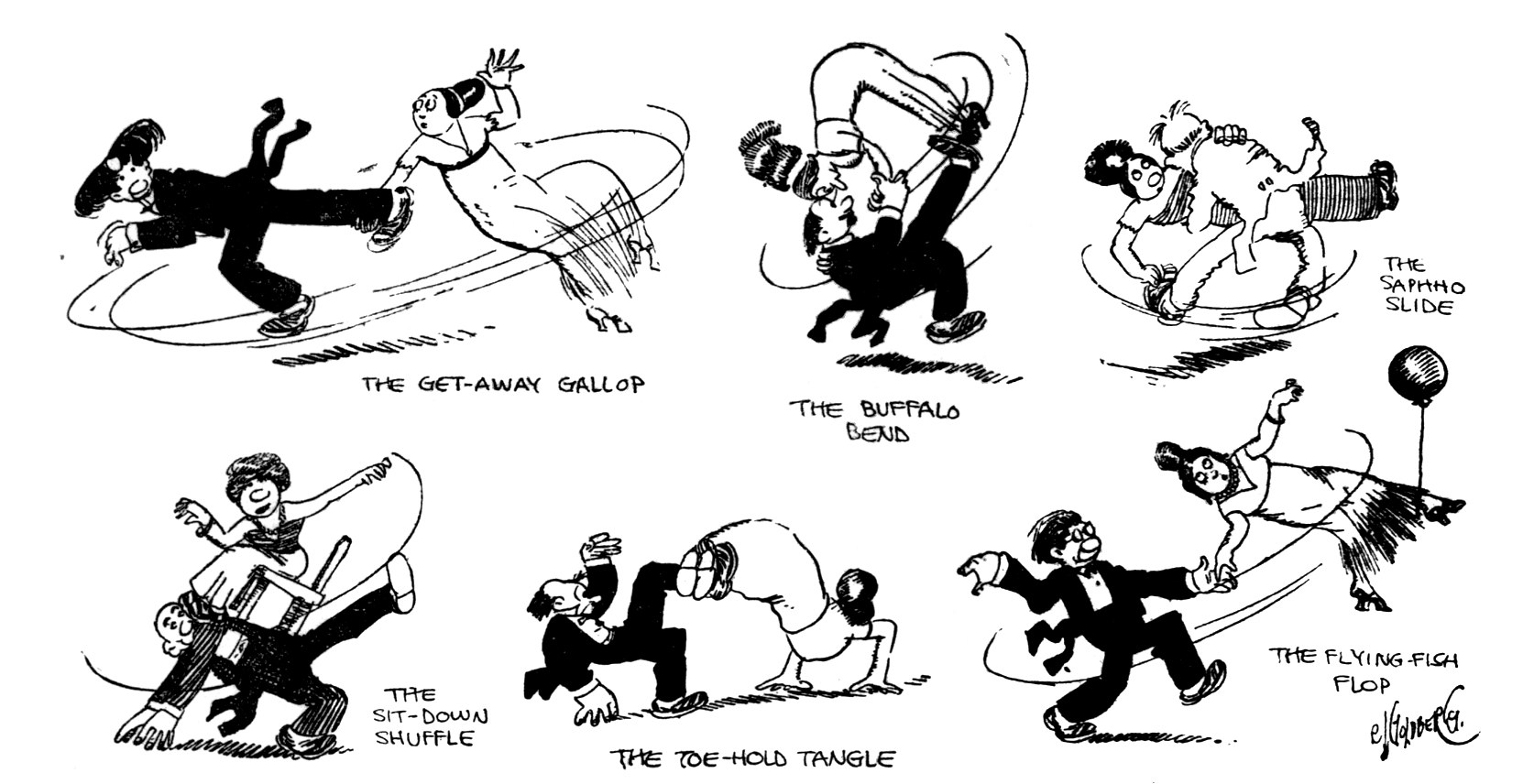
Society Dances to Succeed the Texas Tommy and Dallas Dip - Goldberg 1912
Rube Goldberg
- Medium:
- Oil Painting
- Era:
- 1900-1920 (Ragtime/Early Jazz)
- Source:
- Wikimedia Commons
- Rights:
- Public domain — free to use, share and adapt.
- Recorded as:
- Public Domain
This image is one of the earliest visual documents of ragtime-era dances at the moment they entered mainstream American consciousness, and it shows how that entry was mediated through ridicule and caricature. For dance historians, it is invaluable evidence of what movements were considered shocking or novel in 1912, what the dances were called, and how white middle-class culture received them. For art historians, it is a signature example of Goldberg's early work as a newspaper cartoonist, before he became famous for his contraption drawings.
What you are looking at
This is a cartoon strip presenting six labeled dance moves in a single composition. The drawing is executed in bold black line work with solid silhouettes and minimal interior detail. Each vignette shows exaggerated, dynamic figures caught mid-motion against white space, with curved lines beneath their feet suggesting movement or the arc of the dance floor. The figures wear 1910s dress: men in dark suits with bow ties, women in high-waisted dresses and elaborate hats. The "Get-Away Gallop" shows a couple in profile, the woman's leg extended high, the man appearing to pull away. The "Buffalo Bend" depicts a figure doubled backward, arms extended. The "Sapho Slide" shows two figures in close contact, leaning. The "Sit-Down Shuffle" features a seated dancer with exaggerated arm gestures. The "Toe-Hold Tangle" shows two figures in a tight, interlocked pose. The "Flying-Fish Flop" captures a figure airborne, holding a balloon, one leg high, the other bent, in near-acrobatic extension. Every pose is designed for comic effect through distortion and impossible-seeming contortions.
The dancing
The bodies throughout are drawn in a cartoonist's vocabulary: elongated limbs, impossible flexibility, articulated joints that suggest rubber. Unlike dance instruction or documentation, these figures are not demonstrating technique but mocking exaggeration. The holds are loose or theatrical rather than the precise frames of ballroom dance. Arms are flung wide, legs kick at odd angles, heads tilt and bodies arch. The figures appear to be individuals or unbalanced pairs rather than partners in a closed or even coherent frame. The artist has prioritized visual comedy—contortion, imbalance, and the grotesque—over any accurate representation of technique or proper alignment.
The dance depicted
These are named dances of the ragtime era, the immediate predecessors to which (the Texas Tommy and Dallas Dip) are mentioned in the existing description. The Texas Tommy, emerging in African American communities in San Francisco around 1910–1911, featured hip movement, rhythm changes, and a characteristic kick. The Dallas Dip involved a dramatic backward bend with the partner supporting. The moves shown here—with titles like "Buffalo Bend" and "Flying-Fish Flop"—are invented names in a similar spirit, likely inspired by or parodying the real dances then sweeping American ballrooms. The cartoon documents not the dances themselves but public anxiety and fascination with their wild movements and energetic style. These dances were genuinely performed in dance halls and at social events, but this image is journalistic satire of their perceived excess, not a dance document.
How it was made
This is a cartoon or comic illustration, most likely a pen-and-ink drawing reproduced as a newspaper illustration. The record states it was published in *The San Francisco Call* on August 25, 1912, which establishes its original medium as letterpress newsprint. The high-contrast black-and-white line work is suited to fast newspaper reproduction and required no color separation. The style—bold outlines, solid fills, minimal shading, and energetic contour—is characteristic of early 20th-century newspaper cartooning. Such images were drawn for immediate consumption and topical commentary, and this one was designed to reach a broad general readership the morning after publication.
About this work
This is a cartoon strip by Rube Goldberg published in the San Francisco Call in August 1912, showing six exaggerated parodies of new ragtime dances that had just begun to dominate American ballrooms. The image combines documentary interest—it names and references real dances of the moment—with journalistic satire, using the cartoonist's standard vocabulary of distortion and physical impossibility to mock the dances' unfamiliar energy and hip-heavy movement style. The work captures a moment of cultural anxiety: these dances, many of them emerging from African American communities, were spreading rapidly into mainstream white venues, and the press was divided between fascination and alarm. Goldberg's cartoon channels that alarm through comedy, rendering the dancers as grotesque, dislocated figures whose bodies obey no natural law. Yet the very fact that he chose to draw them, name them, and publish them in a major newspaper is itself evidence of their cultural force.
How to look at it
The viewer should recognize that Goldberg is not documenting these dances accurately but caricaturing them. Each pose is frozen at the moment of greatest exaggeration—the highest kick, the deepest bend, the most awkward interlocking—not at a natural balance point. The curved lines beneath the feet are Goldberg's standard notation for dynamic motion or instability, suggesting that these dancers are permanently off-balance. The labels are crucial: they are the artist's own inventions, playing on the real names (Texas Tommy, Dallas Dip) with absurdist humor (Buffalo Bend, Flying-Fish Flop). The visual style—solid silhouettes, minimal anatomy—reduces the figures to pure action and posture, which is where the comedy lies. A viewer should ask: what about these movements was considered shocking or undignified by 1912 standards, and how is Goldberg's distortion a form of social commentary?
The artist
Rube Goldberg (1883–1970) was an American cartoonist, engineer, and inventor famous for designing complex contraptions that performed simple tasks in roundabout ways. Early in his career, after training as an engineer, he worked as a cartoonist and illustrator for major newspapers, including the San Francisco Call, the New York Tribune, and the New York Evening Journal. His work combined sharp social observation with exaggerated physicality, often satirizing contemporary fads, technology, and social trends. By 1912, he was already a well-known newspaper cartoonist; his later fame came from the mechanical drawings that became synonymous with his name.
The period
In 1912, American ballroom culture was undergoing rapid change. The Texas Tommy and Dallas Dip, which had emerged in San Francisco's African American dance halls around 1910–1911, were spreading into mainstream (white) dance venues and causing genuine controversy. These dances featured energetic hip and body movement, breaking with the stiff, waltz-based ballroom norms of the Victorian era. The press—especially in conservative and middle-class circles—treated new dances as harbingers of moral decline. Simultaneously, ragtime music and jazz were beginning their rise to dominance in American popular culture. Newspapers ran illustrations, articles, and editorials about the "dance craze," and cartoonists seized on the subject as topical comedy. Goldberg's cartoon sits squarely in this moment of rapid cultural change and media panic about youth, race, and modern manners.
Where it lives
This cartoon was published in *The San Francisco Call*, a major daily newspaper, on August 25, 1912. The record indicates the source as Wikimedia Commons, suggesting it has been digitized from a newspaper archive. It is not cataloged to a museum collection. As a newspaper cartoon, it was originally produced for single-day consumption and mass reproduction via letterpress; its survival depends on newspaper library preservation.
Dance in this work
Questions about this work
Are these real dances or made-up names?
The Texas Tommy and Dallas Dip were real dances emerging from African American communities in San Francisco around 1910–1911. The six dances shown here—Get-Away Gallop, Buffalo Bend, Sapho Slide, Sit-Down Shuffle, Toe-Hold Tangle, Flying-Fish Flop—appear to be Goldberg's invented parodies, playing on the style and spirit of the real ones. The cartoon is satirizing the era's dance craze as a whole, not documenting specific choreography.
Why are the figures drawn so distorted?
This is newspaper cartoon style: exaggeration serves both comedy and social commentary. By rendering the dancers as grotesque, rubber-limbed figures, Goldberg invites readers to see the dances themselves as undignified and chaotic. The distortion is a form of ridicule—a way of saying these movements violate proper ballroom decorum. It is also a visual shorthand for energy and instability, used in newspaper comics to convey rapid motion and disruption.
What was the Texas Tommy?
The Texas Tommy was an early ragtime dance that emerged in African American dance halls in San Francisco around 1910–1911. It featured rhythmic hip movement, weight shifts, and a characteristic swing-out or break position. It was one of the first dances to break with the closed, formal ballroom frame, and its spread into mainstream venues sparked panic among conservative Americans who saw it as immoral and a sign of cultural decline.
Why did early 20th-century newspapers worry about new dances?
New dances like the Texas Tommy and ragtime moves were associated with African American culture, youth rebellion, and sexual looseness. Conservative critics saw them as threats to social order and moral standards. Newspapers ran editorials warning against the dances, clergy condemned them, and municipal authorities sometimes tried to ban them. Goldberg's cartoon participates in this cultural panic, though through humor rather than outrage.
More dance artwork