49 works in this view — arrow keys or swipe to move between them.
Dance in Art · 2019
Tutu (PSF)
Pearson Scott Foresman
- Medium:
- Oil Painting
- Dance:
- Ballet
- Source:
- Wikimedia Commons
- Rights:
- Public domain — free to use, share and adapt.
- Recorded as:
- Public Domain
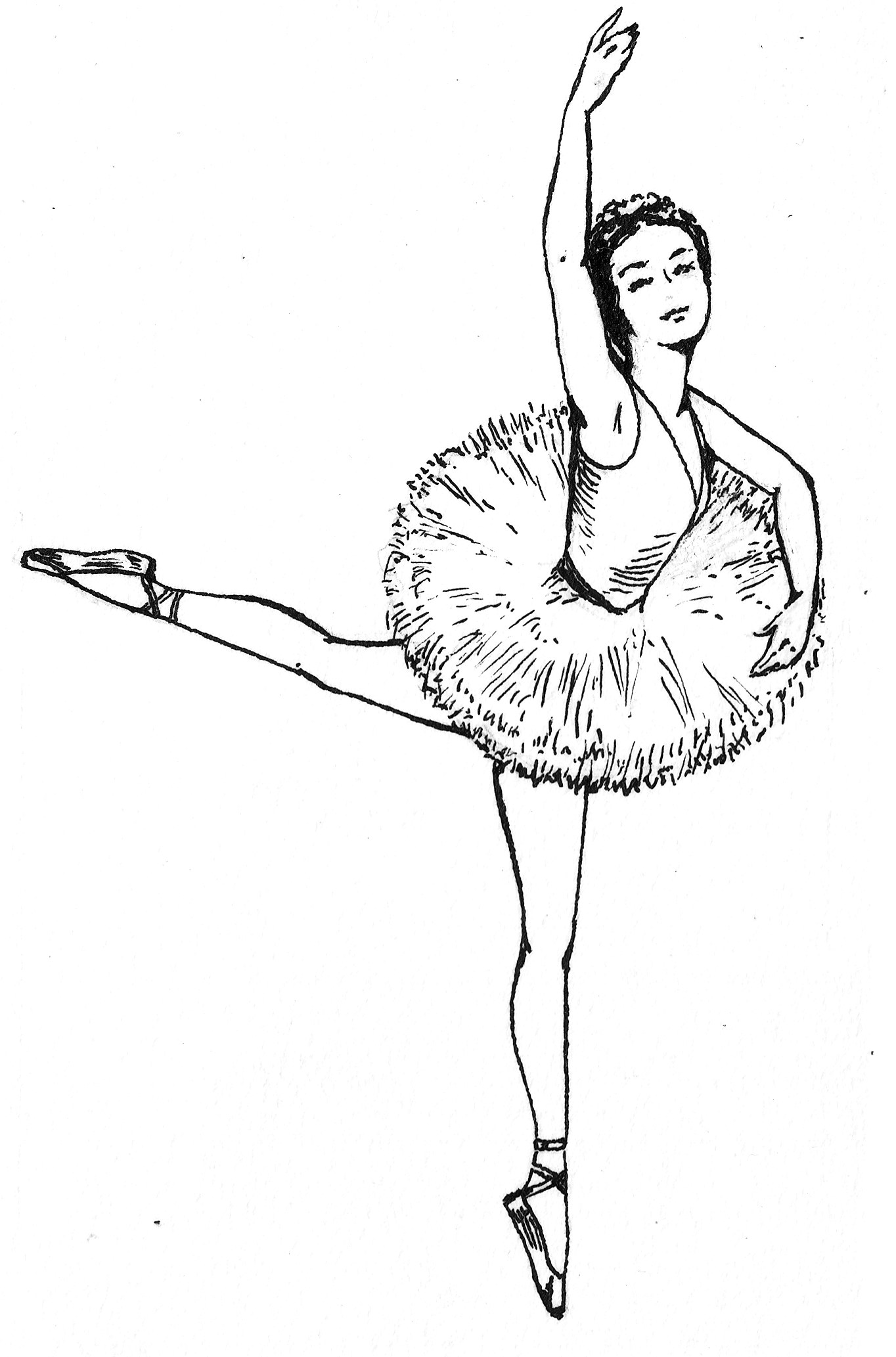
The tutu is not merely costume; it is a technology that made classical ballet visible and iconic. This drawing documents the standard form of that technology at a stage when ballet was established as an international, academically regulated form. For dancers and historians, the image is valuable as a visual reference for the proportions, positions, and aesthetic principles that define classical technique.
What you are looking at
A single ballerina is captured mid-leap against a plain white background, her body weightless and suspended. She wears a classical ballet costume: a fitted bodice and a short, voluminous tutu with pronounced horizontal layers that radiate outward from her waist. Her dark hair is pulled up in a neat style, and she wears pointe shoes. One arm extends upward in an elegant line while the other is held at her side; one leg is extended horizontally to the side while the supporting leg is straight beneath her. The drawing style is spare and linear, executed in black ink, with minimal modeling or shadow. The composition isolates the figure completely, emphasizing the geometry of the pose and the classical lines of the body.
The dancing
A single dancer in a classic balletic position, likely an arabesque or attitude devant. The supporting leg is extended and rotated outward from the hip; the working leg lifts horizontally. The upper body is held upright with one arm raised overhead and the other at hip level—a frame that emphasizes verticality and control. The extension is high and clean, the lines long and unbroken. The pose demonstrates the rotational facility and turnout that classical ballet demands, and shows a dancer trained in an academically pure technique.
The dance depicted
This is unambiguously classical ballet. The pointe shoes, the short tutu, the strict turnout, the specific arm and leg positions, and the overall deportment are all signatures of the academic ballet tradition. The tutu itself—short, stiff, and structured—is the costume of the classical ballet stage, typical of late-19th and 20th-century professional ballet. The pose is canonical in the vocabulary, one that any trained dancer would recognize. Without additional context, the specific ballet is not identifiable, but this depicts the technical and aesthetic ideal of classical ballet.
How it was made
This is a line drawing in black ink on white paper, likely made by pen or fine brush. The technique is economical: the artist uses single continuous or interrupted lines to describe the figure, with minimal hatching and no modeling through tone. This approach emphasizes contour and proportion, making it an effective tool for teaching, documentation, or stylistic simplification. The sparse, graphic quality suggests the image may be derived from a photograph or used as a reference illustration—possibly a teaching diagram or an exercise in simplification. The lack of signature, date mark, or detailed rendering is consistent with commercial or pedagogical use rather than fine art.
About this work
This is a straightforward representational drawing of a classical ballet dancer in a canonical pose. It captures the visual essence of academic ballet training: the costume, the body position, the physical ideal. The image belongs in a dance archive because it documents the vocabulary and visual conventions of classical ballet at a moment when that tradition was the dominant form of theatrical dance. The drawing's simplicity and clarity have made it widely reproducible and it appears to have been created for use as a reference image or instructional material. As a work without clear provenance or attribution, it represents the kind of utilitarian dance documentation that is often overlooked in art history but essential to understanding how dance has been taught, imagined, and circulated.
How to look at it
Observe the compression of the tutu—how the layers are drawn as sharp horizontal bands radiating from the body, creating a stiff, sculptural form. Notice the proportion: the skirt is quite short relative to the dancer's height, exposing the full length of the leg and allowing visibility of the pointe shoe and the line of the supporting leg. The extended arm and raised leg are positioned to show off the dancer's facility in turnout and height of extension. The pose is not a candid moment but a display position, designed to demonstrate technical capability and classical alignment.
The artist
The record lists the artist as Pearson Scott Foresman, a major 20th-century educational publisher. The image may be a commissioned illustration or a photograph adapted for instructional use. No individual artist is named.
The period
By the 20th century, classical ballet had become a globally distributed, codified system taught through printed instruction and photographic documentation. The tutu had been the standard costume of professional ballet dancers since the Romantic era of the 1830s–1840s, but the short, geometric tutu shown here became the norm in classical ballet as codified by the Imperial Russian school and its inheritors. The drawing's date of 2019 in the record appears inconsistent with its style and media; the image is likely much older and has been re-catalogued or scanned into a modern database.
Where it lives
The image was sourced from Wikimedia Commons. It is attributed to Pearson Scott Foresman, an educational publishing company. No specific holding collection is recorded.
Dance in this work
Questions about this work
Why is the skirt called a tutu?
The term comes from French ballet slang, possibly from a child's word for buttocks or skirt. By the Romantic era, the term was in use for the layered skirts worn by ballerinas. The word has remained standard in English-language ballet since the mid-19th century.
What is the difference between a tutu and other ballet skirts?
A tutu is characteristically short, stiff, and geometric, constructed from layers of net or tulle sewn to a firm waistband. It was designed to display the dancer's legs, footwork, and technique. Longer, softer romantic tutus were common in the 1830s–1840s; the shorter classical tutu became standard in the late 19th century Russian Imperial ballet.
Why is this drawing so simple?
The economy of line suggests the image was made for instructional or reference purposes—to teach proportion, position, and vocabulary rather than to capture a specific performance or moment. Educational publishers like Pearson Scott Foresman used such simplified drawings in textbooks and guides.
More Ballet artwork