39 works in this view — arrow keys or swipe to move between them.
Dance in Art · 1935
Ishikawa Tanz
Ishikawa Toraji
- Medium:
- Woodcut
- Era:
- 1920-1950 (Swing Era)
- Source:
- Wikimedia Commons
- Rights:
- Public domain — free to use, share and adapt.
- Recorded as:
- Public Domain
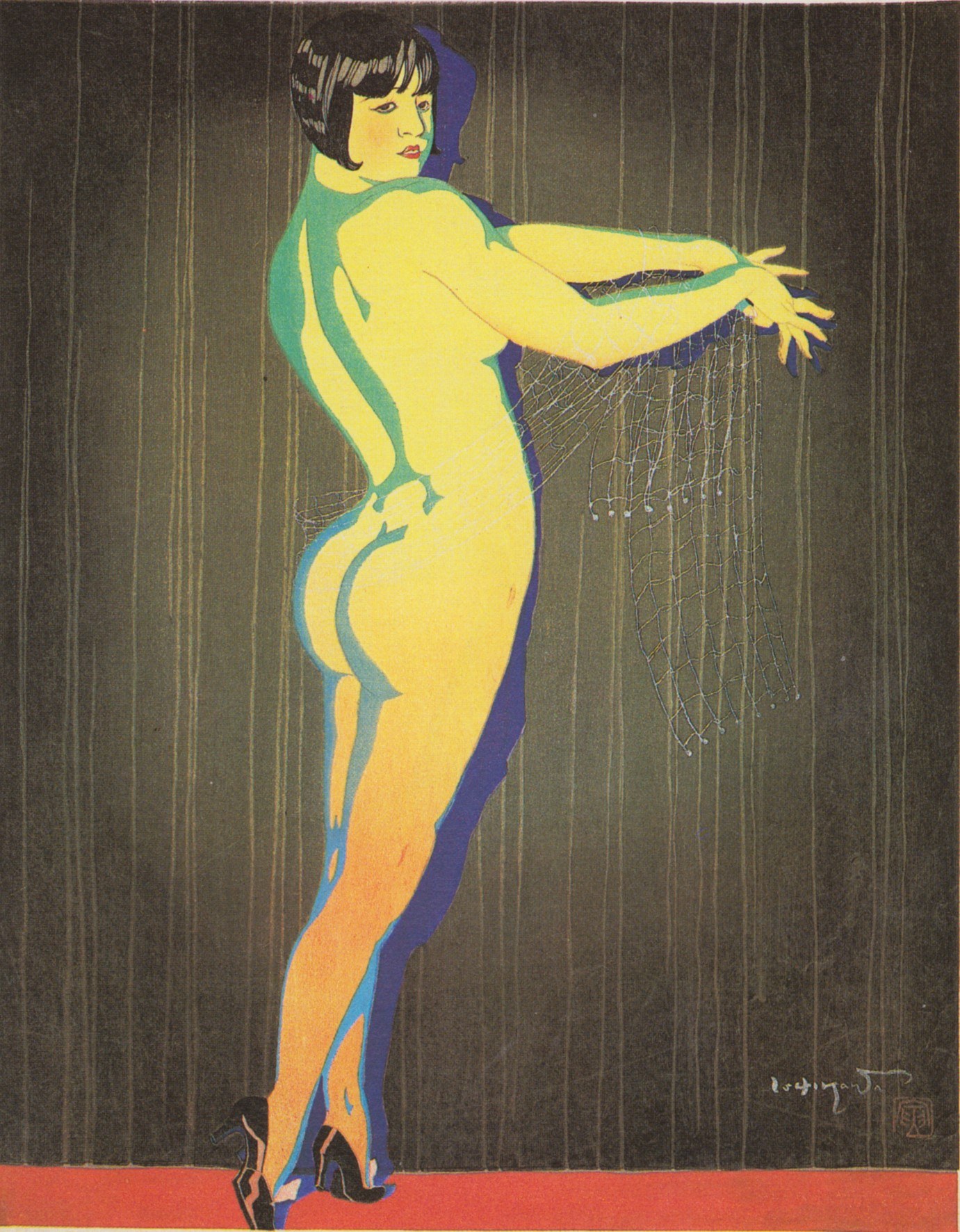
This print documents a named Japanese performer and a specific work, but its modernist treatment—the radical elongation, color abstraction, and graphic distortion—shows how 1930s artists understood dance not as representation but as composition. It reveals the visual language developed to capture the new, non-narrative modern dance of the era.
What you are looking at
A solitary female figure stands in profile against a vertically striped background, her body painted in vivid yellow with contour lines in green and blue. She wears a dark blue headscarf and dark heeled shoes. Her posture is highly stylized and elongated: her torso twists back, her right arm extends forward with fingers splayed in an exaggerated gesture, and her left leg is raised high. The composition emphasizes an almost art-deco angularity—the body is abstracted into simplified planes and curves rather than modeled naturalistically. A delicate spider's web hangs from her raised arm. The striped background and the woman's isolated stance against it create a theatrical, stage-like space. At the foot of the image runs a red horizontal band. The work shows the flattened perspective and bold color blocking characteristic of Japanese woodblock prints.
The dancing
A single dancer in profile, her weight transferred to her supporting left leg while the right leg extends in an unusually high line. Her torso curves backward in an arc, counterbalancing the forward thrust of her right arm, which extends with fingers dramatically splayed. The left arm is held down and back. The overall frame is extremely stylized and exaggerated rather than anatomically realistic, suggesting either a highly mannered theatrical style or an intentional modernist distortion. The extended leg and splayed-hand gesture suggest a moment of expansion and reach, but the pose is too abstracted to confirm conventional dance technique.
The dance depicted
The work is difficult to place within a specific dance vocabulary. The extreme elongation, the high extension, the splayed fingers, and the theatrical abstraction suggest either modern dance or a stylized, avant-garde interpretation of dance rather than a classical form. The figure's pose and the exotic setting implied by the headscarf might reference orientalist or exoticist performance traditions popular in 1930s entertainment and modernist circles—including cabaret, variety theater, or experimental modern dance. The title 'Ishikawa Tanz' (Ishikawa Dance) suggests a named performer, but without further documentation, the specific form remains ambiguous. The artist has prioritized visual dynamism and formal experimentation over anatomical clarity.
How it was made
This is a woodblock print (woodcut), a medium that demands bold, high-contrast imagery and simplified forms. The artist has used the medium's strengths: clean color separation, strong graphic lines, and flattened perspective. The technique required carving separate blocks for each color (yellow, green, blue, dark blue, red, and the cream paper), which explains the crisp color boundaries and lack of gradation. Woodblock printing was a primary vehicle for fine-art reproduction in Japan and was also used in Europe for modernist and expressionist works. The technique's graphic boldness made it ideal for capturing the stylized, theatrical aesthetic of 1930s avant-garde performance imagery.
About this work
This 1935 woodblock print depicts a solo female dancer in an exaggerated, abstracted pose against a striped stage-like background. The artist, Ishikawa Toraji, has captured a moment of intense physical extension—a high leg line and splayed-hand gesture—but has flattened and distorted the figure in keeping with modernist aesthetics. The work sits at the intersection of theatrical documentation and fine-art abstraction, recording a specific performer (Ishikawa) while transforming the dance into pure formal composition. It belongs in dance history as evidence of how avant-garde artists of the 1930s visualized movement, and of the cross-pollination between experimental theater, modern dance, and visual modernism in this period.
How to look at it
Attend to the moment of maximum extension the artist has chosen: the raised leg, the reaching arm, the arched spine all suggest an instant of dramatic lift or reach. The artist has not aimed for anatomical realism but instead pushed the figure toward geometric abstraction—notice how the contour lines simplify the body into curves and planes. The spider's web hanging from the outstretched hand may suggest fragility, danger, or a poetic conceit about the dancer's gesture. The striped background flattens the space, emphasizing that this is a theater or studio scene, not a natural setting.
The artist
Ishikawa Toraji was a Japanese artist active in the 1930s. The work's signature appears in the lower right. Beyond this, biographical and professional details are not established in available records.
The period
The 1930s saw the rise of modern dance as an art form across Europe, America, and Japan, with dancers and choreographers rejecting classical ballet vocabulary in favor of more abstract, expressive, and formally experimental movement. Simultaneously, woodblock printing experienced a revival among fine artists, who valued its graphic directness and its links to Japanese artistic tradition. The convergence of these interests—modern dance as subject matter and woodblock as medium—produced a significant body of visual documentation of this period's experimental performance culture.
Where it lives
The work is recorded in Wikimedia Commons. No holding collection is recorded in the catalogue.
Dance in this work
Questions about this work
Who was Ishikawa and what did she dance?
The print is titled 'Ishikawa Tanz' (Ishikawa Dance), suggesting the subject was a performer named Ishikawa, but her biographical details, training, and repertory are not documented in available sources. The print itself is the primary surviving record of her practice.
What dance style is this?
The abstracted, modernist treatment and the exaggerated poses suggest modern or experimental dance rather than a codified classical form. The 1930s date aligns with the international emergence of modernist dance. The exact style or school cannot be determined from the image alone.
Why does the artist distort the body so much?
The exaggeration and flattening reflect 1930s modernist aesthetics: the artist prioritized formal composition, emotional intensity, and visual impact over anatomical accuracy. This approach was common in avant-garde theater and visual art of the period and suited the dynamic, abstracted qualities artists associated with modern dance.
What is the spider's web doing in the image?
The web may be a symbolic or poetic element—suggesting fragility, entrapment, or delicacy—or it may be a literal detail of a costume or stage prop. Its meaning is ambiguous without additional context.
More dance artwork