49 works in this view — arrow keys or swipe to move between them.
Dance in Art · 1912
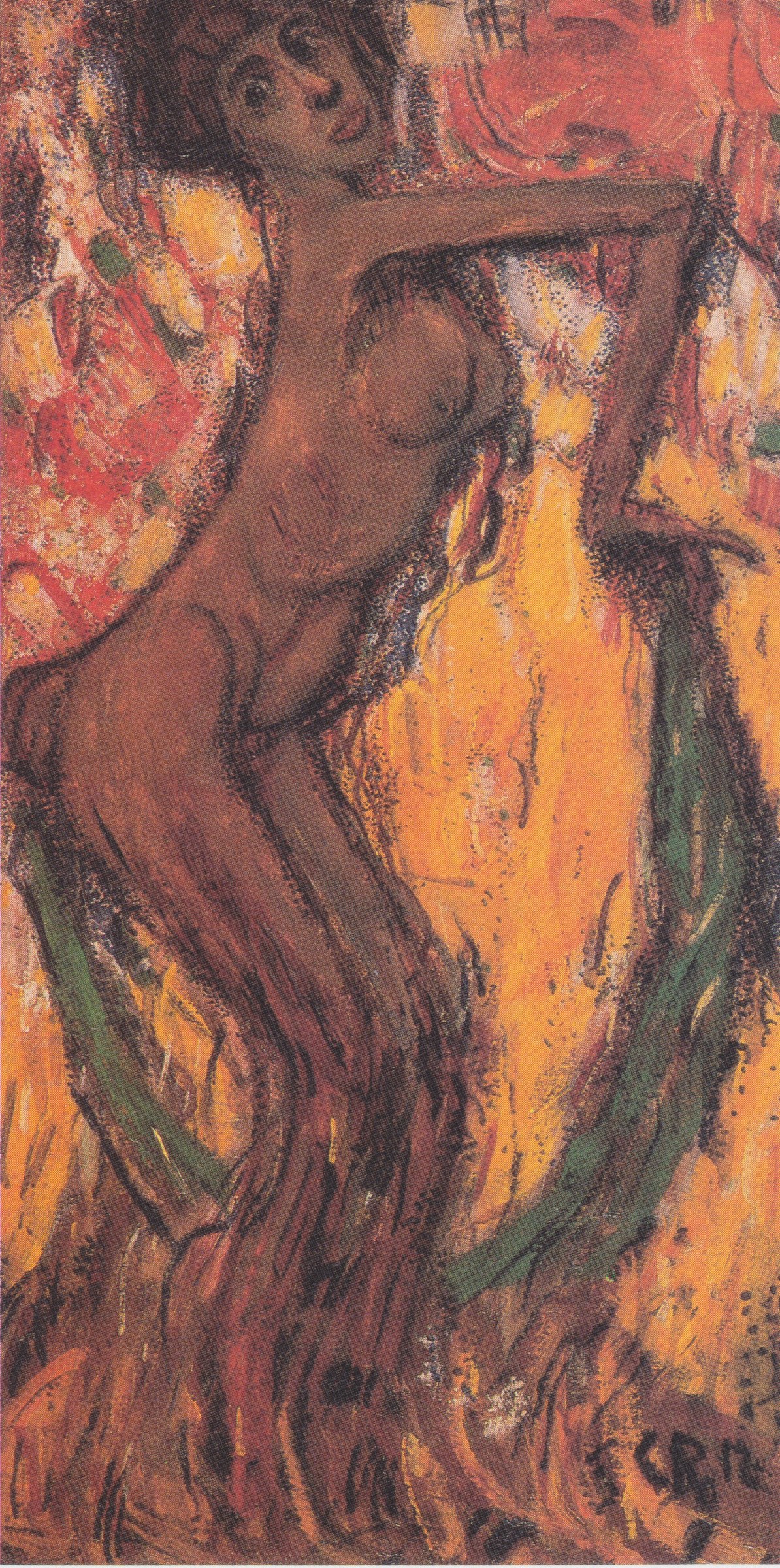
Rohlfs - Tanzende Faunin mit grünem Schleier, 1912
Christian Rohlfs
- Medium:
- Oil Painting
- Era:
- 1900-1920 (Ragtime/Early Jazz)
- Source:
- Wikimedia Commons
- Rights:
- Public domain — free to use, share and adapt.
- Recorded as:
- Public Domain
The painting documents a pivotal moment when visual artists embraced modern dance as a serious subject worthy of expressionist treatment. The ecstatic, arched pose reflects the values of early modern dance—authenticity, emotional truth, and a rejection of classical rigidity—at the precise historical moment when that movement was reshaping European culture. For historians of dance, the work is evidence of how thoroughly modern dance had penetrated the visual arts by 1912.
What you are looking at
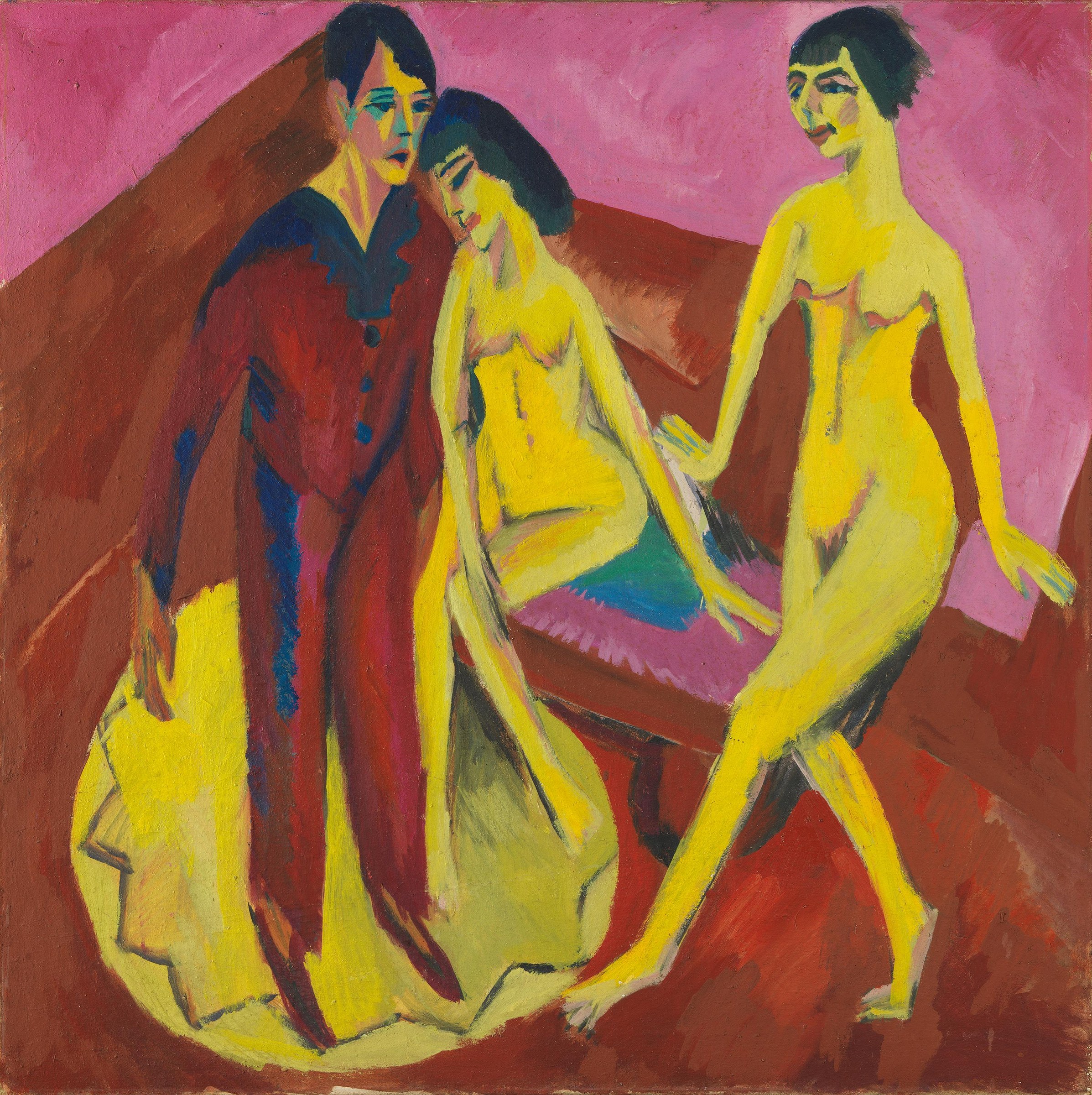
A single female figure dominates this expressionistic oil painting, her body arched in a dynamic contrapposto pose against a richly textured background of warm oranges, reds, and yellows. The dancer's form is rendered in warm browns and ochres, creating a sensual silhouette that seems to emerge from and merge back into the surrounding color field. Her head is thrown back, one arm extended upward in an arc, while her body twists with a fluid, almost serpentine quality. A green drapery or veil flows from her lower body, adding a note of cool color and suggesting movement. The painting's technique is gestural and loose—the background built up in thick, visible brushstrokes that create a sense of energy and warmth. The figure's musculature is suggested rather than anatomically precise, with emphasis on the emotional intensity of the pose rather than classical form.
The dancing
A single female dancer occupies the composition, her body in a pronounced backward arch with the weight shifted to one leg. One arm reaches upward and back in an arc; the other hangs or curves along her torso. Her head is tilted back, neck extended. The pose suggests a moment of ecstatic movement—the torso open, the spine extended, the limbs articulate but not rigid. There is no geometric precision to the stance; instead, the artist has captured a sense of organic, flowing motion and emotional abandon.
The dance depicted
The painting depicts what appears to be free or interpretive solo female dance, most likely of the early modern or expressionist tradition that flourished in the early 20th century. The pose—with its emphasis on spinal extension, the backward tilt of the head, and the flowing drapery—suggests the vocabulary of Isadora Duncan or her contemporaries, who rejected classical ballet's rigid geometry in favor of emotionally direct, naturally flowing movement. The figure's state of apparent ecstasy and the sensual, unrestrained quality of the pose point to the modern dance of the 1900s–1920s rather than any codified technique. The green veil echoes the use of flowing drapery as both costume and kinetic element in that tradition.
How it was made
An oil painting executed with expressionist technique, using loose, gestural brushwork and a limited but intense color palette dominated by warm earth tones. The artist has built up the paint in visible, textured layers, particularly in the background, which creates a luminous, almost vibrating surface. This approach allows for emotional intensity and movement to be conveyed through color and mark-making as much as through the figure itself. The handling is painterly rather than precise, prioritizing the mood and energy of the moment over anatomical detail.
About this work
This work depicts a solitary female dancer in a state of physical and emotional intensity, her body arched backward in a pose that speaks to early modern dance aesthetics. The painting belongs to the expressionist tradition that engaged with dance as a subject of psychological and spiritual significance. Created in 1912, it captures a moment at the cusp of European modernism, when visual artists were drawn to dance as an embodiment of authentic human emotion and movement liberated from academic constraint.
The work matters because it documents the cultural moment when visual artists recognized modern dance as a legitimate and urgent subject. The figure's ecstatic pose and the painting's emotional intensity suggest that the artist understood dance not as decoration or entertainment, but as a language of the body capable of expressing the inner life. This was a crucial perception in early 20th-century European art.
How to look at it
Attend to the moment the artist has chosen: not a balanced, composed pose, but a moment of apparent abandon and emotional intensity. The arched spine, the thrown-back head, and the upward-reaching arm suggest a climax of movement rather than a transitional step. Notice how the background—warm, turbulent, alive with brushwork—mirrors the energy of the body rather than providing a neutral stage. The green veil is not incidental; it moves with the body and adds another dimension to the sense of flowing, liberated movement. The painting asks you to feel the dancer's ecstasy rather than analyze her technique.
The artist
Christian Rohlfs (1849–1938) was a German painter and graphic artist associated with German Expressionism. He worked across multiple media and was engaged with modernist movements throughout his long career. His interest in dance subjects reflects the broader expressionist fascination with the body as a vehicle for emotional and spiritual expression. Rohlfs was a significant figure in German art and part of the cultural milieu in which modern dance was gaining recognition as a serious art form.
The period
This painting was created in 1912, a moment of intense ferment in both visual art and modern dance. In Europe, Isadora Duncan and her followers had spent the previous decade establishing modern dance as a radical alternative to classical ballet, emphasizing natural movement, emotional authenticity, and the expressive possibilities of the unencumbered body. Simultaneously, the visual arts were undergoing their own revolution: Expressionism was emerging as a dominant force in German art, with artists using distortion, intense color, and gestural mark-making to convey inner psychological states. The convergence was natural—dance offered a perfect subject for expressionist aesthetics, because the moving body could embody those same values of emotional truth and authentic feeling. Rohlfs was working in this cultural context, where the visual arts and dance were in active conversation about modernity and the liberation of the human form.
Where it lives
The work is documented in Wikimedia Commons. No holding institution is recorded in the available catalogue information.
Dance in this work
Questions about this work
Is this Isadora Duncan?
We cannot identify the specific dancer from the painting alone. However, the pose and movement vocabulary strongly suggest the early modern dance tradition that Duncan pioneered. The title identifies the figure as a Faunin (a female faun)—a mythological reference rather than a portrait of a named dancer. The work depicts the type of movement and emotional intensity associated with that tradition rather than a specific performance or individual.
Why is there a green veil?
In early modern dance, flowing drapery served multiple purposes: as costume, as a kinetic element that extended the line of the body, and as a symbol of liberation from the rigid tutus of classical ballet. The green veil here moves as part of the dancer's body, adding visual interest and suggesting the fluid, organic quality of the movement. It also adds a mythological dimension, evoking classical imagery.
Why did visual artists care about dance in this period?
Modern dance offered visual artists a perfect subject for modernist concerns. The unadorned, expressively moving body seemed to embody authenticity, emotional truth, and liberation from academic convention—values that expressionist painters were pursuing in their own work. Dance became a way to explore the expressive potential of the human form and to imagine a new kind of modernity based on feeling rather than intellect.
More dance artwork