49 works in this view — arrow keys or swipe to move between them.
Dance in Art
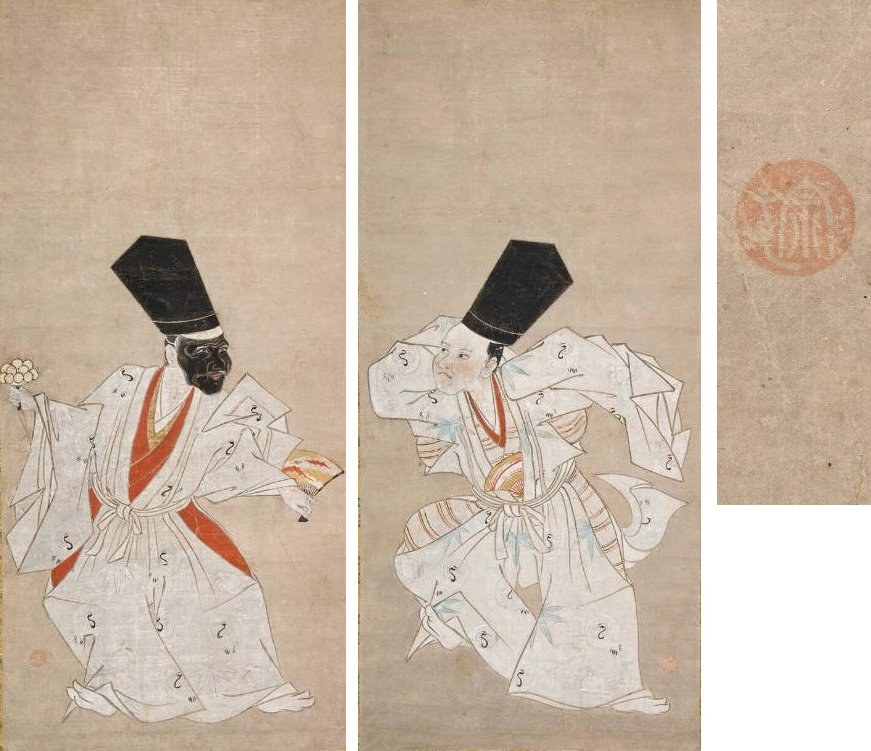
Sambaso Performing the Kokushikijo Dance and the Momi no Den Dance, Honolulu Museum of Art
an anonymous late 17th-18th century Japanese painter
- Medium:
- Ink
- Source:
- Wikimedia Commons
- Rights:
- Public domain — free to use, share and adapt.
- Recorded as:
- Public Domain
For anyone studying Japanese dance history or the role of costume in theatrical practice, this work is invaluable as a primary record of how the Sambaso was actually dressed and posed in the late 17th or 18th century—not how it was imagined or idealized, but how it was built and performed. The numbered annotations reveal that dance and tailoring were understood as a single technical problem, not as separate crafts, offering rare insight into the creative and material partnership between dancer and costume maker in pre-modern Japanese theater.
What you are looking at
Two scrolls depict a solo male performer wearing an elaborate costume of white and pale silk garments with voluminous sleeves, a red collar or underjacket visible at the chest, and a tall black hat of geometric form characteristic of Noh performance dress. The left panel shows the figure in profile or three-quarter view, facing left with one arm extended holding what appears to be a ceremonial object or fan, the other arm folded. The right panel shows the same figure or a closely related one in a different pose, with both arms raised and extended outward within the billowing fabric, the sleeves dominating the composition. The costume is densely marked with numbered annotations in ink, suggesting this is a study document. A third, smaller panel shows a red circular seal or stamp. The background throughout is plain, uncolored paper with visible aging and wear. The spare setting and focus on costume detail emphasizes this as a technical record rather than a narrative scene.
The dancing
The performer stands with weight evenly distributed, the body relatively upright and dignified. The pose on the left shows restrained, controlled arm placement; the right shows a more expansive statement with both arms lifted and the voluminous sleeves creating a tent-like silhouette around the upper body. The numbered annotations suggest the artist was mapping the construction of the costume layers and movement potential rather than capturing dynamic motion. The scale and formality of the silhouette—the swollen sleeves and stiff geometric hat—indicate this is a figure of ritual or ceremonial rank.
The dance depicted
These are studies of the Okina performance, specifically the Sambaso (also called Sambaso no mai), which appears in the Noh play "Okina" as one of the auspicious dance sequences performed within the formal structure of that work. Sambaso is a male solo dance traditionally performed by an aging or masked character, and the Kokushikijo and Momi no Den are discrete dance sections within or associated with Okina. The pose and dress confirm this is Noh theater rather than Kabuki or secular dance. The numbered annotations record the costume architecture in service of the movement, a common practice in Japanese theatrical documentation.
How it was made
The work is executed in ink and pigment with white gofun (gesso) applied to paper, creating a matte surface and allowing the artist to model form through line and wash rather than perspective or shadow. The numbered annotations in a careful hand and the technical focus suggest this was a working document for costume makers or performers rather than a finished artwork for display. The pairing of two poses on a single scroll (or two scrolls) is typical of Japanese dance notation and costume study sheets, which circulated among theater families and their workshops to record essential information about performance.
About this work
This is a technical study of costume and pose from the Noh performance tradition, documenting the Sambaso dance from the play "Okina." The work records two distinct moments of the solo male performer's movement, rendered in ink and pigment with careful annotation. Rather than attempting narrative effect or naturalism, the artist has prioritized the architecture of the costume—the massive white sleeves, the formal hat, the layering of garments—as both the visual and functional center of the dance. This places the work within a long Japanese tradition of theater documentation that served simultaneously as a record for future performers and as a study of how costume and body move together in ritual performance.
The scroll exists at the intersection of several worlds: the formal constraints of Noh theater with its masked or aged characters and auspicious dances; the practical need to transmit technical knowledge across generations; and the aesthetic tradition of ink painting on paper that dominated elite Japanese visual culture. Its value lies not in capturing a moment of expressive virtuosity, but in encoding the precise, layered, and formally prescribed movement vocabulary of one of Japan's most conservative theatrical forms.
How to look at it
Observe how the artist has positioned the sleeves: in the left panel they fall relatively straight, while in the right they billow outward, suggesting the moment when the arms lift and the fabric catches air. The numbered annotations are not decorative; they record where one layer ends and another begins, how the garment is constructed to allow movement, and perhaps cues for dressing. The black hat, rigid and geometric, anchors the figure's dignity and formal status. This is not a portrait or expression study, but a blueprint—a visual instruction set for how to dress and move as Sambaso.
The period
Noh as a formal theatrical tradition was already nearly two centuries old by the 17th and 18th centuries, having been patronized by the Tokugawa shogunate as an official and highly regulated art form. During this period, Noh performance became increasingly codified: movements, texts, and costumes were standardized and passed through families of hereditary performers. The practice of documenting performance through annotated drawings was well established among theater schools and families, serving as a curriculum and quality control mechanism. This technical drawing sits within that documentation culture, a time when the transmission of knowledge within theater families relied heavily on visual and textual notation.
Where it lives
The work is held in the Honolulu Museum of Art (accession 6836.1-.2), indicating it entered a Western collection at some point and was assessed as historically significant enough to preserve and catalog. The format and materials—ink, pigment, and gofun on paper—are consistent with Japanese theater documentation sheets, which were created within and circulated among performance families.
Dance in this work
Questions about this work
What is Sambaso, and why is it in a play called Okina?
Sambaso is an auspicious male solo dance performed by an elderly or masked character, appearing as an interlude or structural element within the Noh play "Okina," which is itself one of the most formal and ritual-laden works in the Noh repertory. Okina celebrates longevity, fertility, and good fortune; Sambaso is the blessing dance that fulfills that celebratory function. The dance is highly codified and appears in similar form across different Noh schools.
What do the numbers on the costume mean?
The numbers are a labeling system used by costume makers and performers to identify different layers, pieces, and construction points of the garment. They may correspond to a written description or pattern document, allowing a maker to recreate the costume accurately or a performer to understand how it was assembled. This is technical notation for a highly skilled craft.
Why are there three images here instead of one?
The two large panels show two distinct poses of the same dance or two moments from its sequence; the smaller panel on the right is the artist's seal or studio mark, a common feature of Japanese drawings and scrolls. Together they constitute a single documentary work, likely created to preserve a performance tradition within a theater family or school.
Is this a painting or a drawing?
It is a drawing and study using ink, pigment, and gofun (a white chalk-based gesso) on paper. The technique is typical of Japanese working drawings and technical documents from the period, distinct from the more finished ink paintings of elite artists. The focus is on information and instruction rather than aesthetic finish.
More dance artwork