49 works in this view — arrow keys or swipe to move between them.
Dance in Art · 1899
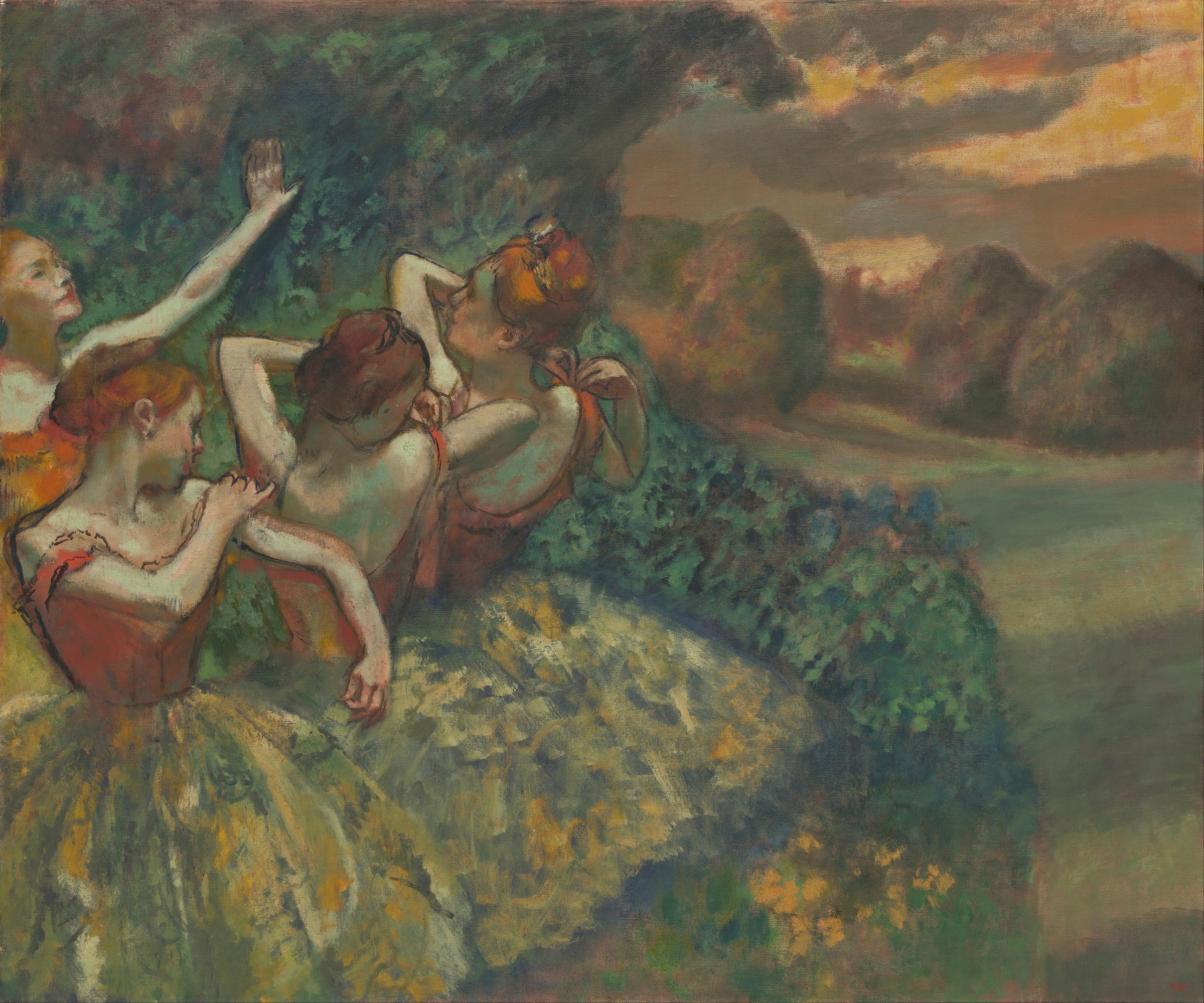
Edgar Degas - Four Dancers
Edgar Degas
- Medium:
- Oil Painting
- Dance:
- Ballet
- Era:
- Late 1800s (Victorian Ballroom)
- Source:
- Wikimedia Commons
- Rights:
- Public domain — free to use, share and adapt.
- Recorded as:
- Public Domain
Degas revolutionized the representation of ballet by showing dancers in rehearsal, rest, and private life rather than only in performance. This work exemplifies his conviction that the truth of ballet was not in the finished spectacle on stage but in the lived experience of dancers' bodies—their fatigue, their beauty, their casual gestures. For historians of dance and of visual culture, Degas's works are primary documents of nineteenth-century ballet practice and of how dancers were seen and valued by their society.
What you are looking at
Four young women in ballet dress are posed outdoors against a dark green leafy backdrop, with a golden-brown landscape visible behind them. Three sit or recline on the ground in the foreground, their bodies arranged in relaxed, informal positions; a fourth stands or kneels at left, one arm raised toward the foliage above. All wear short tutus in pale yellow or cream with coral-red bodices or sashes. The light is warm and diffuse, suggesting late afternoon or early evening. The composition is intimate and casual rather than theatrical—these are not dancers mid-performance but in a moment of rest or play, their poses unstudied and their expressions gentle. The setting suggests a garden or park rather than a stage.
The dancing
The dancers occupy the composition in a loose cluster, none in a classical ballet frame or closed partnering hold. The standing figure at left stretches upward in a relaxed reach, her body weight seemingly easy. The three seated or reclining figures show soft, curved spines and naturalistic arm positions—one rests her head on her hand, another lies back with limbs extended. There is no turn-out discipline visible, no pointed feet caught mid-step, no arabesque or attitude. The bodies read as youthful and unguarded, closer to a moment of repose than to the controlled geometry of classical ballet technique.
The dance depicted
This is ballet in a domestic or outdoor setting rather than a stage scene, and the painting resists any reading of active dancing. The tutus and pointe shoes (if worn—the feet are not clearly visible) confirm these as ballet dancers, but the composition shows them at rest, perhaps during a rehearsal break or a private gathering. The informality and the reclining poses suggest Degas's characteristic interest in dancers' lives away from performance—a theme he pursued throughout his career. The work depicts not a dance style but a moment in dancers' existence, which may be more sociological than choreographic in intent.
How it was made
Oil painting on canvas, a medium that allowed Degas to work with soft, blended color and atmospheric light. The brushwork is loose and gestural, particularly in the foliage and sky, while the figures are rendered with greater precision. The warm tonality and the way light dissolves into shadow suggest pastel-like effects, and the composition feels sketched or spontaneous despite the oil medium. This technique—painterly and unfinished-seeming—was characteristic of Degas's later work and suited his interest in capturing fleeting moments rather than formal compositions.
About this work
This is Edgar Degas's *Four Dancers*, an oil painting from 1899 that shows ballet dancers in an unguarded, informal moment outdoors. Rather than depicting a performance or a recognizable dance, it captures dancers' bodies at rest—sitting, reclining, stretching—in what may be a garden or park. The work belongs to Degas's sustained exploration of ballet life beyond the stage, a preoccupation that made him one of the most important artists of dance in the nineteenth century. The painting demonstrates his interest in the bodies of dancers as subjects for artistic study, separate from the choreographic or theatrical demands placed on them.
How to look at it
Notice the absence of a frame or a stage: these dancers are not "performing" for the viewer. Look at how Degas has arranged the bodies—not in the symmetrical, hierarchical composition of academic painting, but in an apparently casual scatter that suggests a candid moment. Observe the handling of light: it falls softly and doesn't dramatize or spotlight any one figure. The artist has chosen a moment of repose, which was a radical choice in dance imagery. Finally, attend to the tension between the dancers' professional bodies—trained, muscled, shaped by years of discipline—and the domestic, almost domestic quality of the setting and pose. This tension is the heart of Degas's vision.
The artist
Edgar Degas (1834–1917) was a French painter and printmaker who developed an obsessive interest in ballet dancers, particularly those of the Paris Opéra, from the 1860s onward. He made hundreds of paintings, pastels, prints, and sculptures of dancers in rehearsal, performance, and off-stage life. Unlike many of his contemporaries, Degas had access to backstage areas and could study dancers in motion and at rest. His practice was systematic and scientific—he studied anatomy, used photography, and made countless drawings from life. By the late 1890s, when this work was painted, Degas had largely abandoned the stage as his subject and focused instead on dancers' bodies as abstract formal studies, exploring movement, light, and the expressive potential of the human figure. His work influenced modern art profoundly and established the dancer as a central subject of fine art.
The period
In 1899, ballet was primarily a professional theater spectacle in Paris, centered on the Opéra and performed for paying audiences. The "gilded age" of Romantic ballet had passed, and the late nineteenth century saw the rise of naturalism in art and an appetite for subjects drawn from modern urban life. Degas was unusual in his sustained focus on ballet, which he treated as a subject worthy of serious artistic study comparable to history painting. At the same time, the Impressionists and Post-Impressionists were moving away from academic hierarchies of subject matter, and Degas's choice to paint dancers—often in informal settings—reflected this broader shift. By 1899, Degas was in his sixties and working in isolation; his eyesight was failing, which may account for the looser, more gestural quality of his late works.
Where it lives
The painting is listed as sourced from Wikimedia Commons. No current holding institution is recorded in the catalogue. The work dates to 1899, late in Degas's career and after the majority of his most famous ballet images had been made.
Dance in this work
Questions about this work
Is this a performance scene?
No. The absence of a stage, audience, or theatrical lighting, combined with the relaxed, reclining poses, indicates this is a moment away from performance. Degas was famous for depicting ballet dancers in rehearsal, in the wings, or at rest—moments when they were not "on." This painting is part of that sustained investigation into dancers' lived experience.
What are the dancers wearing?
Short tutus in pale cream or yellow, paired with coral or rust-colored bodices or sashes. The dress is recognizably ballet costume of the late nineteenth century, though simplified and stripped of the ornament and formality of stage costume. The informality of the dress matches the informality of the poses.
Why did Degas paint dancers so often?
Degas had unusual access to the Paris Opéra, where he could study dancers in rehearsal and off-stage. He was fascinated by the human body in motion and at rest, by the geometry of the dancer's form, and by what he saw as the truth of ballet—not the artificial spectacle on stage but the disciplined, often exhausted reality of dancers' lives. His interest was both aesthetic and sociological.
What is the setting?
A garden or park, suggested by the green foliage behind the dancers and the golden landscape in the distance. The outdoor setting was unusual for ballet imagery of the period, which typically depicted stages. It emphasizes the private, domestic quality of the moment and removes the dancers from institutional or theatrical context.
More Ballet artwork