49 works in this view — arrow keys or swipe to move between them.
Dance in Art · 1877
Degas - Dancers Practicing at the Bar
Edgar Degas
- Medium:
- Oil Painting
- Dance:
- Ballet
- Era:
- Late 1800s (Victorian Ballroom)
- Source:
- Wikimedia Commons
- Rights:
- Public domain — free to use, share and adapt.
- Recorded as:
- Public Domain
This painting is a primary document of how ballet was actually trained and practiced in the 1870s, and it shows that the barre work we recognize today was already central to the method. For historians of dance and pedagogy, it provides visual evidence of technique, carriage, and the studio environment. For art historians, it exemplifies a significant turn in late-19th-century painting toward the representation of everyday artistic labor, moving beyond narrative or theatrical subjects toward pure observation of form and light.
What you are looking at
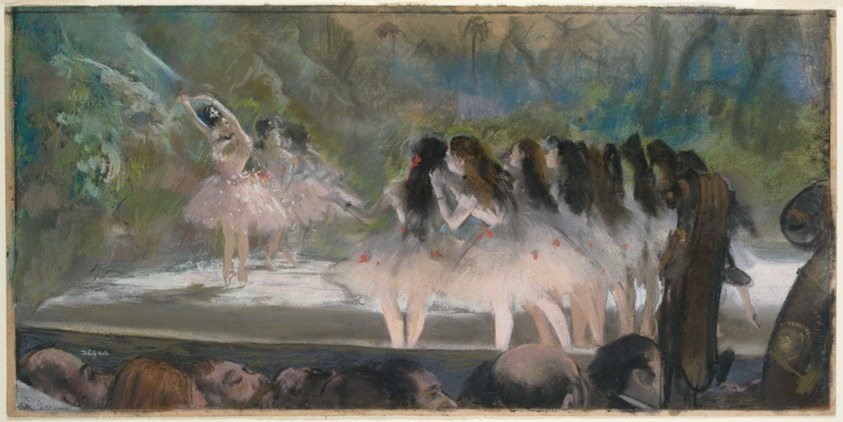
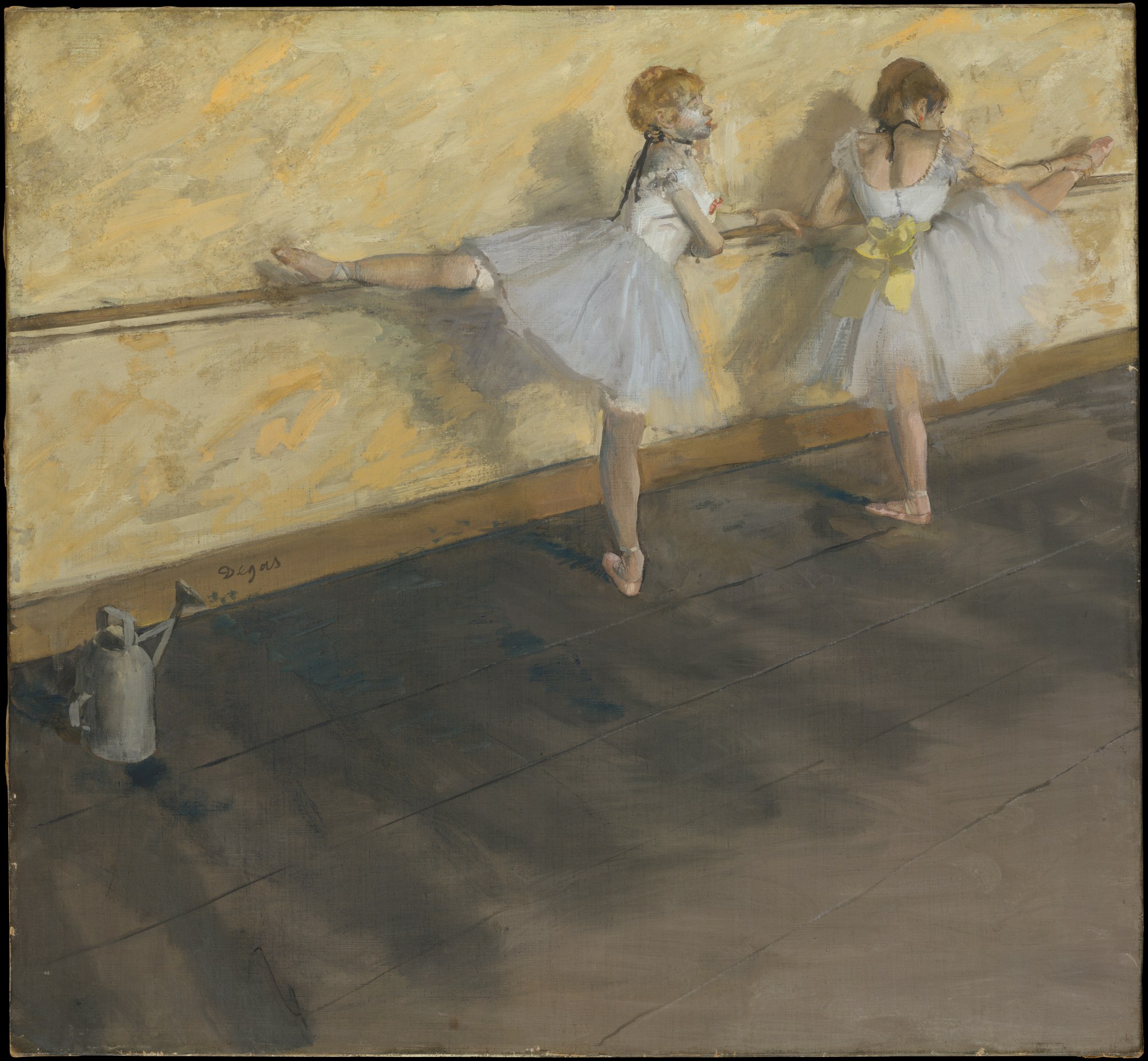
Two young ballet dancers stand at the barre in an airy studio suffused with warm, golden light. Both wear the pale tulle tutus standard to 19th-century ballet practice, their hair arranged in the period style. The dancer at left, caught mid-extension with one leg raised high behind her in an arabesque or développé, gazes upward with an air of concentration; the dancer at right mirrors a similar pose, her arm extended toward the barre for balance, her body angled away from the viewer. The wooden barre runs horizontally across the composition, anchoring both figures. The studio walls are rendered in soft ochre and cream, with dappled shadow suggesting light from high windows or skylights—a setting characteristic of the Parisian dance studios of the 1870s. A small bucket or water vessel sits on the floor in the foreground left, a detail suggesting the everyday reality of rehearsal rather than performance. The composition is intimate and observational, capturing a fleeting moment of private practice.
The dancing
Both dancers are in classical ballet alignment at the barre, their posture upright and their legs extended into what appear to be arabesques or similar vocabulary requiring turnout and control. The dancer on the left holds her extended position while looking upward—a focus technique used to maintain balance and elongate the line of the body. The dancer on the right uses her arm connection to the barre as support while achieving a comparable extension, her torso angled to show the profile of her working leg. Neither dancer makes eye contact; both are absorbed in the technical demand of their work, a truthful observation of the mental concentration required in ballet training.
The dance depicted
This is classical ballet practice, specifically the work done at the barre—the foundational daily training that builds technique, strength, and muscle memory. The dancers are performing adagio combinations, slow movements executed with maximum control and extension. The barre work shown here was essential to ballet training by the 1870s and remains so: it isolates and strengthens the supporting leg while allowing the working leg to achieve full extension and turned-out positioning. These are not courtship dances or virtuosic variations meant for theatrical display, but the methodical, disciplined daily labor that made performance possible.
How it was made
Oil paint on canvas, executed with a characteristically Impressionist feathering of color and light. The artist has built the composition using loose, broken brushwork—the warm ochres and pale yellows of the studio walls are not uniformly rendered but suggested through layered, impressionistic strokes that dissolve at the edges. The dancers' bodies are rendered with greater definition but still maintain that softness at the contours; the tutus are achieved through delicate glazes of pale gray and white that suggest transparent silk rather than describe it literally. This technique allows the artist to capture the ephemeral quality of movement, the momentary stillness within motion, and the atmospheric quality of the studio itself—effects that would have been difficult to achieve in more linear academic painting. The scale and finish suggest a work intended for exhibition and private collecting rather than public commission.
About this work
This is an oil painting of two young ballet dancers engaged in the daily barre work that formed the foundation of professional ballet training in the late 19th century. The work is characteristic of a period when painters—particularly in Paris—turned their attention to the world of ballet and dance as subjects worthy of sustained artistic interest. The painting captures not the theatrical spectacle of a performance but the private, disciplined labor of dancers training, a shift in artistic perspective that reflects broader changes in how dance was valued and understood. The work documents both a specific moment in the history of ballet pedagogy and a moment in the history of art when the ballet studio became a compelling subject.
How to look at it
Look at the posture and extension of both dancers and notice how the artist has caught them not in a dramatic moment but in a sustained position—this is the work of class, not performance. Observe how the light falls across their bodies, creating soft shadows that define the contours of limbs and torsos without harsh outlines; this technique allows the viewer to read the dancers' physical effort through color and tone rather than line. Notice the barre itself—it is not treated as a theatrical prop but as a functional tool, rendered simply and integrated into the composition without ceremony. The upward gaze of the left-hand dancer and the absorbed focus of her companion invite us to understand that concentration and internal focus are as much part of dance as extension and turnout.
The artist
Edgar Degas (1834–1917) was a French painter and printmaker who made ballet dancers one of his signature subjects across five decades. Degas had unprecedented access to the rehearsal studios and backstage areas of the Opéra in Paris, where he observed dancers training and preparing for performance. His approach to dancers was unusual for his era: he avoided idealizing them or depicting only performance moments, instead recording them at rest, in mid-combination, stretching, or attending to their bodies. His practice was drawn from careful observation and numerous preparatory drawings; he used pastel, oil, and printmaking techniques to explore movement, light, and the human figure under strain. His work helped establish the ballet studio and the dancer's body as serious subjects for modern art.
The period
The 1870s were a pivotal moment in European ballet. The heyday of Romantic ballet—with its emphasis on ethereal, otherworldly female dancers—was giving way to a more technically rigorous aesthetic influenced by Russian Imperial Ballet training methods. The barre work shown here reflects the systematic pedagogy that was becoming standard in Paris and elsewhere as ballet professionalized and codified its training. Simultaneously, Impressionism was emerging as a major artistic movement, and painters were turning away from historical and narrative subjects toward scenes of contemporary life—urban leisure, entertainment, and labor. The ballet studio, with its particular qualities of light, movement, and human effort, became an ideal subject for this new artistic vision.
Where it lives
This work is documented in Wikimedia Commons. The catalogue record indicates it is oil on canvas, dated 1877, though the collection holding is not recorded.
Dance in this work
Questions about this work
Why are both dancers facing the barre and not facing different directions?
In classical ballet barre technique, dancers perform combinations facing the barre, then turn and repeat them on the other side. The artist has captured a moment in which both dancers are on the same side of the barre, working through the same combination. In a full class, dancers would rotate through all directions and positions, but this painting shows a single, transient moment.
Are these professional dancers or students?
The record does not identify the specific dancers, and nothing in the image alone definitively establishes their professional status. However, the context of Degas's practice—he worked extensively with dancers from the Paris Opéra—suggests these are likely dancers in a professional company training studio rather than amateurs. The level of extension and control shown would be consistent with professional dancers.
What is the small object on the floor?
It appears to be a bucket or vessel for water, a practical studio object used during rehearsal. Its inclusion is a marker of Degas's commitment to depicting dancers' lived reality rather than an idealized vision of the art form.
Why did Degas paint ballet dancers so often?
Degas had formal access to the backstage areas and rehearsal studios of the Paris Opéra. He was fascinated by the ballet as a subject that allowed him to explore light, movement, the human figure under physical strain, and the relationship between body and space. For him, dancers offered a way to move beyond conventional portrait or narrative painting into something more psychologically complex and formally innovative.
More Ballet artwork