49 works in this view — arrow keys or swipe to move between them.
Dance in Art · 1877
Degas - Dancers Practicing at the BarFXD
Edgar Degas
- Medium:
- Oil Painting
- Dance:
- Ballet
- Era:
- Late 1800s (Victorian Ballroom)
- Source:
- Wikimedia Commons
- Rights:
- Public domain — free to use, share and adapt.
- Recorded as:
- Public Domain
This painting records how classical ballet technique was actually taught and practiced in the late nineteenth century, preserving the barre method and basic positions in specific visual form. For dancers and historians, it is documentary evidence of pedagogical methods, body alignment conventions, and the working conditions of ballet students during a formative period in the art form's history.
What you are looking at
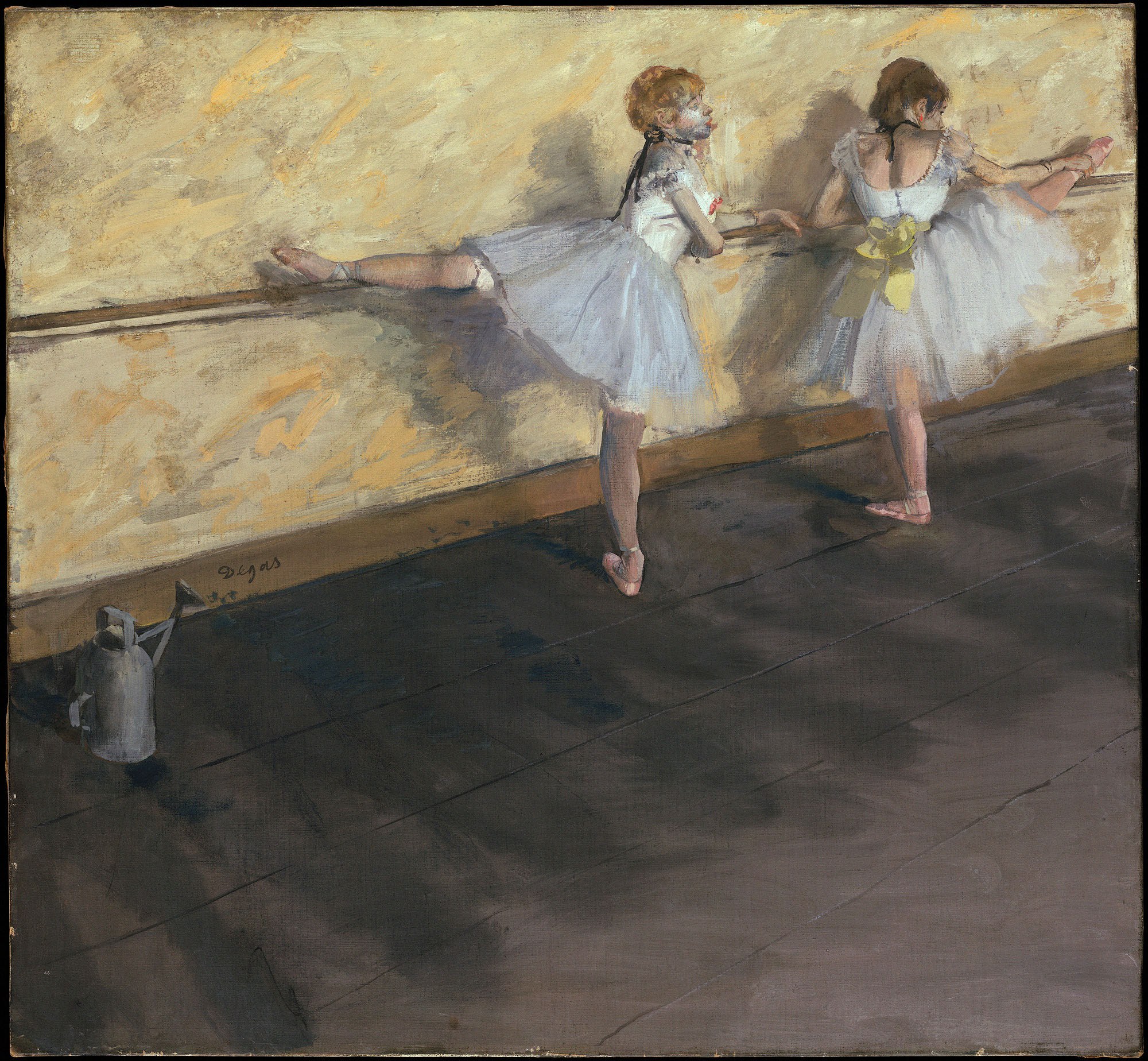
Two young dancers in practice clothes stand at a wooden barre in what appears to be a studio, lit by natural light from above. The figure on the left, with reddish hair and pale skin, stands in profile with one leg extended behind her in a développé or attitude derrière, her body angled forward from the hips in a controlled arch. Her companion on the right, viewed from behind, also extends a leg backward while holding the barre. Both wear simple white or pale practice garments—fitted bodices and full skirts that fall below the knee—typical of late-nineteenth-century ballet rehearsal dress. The studio walls are rendered in warm ochres and grays, with the horizontal barre itself a deep brown wood dominating the lower third of the composition. A small watering can sits on the floor at left. The painting captures a moment of intense focus and physical effort, the dancers' bodies taut with the controlled strength required to sustain these positions.
The dancing
Both dancers maintain proper classical ballet alignment: upright posture from the supporting leg, extended working legs held high and turned outward from the hip (en dehors), arms positioned at the barre for balance and support. The leftmost dancer's extended leg appears to be in retiré or attitude, with visible plantarflexion of the foot. Their weight is distributed through a straight supporting leg; the core engagement required for this position is evident in the tautness of their bodies. The painter has observed that ballet practice at the barre demands simultaneous relaxation and extreme tension—the upper bodies and arms appear almost casual while the legs execute precise, demanding positions.
The dance depicted
This is unquestionably a ballet rehearsal scene, depicting the classical training method of barre work that became central to ballet pedagogy in the nineteenth century. The barre serves as an essential tool for learning and maintaining the turned-out positions, controlled extensions, and weight distribution that define classical ballet technique. The positions shown—likely développé or attitude derrière—are foundational exercises that build strength and control. These appear to be young students or apprentices in a professional or semi-professional training environment, probably at a Paris opera ballet school given the specificity and knowledge of ballet practice evident in the composition.
How it was made
This is an oil painting, executed with a characteristic impressionist handling: loose, directional brushwork especially in the walls and floor, rapid notation of form through color and value rather than outline, and an elevated viewpoint that flattens the spatial composition. The painter has used warm ochres and pale lavenders to construct the studio space, with the barre's dark wood anchoring the composition. The impasto of the walls creates texture that reads as afternoon light filtered through studio glass. The technique allowed for the capture of movement and momentary gesture that would have been impossible in more formally finished academic painting, while the oil medium permitted the luminous rendering of flesh tones and pale practice fabrics against the warm walls.
About this work
This is a study of young ballet dancers during barre practice, painted in oil with the immediacy and light-sensitivity that characterize late-nineteenth-century impressionism. The work belongs to a substantial body of dance imagery produced during this period, when ballet was undergoing rapid professionalization and the Paris Opéra Ballet school was training a new generation of dancers. The painting is significant both as a document of historical ballet pedagogy—showing how the barre was used in training—and as evidence of how artists of the period found artistic interest in the ordinary labor of dance, the studio rather than the stage, and the female body in controlled, difficult positions. The work demonstrates intimate knowledge of ballet practice and respect for its technical demands.
How to look at it
Attend to the precision of the poses: the painter has rendered the turned-out hip position and the supported extension with anatomical accuracy that suggests direct observation of ballet training. Notice how the two dancers occupy the same space but are absorbed in separate, parallel efforts—this is the nature of barre work, where students train individually even in proximity. The lighting is crucial: the warm, slightly diffuse illumination from above reads as afternoon studio light, and the painter has used shadow to model the musculature and strain of the extended legs. Look at the small details—the angle of the foot, the tension in the supporting leg, the slight forward pitch of the torso—that collectively convey the physical intelligence required to hold these positions.
The artist
Edgar Degas (1834–1917) was a painter, printmaker, and sculptor obsessed with the visual language of movement, particularly ballet and horses. He spent decades in and around the Paris Opéra, studying dancers in rehearsal, performance, and backstage moments, eventually producing hundreds of works on these subjects. Degas approached ballet not as a romantic spectacle but as a craft requiring intense physical discipline, and he brought anthropological precision to his rendering of movement and anatomy. His pastels, oils, and prints of dancers constitute a sustained investigation into how the human body moves through space and how light falls on skin and fabric during effort.
The period
In the 1870s, ballet in Paris was in the midst of a profound shift. The Romantic ballet tradition—emphasizing ethereal, otherworldly femininity—was giving way to a more technically demanding, virtuosic aesthetic. The Paris Opéra Ballet was systematizing training through the barre method, which had become formalized as the foundation of classical technique. Simultaneously, impressionist painters were turning away from grand historical and mythological subjects toward scenes of modern life, leisure, and labor. The ballet studio became an attractive subject for artists precisely because it offered both the formal beauty of bodies in motion and the gritty reality of training and work. Photography was also advancing, which spurred painters to capture what the camera could not: the sense of effort, balance, and the fleeting moment of a difficult position.
Where it lives
The work is documented as part of the corpus of Degas's dance paintings, accessed here through Wikimedia Commons. The specific holding collection is not recorded in the source metadata provided.
Dance in this work
Questions about this work
Why did Degas paint ballet dancers so many times?
Degas was fascinated by movement and the technical demands of ballet as a physical practice. Rather than depicting the romantic fantasy of ballet performance, he sought to document the real labor of training: the strength required, the concentration, the repetition. Ballet dancers offered him a subject where he could study the human body in disciplined, repeated motion—a theme central to his entire artistic project.
What is the barre, and why is it important to ballet training?
The barre is a horizontal wooden rail mounted to the studio wall. Dancers hold it while performing exercises that develop the core strength, hip rotation, balance, and controlled extension essential to classical ballet. The barre supports the dancer's weight while they learn to move their legs independently of their upper body and to maintain the turned-out hip position that defines ballet aesthetics. By the time this painting was made, barre work was the foundation of every ballet training regimen.
How do we know these are professional or semi-professional dancers?
The studio setting, the formal barre, the precision of the positions depicted, and the quality of their practice clothing all suggest institutional training at a serious level. The painter's accurate rendering of ballet technique indicates these are not amateur dancers or ballroom dancers, but students of classical ballet in a professional training environment—likely the Paris Opéra Ballet school.
What is the leg position shown here?
Both dancers appear to have extended one leg behind the body while standing on the other leg, a position called arabesque, attitude derrière, or possibly développé depending on the exact angle of the raised leg and the angle of the supporting hip. The specific position matters less than what it demonstrates: sustained, controlled extension that requires significant core strength and hip flexibility.
More Ballet artwork