26 works in this view — arrow keys or swipe to move between them.
Dance in Art · 1884
Dancing and prompting, etiquette and deportment of society and ball room
Unknown artist
- Medium:
- Illustration
- Dance:
- Ballroom
- Era:
- Late 1800s (Victorian Ballroom)
- Source:
- Library of Congress
- Rights:
- Public domain — free to use, share and adapt.
- Recorded as:
- public_domain
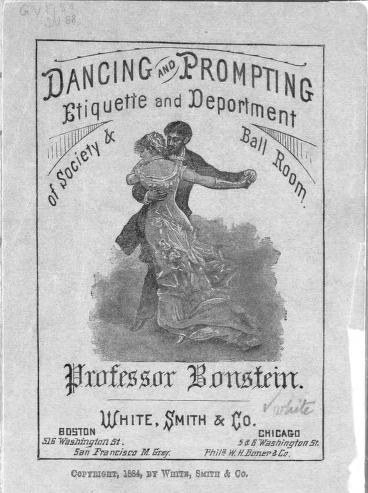
For historians of ballroom culture and social dance in America, this image documents the aesthetic and postural ideals of the Gilded Age ballroom—the expectation that dancing women embody restraint, verticality, and controlled elegance. For dancers and choreographers today, it reveals how professional instruction in the 1880s made use of the printed image as a teaching tool, and how the 'ideal form' was marketed and standardized across a reading public. The book itself was widely distributed, making this image part of a mass pedagogy of grace.
What you are looking at
A single female figure occupies the center of this engraved book cover, posed in a moment of ballroom dance. She wears an elaborate late Victorian gown with a fitted bodice, full skirt with substantial train, and long sleeves—all rendered in the formal dress of the 1880s. Her right arm extends gracefully outward at shoulder height, palm open in a refined gesture of deportment; her left arm rests at her side. Her posture is upright and controlled, the weight balanced on her back leg, her body angled three-quarters to the viewer. The background is plain, allowing the figure to dominate. At the top of the page, the title 'DANCING AND PROMPTING / Etiquette and Deportment / of Society and Ball Room' appears in large ornamental type. Below the figure is credited 'Professor Bornstein.' Publisher information for White, Smith & Co. appears at the bottom, with locations in Boston, Chicago, and San Francisco. The engraving style is typical of instructional book frontispieces of the period—clear lines, high contrast, designed for reproduction and wide distribution.
The dancing
The single dancer is shown in a standing position rather than in motion with a partner. Her body demonstrates the posture expected of well-trained ballroom society dancers: shoulders back, spine extended, head held with formal bearing. The extended right arm shows the kind of arm carriage taught in deportment instruction, neither rigid nor limp. The pose suggests a moment between figures rather than active dance—more a demonstration of 'how to stand' than how to move through a waltz or quadrille.
The dance depicted
This is a ballroom etiquette and deportment manual for late-19th-century American society dancing. The figure appears to represent the ideal posture and carriage expected of a woman in ballroom contexts—it is illustrative of proper form rather than a depiction of a specific dance in progress. The image teaches visual protocol: how a woman of genteel background should present herself in the dancing spaces of 'Society and Ball Room.' The figure's dress and bearing are those of the Gilded Age ballroom, when dancing served as a primary venue for courtship, social ranking, and the performance of class status among the urban and country gentry.
How it was made
This is a wood or steel engraving, identifiable by its fine parallel lines, sharp edges, and high contrast between black and white. The technique allows for clear reproduction at small scale and was the standard method for book and periodical illustration in the 1880s. The engraving's clarity made it suitable for distribution across multiple printings and editions—the book could be reprinted from the same plates. This method was faster and cheaper than hand-coloring and reached a middle-class readership. The frontispiece position indicates that Professor Bornstein's name and image carried commercial and educational weight: this figure was the brand promise of the book.
About this work
This is the title page illustration of an American manual on ballroom dancing and social deportment, published in 1884 by White, Smith & Co., a major Boston music and instruction publisher. The image serves a dual purpose: as a commercial frontispiece advertising the book's authority (through the credited professor), and as a visual definition of the ballroom ideal—a woman of refinement, propriety, and correct posture. Rather than showing dancers in animated partnership or in the midst of a step, it presents a static ideal of form, which is precisely what a deportment manual should do. The engraved technique and the plain background emphasize clarity of instruction over narrative or atmosphere.
How to look at it
The figure is not shown in a step or a turn, but in a position of readiness and display. Notice how the extended arm and angled body create an open, welcoming line—this is the posture taught to women to encourage male approach and partnership. The upright spine and lifted chest embody the 'moral' dimensions of ballroom propriety: a woman's posture was understood as expressing her virtue and restraint. This frozen moment is not about capturing motion but about teaching form, which is why the background is empty and the lighting even. The engraver has rendered every fold of fabric and every detail of dress to show status; the dancer herself is less a moving body than a clothed form arranged to teach.
The artist
No artist is credited for the engraving. The book credits Professor Bornstein as the author and authority on etiquette and deportment. Bornstein was a dancing master and instructor active in late-19th-century American ballroom culture; his name appears on multiple dance instruction titles from this period. He represents the immigrant European tradition of ballroom expertise being adapted and taught to the American middle and upper classes. The publisher White, Smith & Co. was known for music publishing and instruction books, suggesting Bornstein's work reached a broad instructional and commercial market.
The period
The 1880s ballroom was undergoing rapid codification. As social dancing became more accessible to the American middle class, instruction books, teachers, and published standards proliferated. The Victorian emphasis on deportment—the 'carriage' of the body as a sign of moral and social worth—was at its height. Simultaneously, the rise of the trained 'dancing master' and the commercial publication of his methods reflected a democratization of dance knowledge: what had once been the province of aristocratic courts or wealthy families could now be purchased in book form. The engraving technology allowed these books to circulate widely, making the dancing master's authority portable and reproducible.
Where it lives
This is a title page illustration from a bound instructional book held in the Library of Congress. The book is part of the broader archive of American ballroom instruction manuals and deportment guides from the Gilded Age. Such books were typically published in editions of several hundred to several thousand copies and sold through music stores, circulating libraries, and direct mail—reaching piano owners and dancing families across the country.
Dance in this work
Questions about this work
Why is the dancer shown alone, not with a partner?
This is a deportment manual, not a narrative dance scene. The image teaches the ideal posture and carriage of a single woman in ballroom contexts—how she should hold her body, position her arms, and present herself. A partner would distract from that instruction. Male dancers appear in later pages of such books, but the title page often showcases the female ideal of grace and vertical bearing.
What dance style is this showing?
No single style. The posture and dress are appropriate to any of the standard Gilded Age ballroom dances—waltz, quadrille, lancers, cotillion. The image shows the foundation position and carriage from which all these dances proceed. The book itself would cover multiple styles and their specific steps.
Who was Professor Bornstein?
A professional dancing master active in American cities in the late 1800s. He published multiple instruction books and represented the European ballroom tradition adapted for American society. His brand—credentialed expertise in dance and deportment—was the selling point of the book. Many such books featured a named professor or maestro on the cover, lending authority to the instructional text inside.
What does 'deportment' mean in this context?
The bearing and carriage of the body in social settings. For Victorian and Gilded Age society, 'good deportment' meant upright posture, controlled gesture, refined movement—visible signs of education, breeding, and moral worth. A woman's deportment on the dance floor was an essential part of her social currency.
More Ballroom artwork