49 works in this view — arrow keys or swipe to move between them.
Dance in Art · 1893
Edgar Germain Hilaire Degas 074
Edgar Degas
- Medium:
- Oil Painting
- Dance:
- Ballet
- Era:
- Late 1800s (Victorian Ballroom)
- Source:
- Wikimedia Commons
- Rights:
- Public domain — free to use, share and adapt.
- Recorded as:
- Public Domain
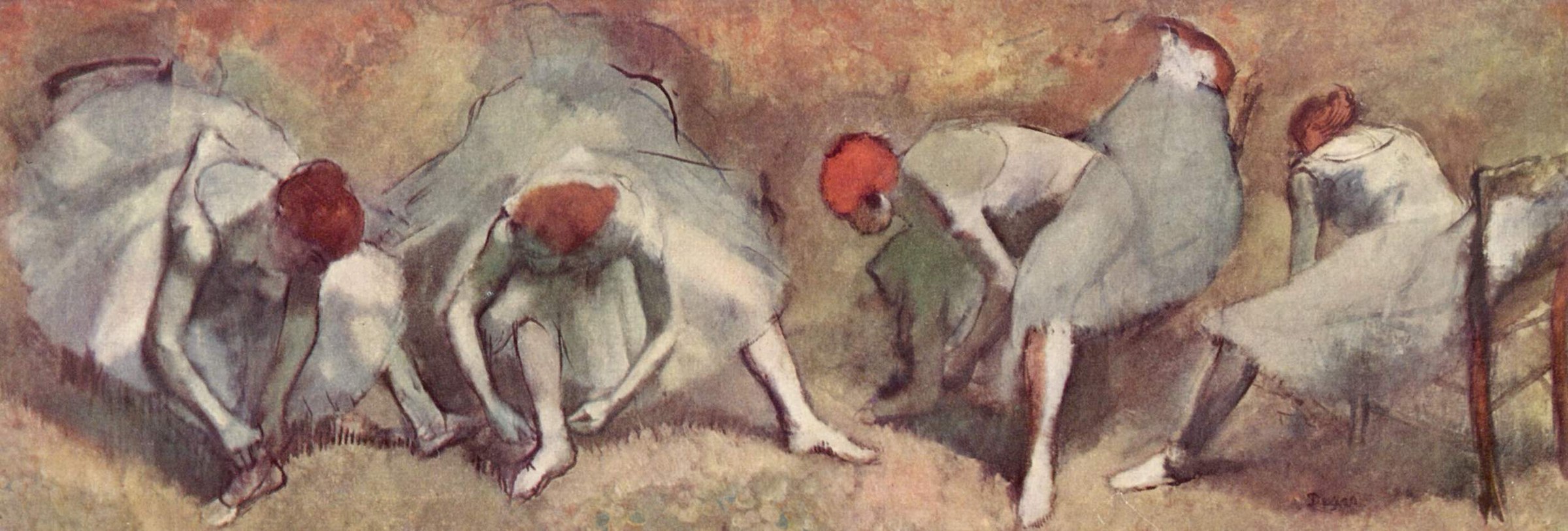
This image documents a crucial transition in early modern dance practice—the moment when artists began to interrogate what the human body could express beyond the turned-out, lifted lines of ballet. The repeated study of a single movement idea across five figures suggests a pedagogical or compositional interest that prefigures both Denishawn-era modernism and later Laban-based movement analysis. For historians of dance and visual art, it is evidence that serious visual artists were paying attention to experimental movement practices almost a century before postmodern dance established itself in visual culture.
What you are looking at
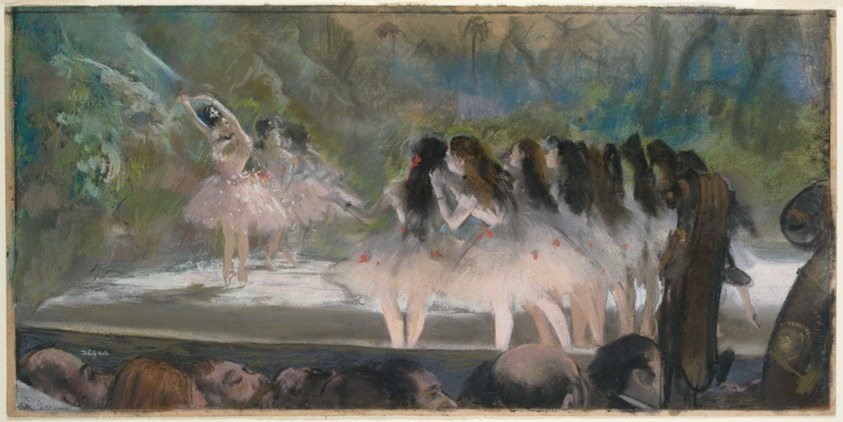
Five female figures in pale, diaphanous costumes are arranged across a warm, muted background of ochre and grey. Each wears what appears to be a simple tunic or chemise and has reddish-auburn hair or a reddish tint to the head. They are caught in various attitudes of bending, reaching, and introspective stillness. The leftmost figure bends sharply forward, arms extended downward. Moving right, one figure appears to crouch or genuinely fold inward; another stands with torso twisted and one arm raised; a fourth bends at the waist with arms stretched; the rightmost is in a deep forward fold or genuflection. The poses suggest neither synchronized movement nor a formal line, but rather a sequence of individual explorations—a study of the body's capacity to bend, reach, and release. The setting is bare and abstract, with no floor line or architectural detail to anchor the space.
The dancing
The five dancers occupy different spatial planes and temporal moments. None face the viewer directly; all are turned inward or downward. Their weight appears to shift through folding—the spine is the primary axis of movement. Arms reach without tension, legs are generally straight or slightly flexed. The bodies have a fluid, almost boneless quality; there is no verticality or lifted carriage. The spacing suggests isolation rather than relationship, each figure absorbed in a separate physical investigation. What appears consistent across them is a quality of descent, release, or inward turning rather than extension upward.
The dance depicted
This appears to depict a modern or proto-modern movement vocabulary rather than classical ballet, despite the catalogue's ballet designation. The poses—extreme forward folds, fluid twists, and weight-centered bends—suggest either Isadora Duncan-inspired barefoot modernism or a transitional moment when ballet was being challenged by new somatic ideas. The repetition of a single theme (descent, folding, inward focus) across five variations is itself a compositional approach more characteristic of early 20th-century modern dance than 19th-century ballet. The lack of pointe shoes, the absence of turn-out, and the emphasis on the spine rather than the legs all point away from classical technique. If this is meant to show ballet at all, it shows ballet being reimagined.
How it was made
The work is recorded as an oil painting. The technique is loose and impressionistic: forms are suggested rather than precisely rendered, with soft edges and a muted palette of warm browns, greys, and flesh tones. The brushwork is visible and gestural, particularly in the background, which is worked as an abstract field rather than a defined space. This approach allows the artist to capture a sense of movement and weight through suggestion and atmosphere rather than line. The painting's lack of detailed finish gives it the quality of a study or sketch, which suits its apparent purpose: the exploration of a single movement theme across variations.
About this work
This is a late-19th or early-20th-century painting—the record dates it 1893—depicting five women in simple costumes exploring a vocabulary of forward folds, twists, and spinal releases. The work sits at a pivotal moment in dance history, when the classical ballet tradition was being actively challenged by dancers and choreographers seeking new expressive possibilities. The five figures are not performing for an audience; they appear to be studying, experimenting, or demonstrating a movement principle. The painting's impressionistic technique and its focus on the body's internal architecture rather than its external display mark it as a record of modern dance emerging.
How to look at it
Attend to the spine of each figure. Notice that no two bodies hold the same shape, yet all are engaged in the same fundamental action: folding, bending, turning inward. The artist has frozen a moment not of synchronized ensemble movement but of individual exploration—as if the five dancers are working through variations of a single idea in parallel. Look at the weight distribution: there is no lifted, linear verticality; instead, weight pools and shifts through the spine. The pale color and soft edges of the figures against the warm, worked background create a sense of the dancers being immersed in or emerging from an atmosphere rather than standing apart from it. This is a painting about interiority in movement.
The artist
Edgar Degas (1834–1917) was among the most sustained visual chroniclers of dance in the 19th century. His repeated studies of the Opéra and its dancers—in pastel, monotype, and oil—span nearly four decades. However, his work also evolved: the tightly observed, naturalistic ballet scenes of the 1870s gradually gave way to more abstracted, expressive treatments of the moving body. His late work increasingly emphasizes movement as an internal, sculptural investigation rather than as a performed spectacle. This painting sits late in his career and shows him in dialogue with emergent modern dance ideas, not simply documenting classical ballet practice.
The period
In 1893, classical ballet was still the dominant theatrical dance form, but its hegemony was being quietly challenged. Isadora Duncan was beginning to develop her barefoot movement aesthetic (though she did not debut publicly in America until 1896). The Ballets Russes would not form until 1909, but the intellectual groundwork for modernism in dance—the rejection of turn-out, the embrace of spinal flexibility, the idea of dance as personal expression rather than technical display—was already circulating in artistic circles. In painting, Impressionism had shifted the art world's attention from narrative to light, form, and the fleeting moment; dancers and choreographers were similarly beginning to ask what movement could express when freed from narrative requirement. Degas's work here shows him alert to these currents.
Where it lives
The work is recorded as sourced from Wikimedia Commons with no current holding institution named in the catalogue record. It is identified as an oil painting dated 1893 and attributed to Edgar Degas, but without accession information or institutional provenance noted.
Dance in this work
Questions about this work
Why does the catalogue call this ballet when it doesn't look like ballet?
The record reflects an older understanding of Degas's practice as exclusively focused on classical ballet at the Opéra. In fact, Degas's late work increasingly engaged with movement vocabularies that challenged ballet convention. The absence of pointe shoes, turn-out, and lifted carriage here, and the emphasis on spinal flexibility and introspection, suggest a modernist investigation rather than classical dance documentation. The label may reflect incomplete cataloguing rather than the artist's intent.
Are these meant to be the same dancer repeated?
Possibly, but more likely they are five separate dancers demonstrating variations on a theme. Degas was interested in sequence and repetition—in how a single movement idea could generate multiple expressions. The repeated study format here resembles both classical dance pedagogy (variations on a theme) and modernist compositional thinking (systematic exploration of a movement principle). The effect is more like a study sheet than a single moment caught in time.
What dance style is this actually showing?
It is most consistent with early modern dance as it was developing in the 1890s—Isadora Duncan's nascent barefoot movement, or contemporary experiments with freed spinal movement and emotional expression through the body. It might also depict experimental work within ballet circles as younger artists pushed against classical strictures. The painting is evidence of a transition period rather than a clear-cut style.
Why paint dancers in such muted, impressionistic style?
The soft, atmospheric quality allows movement itself—the shift of weight, the arc of the spine—to be the subject, rather than the visual spectacle of costume or virtuosity. Degas's impressionistic approach mirrors modernist ideas about dance as an internal, spiritual practice rather than external display. The technique suits the apparent purpose: studying how the body moves, not how it appears on stage.
More Ballet artwork