49 works in this view — arrow keys or swipe to move between them.
Dance in Art · 1899
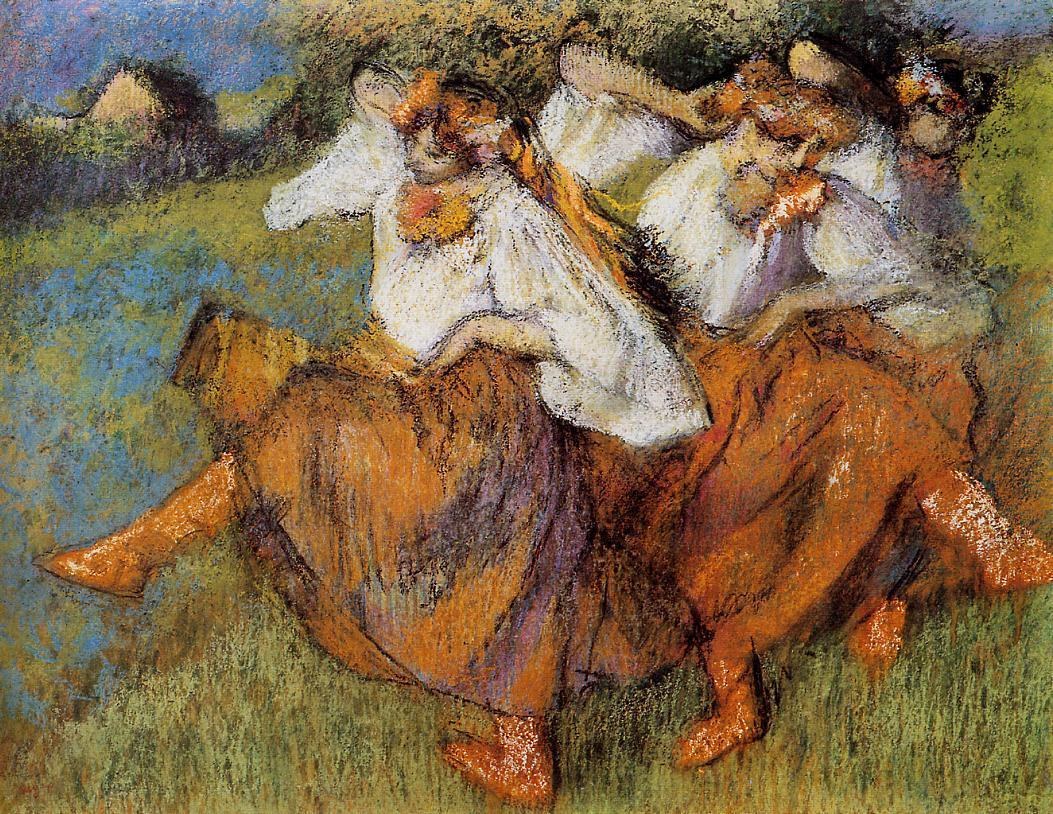
Degas - Russian Dancers, circa 1899, ID=5614
Edgar Degas
- Medium:
- Oil Painting
- Dance:
- Ballet
- Era:
- Late 1800s (Victorian Ballroom)
- Source:
- Wikimedia Commons
- Rights:
- Public domain — free to use, share and adapt.
- Recorded as:
- Public Domain
This work is essential to understanding how late-19th-century artists saw dancers: not as ethereal fantasies but as working bodies, often arranged in asymmetrical, naturalistic groupings that privilege observation over convention. Degas's choice to paint Russian dancers specifically may reflect the cultural moment of the Russian Imperial Ballet's growing influence in European artistic circles. The painting also shows how thoroughly ballet had entered the visual culture of the Parisian avant-garde by the 1890s—it was no longer exotic, but a familiar, almost domestic subject.
What you are looking at
Three female dancers in white tutus and flesh-toned tights are captured mid-movement against a soft blue-green background. They wear their hair up and simple corsages at the bodice. Their bodies lean and twist in dynamic, interrelated poses—one figure arches back sharply while her companions bend and reach around her, their limbs overlapping in a moment of close, almost intimate ensemble choreography. The brushwork is loose and impressionistic; Degas has worked in pastel or oil with visible strokes that dissolve the forms slightly, softening the edges of the dancers' bodies and emphasizing the fluidity of their movement. The composition is cropped and off-centre, as if the viewer has glimpsed them through a doorway or caught them unaware. The lighting is even and cool, with warm ochre and brown tones enriching the dancers' limbs and the shadowed folds of their tutus.
The dancing
The three dancers occupy a tightly compressed group, their bodies in a kind of stacked or braided configuration rather than a line or circle. Two of the figures twist sharply from the vertical—one arches backward with her arm extended, the other bends forward—while the third, positioned behind or between them, reaches upward and across. Their legs are barely differentiated in the image; the focus is on the torsos and arms. The poses suggest either a moment of rest between movements or a compressed, off-balance ensemble movement where bodies support or counterbalance one another. There is no classical symmetry or formal spacing.
The dance depicted
These are almost certainly ballet dancers, identifiable by their tutus, pointe shoes, and the vocabulary of their poses. The painting's title suggests they may be members of a Russian ballet company, though the image alone does not confirm that. The choreography—if that is what is frozen here—is not classical in the strict sense. The dancers are not in any recognisable codified position; instead, they occupy a moment of transition or informal togetherness that suggests either rehearsal or a more modern, less rigid choreographic language. This is consistent with the emerging experimental ballets of the 1890s, particularly the Russian Imperial Ballet's move away from pure technical display.
How it was made
The work is executed in pastel or oil paint (the record states oil) with a technique that allows for rapid, visible brushwork and a soft, almost chalky finish. Degas worked frequently in pastel and often on paper rather than canvas, which produced a more intimate, sketch-like quality even in finished works. The technique—rapid directional strokes, visible colour layering, soft edges—suggests this was made quickly, perhaps from life or from memory and sketches. The effect is to emphasize the dancers' bodies as volumes of moving colour and light rather than as precisely rendered figures.
About this work
This is one of Degas's studies of backstage ballet life, focusing on a moment of rest or informal choreography among three dancers rather than on performance or spectacle. The painting sits within his decades-long investigation of dancers' bodies in everyday situations—rehearsal, repose, preparation—rather than in the formal arrangements of the stage. The work exemplifies Degas's impressionistic approach to ballet as a subject: dancers are not idealized or frozen in a single perfect position, but caught in the flux of movement and the mundane reality of dance as labour. The painting demonstrates both his technical mastery and his fundamental disinterest in the ballet as a finished product; instead, he was drawn to the dancers themselves, their physical peculiarities, and the informal moments between performances.
How to look at it
Look first at the rhythm of the composition: notice how the three dancers are knitted together, with no clear top or bottom, and how the viewer's eye moves from one overlapping body to the next rather than resting on a single focal point. This is the ballet vocabulary Degas chose to emphasize—not the clean lines and symmetry of classical training, but the complexity of three bodies moving in close relation. The soft, blurred edges and warm-toned shadows also matter; they suggest movement, breath, and the texture of real bodies rather than the hard outlines of academic art. Finally, attend to what is almost absent: there is no stage, no audience, no grand setting. These dancers exist in an intimate space, as if you have walked into a rehearsal room and glimpsed them between runs.
The artist
Edgar Degas (1834–1917) was obsessed with dancers throughout his career, producing thousands of works on the subject in oil, pastel, charcoal, and print. He spent decades observing rehearsals and performances at the Opéra in Paris, documenting dancers in states of fatigue, concentration, and informal rest. Unlike many of his contemporaries, Degas was not interested in the fantasy or spectacle of ballet; instead, he treated it as a vehicle for exploring human anatomy in motion and the texture of working life. His approach was deeply observational, informed by a lifelong study of Japanese prints, classical sculpture, and modern photography. By the 1890s, his work on ballet had become increasingly loose and experimental, moving away from precise naturalism toward more abstracted, colour-driven compositions.
The period
In the 1890s, ballet was undergoing significant transformation. The Romantic era's emphasis on ethereal, weightless femininity was giving way to more varied, technically demanding choreography. The Russian Imperial Ballet, under directors such as Marius Petipa, was developing a new aesthetic that valued technical virtuosity and dramatic narrative equally. Simultaneously, the Parisian art world was absorbed in Impressionism and Post-Impressionism—movements that rejected academic finish in favour of visible technique and subjective observation. Degas occupied a unique position: he was not a strict Impressionist, but he shared their commitment to modern life as a subject and their interest in light, colour, and informal composition. Dancers fit perfectly into this framework; they were modern, visible, and endlessly various in their poses and states.
Where it lives
The painting is sourced from Wikimedia Commons, as noted in the catalogue record. No holding institution is recorded.
Dance in this work
Questions about this work
Are these dancers really Russian?
The title assigns them that identity, and the catalogue record confirms it, but the painting itself shows no costume or setting that would distinguish Russian dancers from French ones. The designation may reflect either Degas's knowledge of the dancers' company or a later attribution. By the 1890s, the Russian Imperial Ballet's growing reputation in Europe made such identification culturally significant, even if visually invisible.
Is this a finished painting or a sketch?
It is finished in Degas's sense: a complete work with considered composition and colour relationships. However, it has the immediacy and visible technique of a sketch. Degas often worked this way, valuing the energy of loose brushwork and visible process over the smooth, invisible finish of academic painting. This was radical for the time and remains one of his most recognizable traits.
What are the dancers doing?
It is unclear whether they are in a choreographed ensemble, resting between runs, or stretching. Degas was indifferent to narrative clarity; he was interested in the moment as visual and physical rather than as dramatic. This ambiguity is intentional and characteristic of his method.
Why did Degas paint so many dancers?
Dancers offered Degas an inexhaustible subject: the human body in motion, in light, in various states of effort and repose. They also represented modern Paris—the theatre was a public space where he could observe without being observed. Beyond that, he found in the ballet a formal problem that occupied his entire practice: how to render movement, balance, and the infinitely varied poses of the body in space.
More Ballet artwork