49 works in this view — arrow keys or swipe to move between them.
Dance in Art · 1899
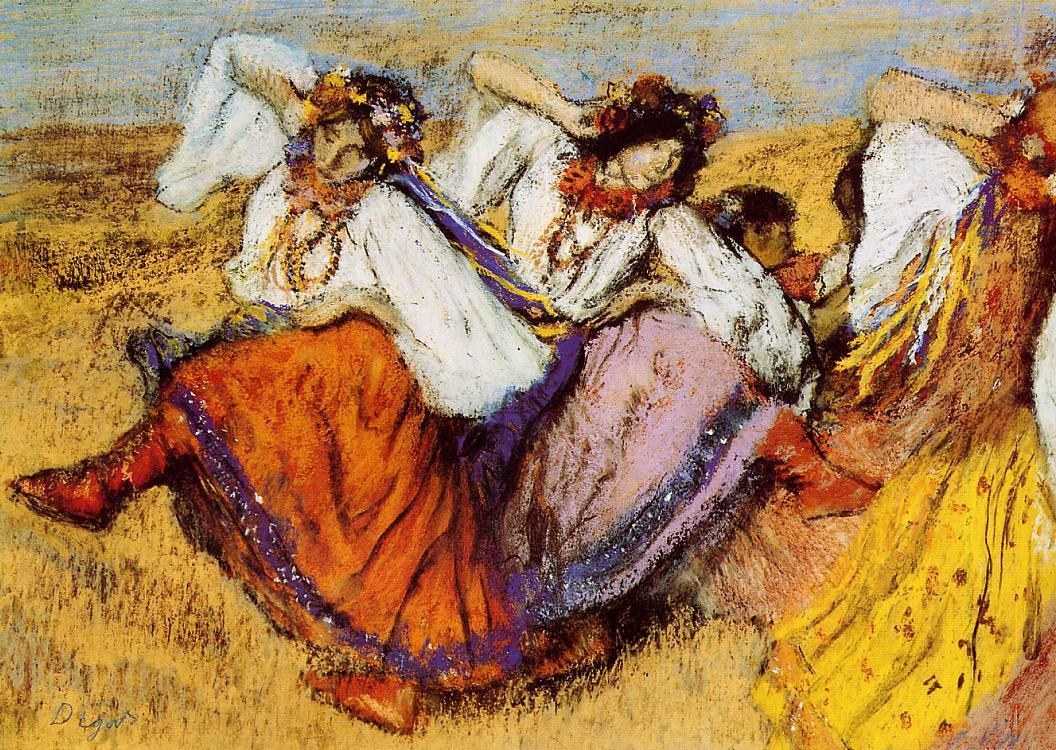
Degas - Russian Dancers, circa 1899, ID=5618
Edgar Degas
- Medium:
- Oil Painting
- Dance:
- Ballet
- Era:
- Late 1800s (Victorian Ballroom)
- Source:
- Wikimedia Commons
- Rights:
- Public domain — free to use, share and adapt.
- Recorded as:
- Public Domain
Degas' Russian Dancers documents a crucial historical moment when Imperial Russian ballet was emerging as a major force in European dance, a shift that would culminate in the 1909 Ballets Russes and transform twentieth-century choreography. The painting also exemplifies Degas' late practice of using the dancer as a subject for modernist exploration of form, light, and movement abstracted from theatrical narrative. For historians of dance, it offers direct evidence of how Imperial ballet was perceived and represented in Paris at the century's turn.
What you are looking at
Three female dancers in white tunics with reddish-brown hair piled high dominate the composition, arranged in a loose diagonal group against a golden-yellow ground. Their costumes—short white chitons or tunics with what appear to be jeweled or ornamental details at the shoulders—and their styling suggest a deliberate evocation of classical or "Russian Imperial" aesthetics. The figure at left leans forward dynamically, one arm raised; the central dancer is caught mid-movement with arms extended; the rightmost figure completes the group. Behind and to the right, a fourth dancer in warmer tones (orange-gold drapery) is partially visible. The painting's rough, sketchy handling and warm palette—dominated by ochres, golds, and terracotta—creates an impression of movement and energy. The shallow space and compressed composition push the figures forward, emphasizing gesture over narrative setting.
The dancing
The dancers' bodies are caught in varied, dynamic poses suggesting continuous motion rather than a static tableau. The leftmost figure bends forward with urgency, her raised arm suggesting an upswing or arabesque preparation. The center dancer's extended arms and twisted torso indicate a turn or traveling step. Weight shifts from foot to foot are implied rather than anatomically precise. The poses are balletic in aspiration—raised arms, pointed feet, the suggestion of turnout—but rendered with the sketchiness of a rehearsal study or quick notation rather than academic precision. The fourth figure's partial visibility creates a sense of ongoing action beyond the frame.
The dance depicted
This work depicts Russian Imperial ballet dancers, almost certainly in a rehearsal or informal study context rather than a finished theatrical moment. The title specifies them as Russian dancers, and the dating (1899) places this in the era of the Maryinsky Theatre and the dominance of Imperial Russian ballet aesthetics. The costumes and poses reference classical ballet vocabulary, particularly the Romantic era's emphasis on ethereal, floating movement. Degas did not typically engage with Russian ballet directly—his ballet subjects were overwhelmingly Parisian (the Opéra and its students)—which makes this work exceptional. The informal, sketch-like treatment suggests Degas may have been capturing dancers in a moment of preparation or informal movement class rather than theatrical performance.
How it was made
Oil painting on canvas (or possibly board), executed with visible, loose brushwork and a palette dominated by warm earth tones. Degas' technique here is deliberately unfinished in appearance, with areas of bare ground showing through and contours suggested rather than defined. This sketchy handling was deliberate in his late practice—a modernist rejection of academic finish—and allowed him to capture the fugitive quality of movement and the dancer's body in transition. The warm, unified tonality and the emphasis on color over line create an impression of movement and light that would have been impossible in more tightly rendered work.
About this work
This small oil painting captures three (or four) dancers in white classical tunics in a moment of rehearsal or informal movement. Degas identified them as Russian dancers, likely invoking the prestige of the Imperial ballet at a moment when Russian dance was beginning to challenge French hegemony in Europe. The work is exceptional in Degas' oeuvre for its explicit engagement with Russian performers and aesthetics, and for its date at the very threshold of the 20th century. Painted in his characteristic late style—loose, warm-toned, with emphasis on the fleeting moment—it represents Degas' mature understanding of the dancer's body in motion, stripped of theatrical spectacle and reduced to pure movement study.
How to look at it
Attend first to the arrested moment Degas has chosen: these are not dancers in a stable pose or final tableau, but in transition between steps, bodies twisted and arms extended in the dynamic geometry of classical training. The loose, sketchy handling invites the eye to complete the motion suggested rather than represented—a modernist technique that makes the viewer an active participant in the illusion of movement. Note how the warm, unified palette (golds, ochres, warm whites) creates atmospheric cohesion, dissolving the distinction between figure and ground and emphasizing the dancers' bodies as volumes moving through space rather than silhouettes. The composition's shallow depth and compressed group push the dancers forward into the viewer's space, collapsing the distance between stage and spectator.
The artist
Edgar Degas (1834–1917) was the preeminent painter of ballet and dancers in the nineteenth century, producing hundreds of works on this theme over more than five decades. Unlike his Impressionist colleagues, Degas approached dancers not as picturesque subjects but as workers and athletes, attending rehearsals and classes at the Paris Opéra obsessively and depicting the grueling labor of training. His late work, particularly after 1890, became increasingly loose and coloristic, with warm, unified palettes and abbreviated forms. Degas' engagement with Russian dancers—a relatively rare subject in his oeuvre—reflects the growing prominence of Russian ballet and the artist's continuing preoccupation with capturing the body in motion.
The period
In 1899, Imperial Russian ballet was entering a period of international ascendance. The Maryinsky Theatre under director Ivan Vsevolozhsky had consolidated a distinctive aesthetic blending Italian technical virtuosity (via maestro Cecchetti) with French choreographic traditions. This style would be showcased to Paris and Europe beginning in 1909 when Sergei Diaghilev's Ballets Russes premiered. Degas himself was elderly and working in relative isolation from the broader Impressionist movement by 1899, but he remained absorbed in the study of movement. The painting's date places it in the final decade of the nineteenth century, when academic ballet still dominated theaters even as modernist painters were beginning to fragment and reimagine representation.
Where it lives
The catalogue record notes this work as sourced from Wikimedia Commons, with no collection or holding location recorded. The work's history and current location are unknown to this database.
Dance in this work
Questions about this work
Why would Degas paint Russian dancers when he was so focused on the Paris Opéra?
By the 1890s, Russian Imperial ballet had become a major force in European dance, and Paris was keenly aware of it. Dancers and companies from Russia performed in Paris, and Russian aesthetics—emphasizing classical technique and ethereal movement—fascinated European artists. Degas may have encountered Russian dancers performing or rehearsing in Paris, or he may have been responding to the broader cultural moment in which Russian ballet was gaining prestige. His engagement with them was relatively rare, which makes this work historically significant.
Are these the same dancers Degas painted elsewhere, or identifiable individuals?
The catalogue record provides no identification of these specific dancers, and Degas' late work often used dancers as generic types rather than individualized portraits. Without additional documentation, we cannot identify them. The title 'Russian Dancers' is sufficient to situate them culturally and aesthetically.
What do the white tunics mean? Are they wearing stage costumes?
The white tunics likely reference classical ballet's aesthetic vocabulary—the Romantic era's association of ballet with ethereal, classical subjects—rather than any specific production costume. They may reflect studio dress or rehearsal attire, or they may be Degas' stylization to emphasize the dancers' bodies and movement. The sketchy handling makes it difficult to determine whether these are historically accurate costumes or artistic convention.
More Ballet artwork