49 works in this view — arrow keys or swipe to move between them.
Dance in Art
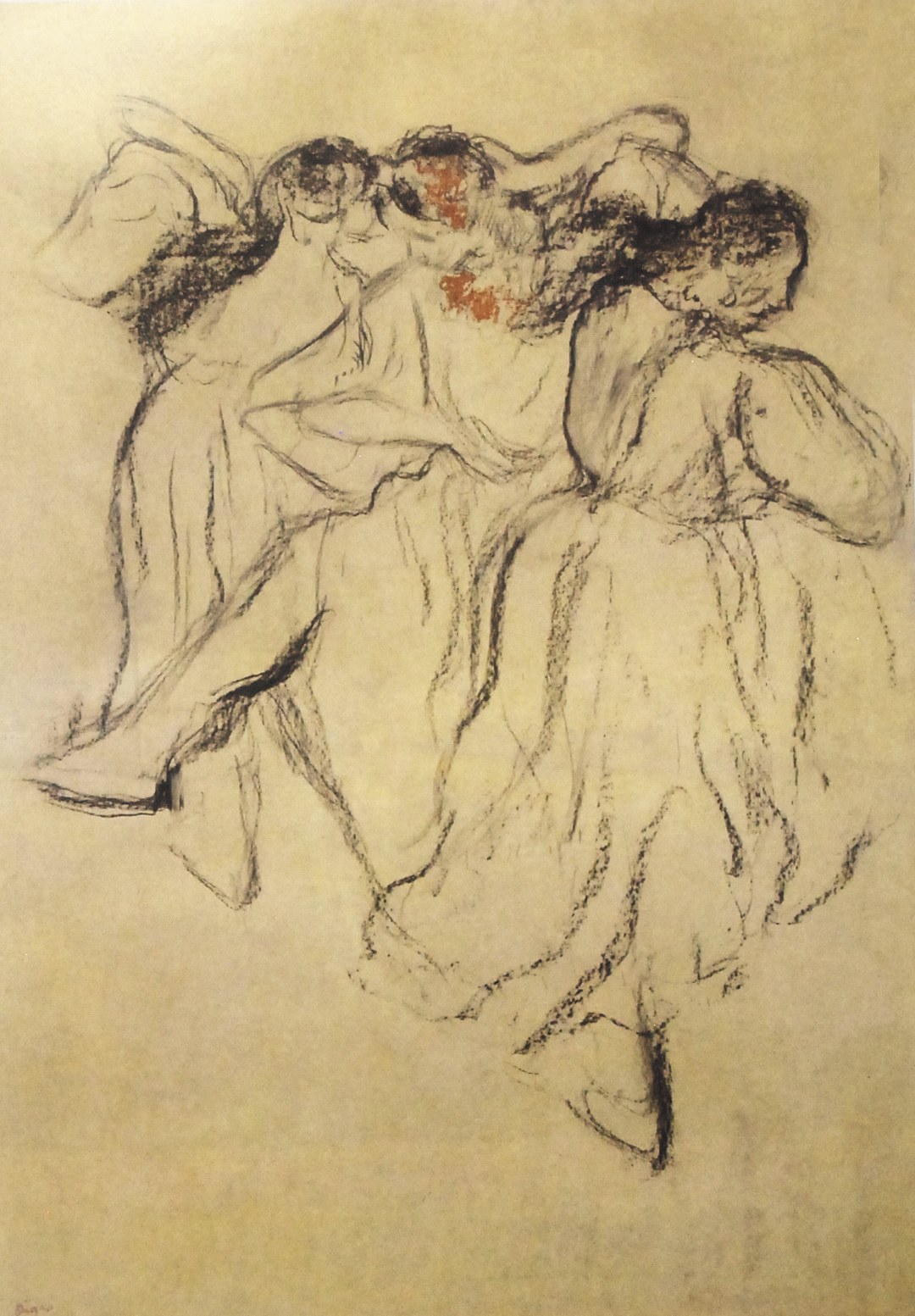
Three Russian Dancers 1204
Edgar Degas
- Medium:
- Oil Painting
- Dance:
- Ballet
- Era:
- Late 1800s (Victorian Ballroom)
- Source:
- Wikimedia Commons
- Rights:
- Public domain — free to use, share and adapt.
- Recorded as:
- Public Domain
This drawing offers rare documentary evidence of how late 19th-century Russian dancers actually carried their bodies in unguarded moments—relaxed, conversational, without the forced artifice of performance. For art historians, it demonstrates Degas's mature technique of capturing the essence of a figure with minimal means. For dance historians, it records the physical type and presence of dancers from a tradition that would soon dominate European ballet through the Ballets Russes.
What you are looking at
Three female figures in flowing, lightweight drapery are arranged in a loose, informal group against a plain background. The drawing captures them in what appears to be a moment of social interaction or preparation rather than formal performance—they lean toward one another, their bodies relaxed and intimate. The central figure faces forward while the others angle inward; their heads cluster together in conversation or conspiratorial closeness. The artist has rendered the women's faces with delicate linear work, adding touches of reddish-brown pigment to cheeks and lips that animate the pale paper. The drapery is suggested through loose, gestural charcoal lines that follow the fall of fabric and the implied movement of the bodies beneath—the skirts trail toward the lower edge of the composition with fluid, unhurried lines. The drawing technique is economical: the artist has left large areas of the paper bare, using negative space to define form, while darker passages of charcoal emphasize the heads and upper bodies where the viewer's attention is drawn.
The dancing
The three dancers stand close together in a grouping that suggests ease and familiarity rather than formal arrangement. None adopts a lifted, turned-out classical position; instead, their weight appears naturally distributed, their posture conversational. The central figure's torso faces the viewer while her head tilts toward her companions; the flanking figures lean inward with soft, rounded arm positions. There is no visible tension in the necks or shoulders—no held turnout from the hips—that would signal classical ballet training. The bodies read as young, female, and lightly muscled, but the drawing technique does not clarify footwork or the precise mechanics of their stance.
The dance depicted
The image most likely depicts Russian Imperial Ballet dancers, probably from the Ballets Russes era or the decades immediately before it, given the catalogue title and the date range (late 1800s). The relaxed, informal gathering—three women without scenery or formal costume—suggests a backstage or dressing-room moment rather than a staged performance. They wear no pointe shoes visible in the drawing, and their posture suggests the preliminary ease of preparation or socializing rather than active dance. If these are ballet dancers, the image captures them in repose, a moment the artist found more compelling than the formal geometry of a choreographed sequence. The style of dress and the delicate handling suggest dancers from a tradition that prized grace and lightness over the dramatic intensity of pantomime ballet.
How it was made
This is a mixed-media drawing on paper, combining charcoal (or graphite) line work with touches of oil or pastel in reddish-brown. The artist has worked economically, using the paper's pale tone as an active element rather than filling the whole surface. The linear quality of the underdrawing—fine, assured lines defining the heads and upper bodies—suggests the artist worked from life or from practiced observation of dancers' bodies. The addition of color to the faces was a deliberate second step, giving those areas emphasis and presence. This technique of selective color in an otherwise linear drawing is characteristic of late 19th-century figure study and suggests a work made for study or private collection rather than for public exhibition or reproduction.
About this work
This is an informal study of three young dancers, captured by Degas in a moment of social ease rather than formal performance. The work exemplifies Degas's lifelong fascination with the ballet world—not the grand spectacle of stage performance, but the everyday intimacy of dancers' lives, their bodies, and their relationships. The drawing is characteristic of his practice: economical in means, precise in observation, and attentive to the particular grace of the female form in motion and at rest. The catalogue identifies them as Russian dancers, placing the work within the early decades of the Ballets Russes or the wave of Russian dancers who performed in European capitals in the late 19th century. For a historian of dance, the image documents not technique or choreography, but the physical presence and social world of professional dancers at the turn of the century.
How to look at it
Look first at the grouping: the artist has arranged the three figures so that their heads cluster and their bodies create a kind of informal circle, with no hierarchy or formal axis. This composition—intimate, offstage, conversational—was Degas's signature move. Notice how lightly he has drawn the lower bodies: the skirts are nearly abstract, defined by a few gestural strokes, while the heads are more fully realized. The touches of color to the cheeks and lips are crucial—they animate the faces and suggest the living presence of young women, not abstract forms. Finally, observe the artist's economy: he has used almost no shading, no modeling of form, yet the bodies read clearly in space. This is the work of an artist who understood the mechanics of the human body so thoroughly that he could suggest it with minimal means.
The artist
Edgar Degas (1834–1917) was obsessively committed to depicting the Paris Opéra and its dancers. He attended rehearsals, obtained backstage access, and produced hundreds of works—paintings, pastels, prints, and drawings—of dancers in performance, training, and rest. His interest was neither moralistic nor prurient; he was fascinated by the formal and anatomical problems of representing the moving body, and by the particular grace and musculature of young female dancers. He worked from life and from memory, often combining observations into composite scenes. His late work, as here, became increasingly economical in line and selective in color, moving toward abstraction while remaining grounded in precise anatomical knowledge.
The period
The late 1800s saw the rise of Russian Imperial Ballet as a dominant force in European dance, particularly after the Ballets Russes began touring the West from 1909 onward. But Russian dancers had performed in Western Europe throughout the latter decades of the 19th century, and their technical virtuosity and dramatic intensity had already begun to displace the older Romantic tradition. Degas, who came of age during the height of the Romantic ballet and witnessed the transition to more athletic, virtuosic styles, was drawn to capturing dancers of this transitional moment. His late drawings and pastels often focus on the informal, unglamorous aspects of dance—rehearsal, rest, preparation—at a moment when the profession itself was undergoing rapid change.
Where it lives
The work is attributed to Edgar Degas and listed as belonging to the Wikimedia Commons database, where it is available as a digital image. The catalogue record provides no information about the current holding institution or accession number. The title 'Three Russian Dancers' appears to be a later descriptive label rather than an original designation.
Dance in this work
Questions about this work
Are these dancers performing or posing for the artist?
Almost certainly neither. The composition and the relaxed posture suggest Degas captured them in a backstage or dressing-room moment—a candid observation of dancers in repose. The informal grouping and the absence of any formal setting or costume indicate he was interested in their presence as individuals, not in choreography or performance.
Why did Degas draw dancers so often?
Degas was fascinated by the technical and formal problems of representing the moving human body, and by the particular challenges of depicting young female dancers whose bodies were trained in ways that distinguished them from ordinary people. He also had unusual access to rehearsals and backstage spaces, and he valued the informality and grace he found there over the spectacle of finished performance.
What does the style of drawing tell us about when this was made?
The economical line work, the selective use of color, and the mature handling of negative space are all characteristic of Degas's late practice, roughly the 1880s–1900s. By this point he was working with extreme confidence, using minimal means to achieve maximum effect.
Why does the catalogue call them Russian dancers?
The title is a later attribution, likely based on visual evidence of costume or type, or on Degas's documented interest in Russian dancers of the period. Without more detailed provenance information, we cannot be certain when or how this identification was made.
More Ballet artwork