49 works in this view — arrow keys or swipe to move between them.
Dance in Art · 1873
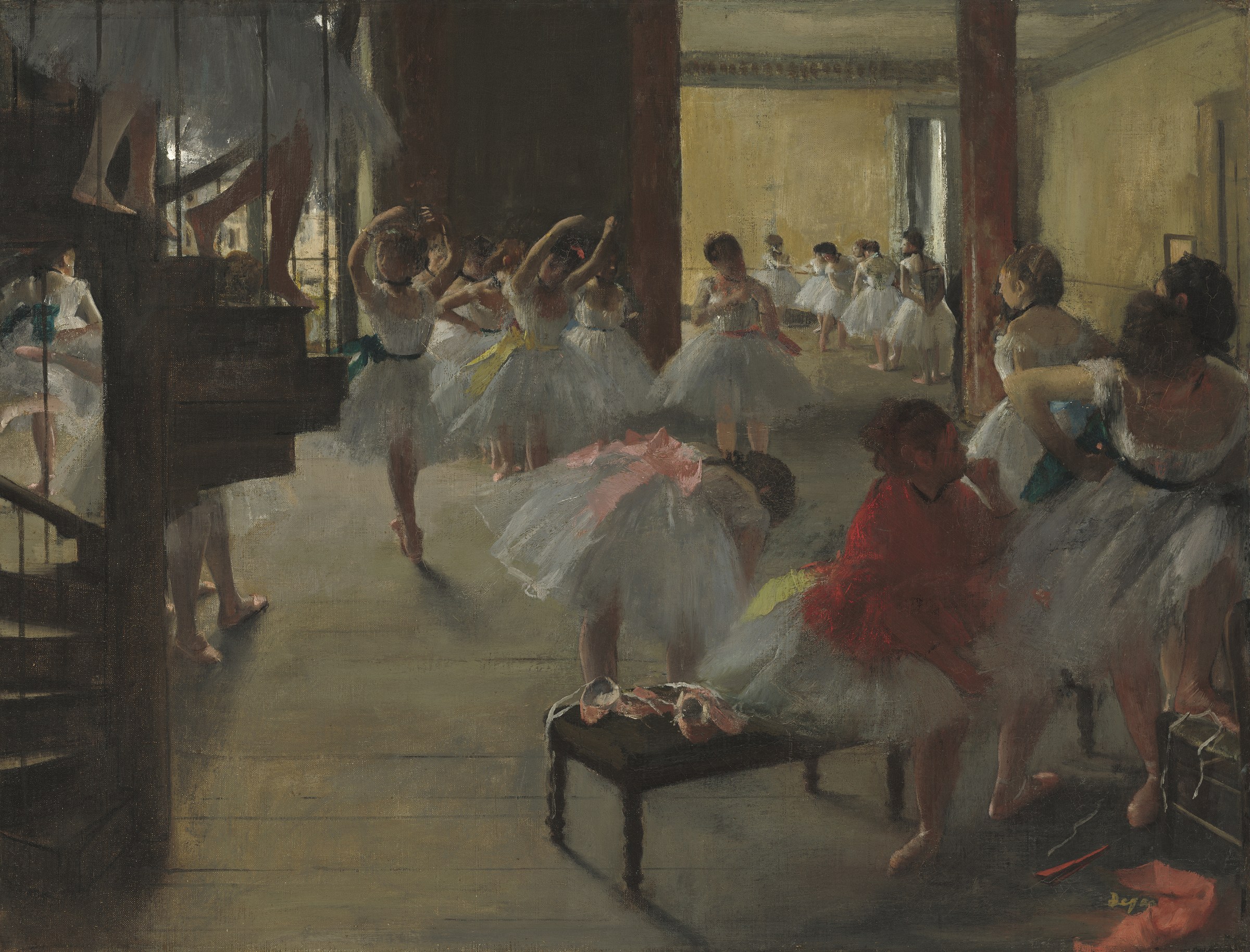
Hilaire-Germain-Edgar Degas, The Dance Class, c. 1873, NGA 165300
Hilaire-Germain-Edgar Degas
- Medium:
- Oil Painting
- Dance:
- Ballet
- Era:
- Late 1800s (Victorian Ballroom)
- Source:
- Wikimedia Commons
- Rights:
- Public domain — free to use, share and adapt.
- Recorded as:
- CC0
This painting is among the earliest systematic artistic representations of ballet rehearsal and the hidden labor of dance training. For dance historians and practitioners, it is invaluable evidence of studio practice, dress, posture, and pedagogical method in the professional ballet world of the 1870s—a documentary record painted from direct observation.
What you are looking at
A ballet studio in the late nineteenth century during a rehearsal or class. The space is a long, high-ceilinged room with cream-colored walls and support columns; its industrial proportions and plain fixtures suggest a working studio rather than a performance venue. Most of the dancers are young women in white tutus, positioned at various points across the floor: some standing in loose formation, others bending or stretching, a few in the middle distance appearing to move through combinations. A woman in a red dress sits to the right, her posture suggesting she is an instructor or supervising adult. In the left background, a figure in darker clothing stands near a mirror or barre. Clothing, shoes, and fabric scatter across the floor in the foreground. The light is diffuse and cool, falling from windows or skylights, giving the scene an air of focused concentration without drama. The composition captures dancers between moments rather than mid-leap: the artist has chosen to show the work of dance—the repetition, the waiting, the adjustment—rather than its virtuosity.
The dancing
The dancers are in bare feet or soft slippers, many standing with their weight on one leg, arms raised in the preparatory or practice positions of ballet training. Several stand in what approximates turnout, though the artist has not emphasized anatomical precision. One dancer in the center distance has both arms raised in a port-de-bras movement; another bends forward from the hips as if stretching. The figures are distributed across the space rather than arranged in lines, suggesting this is a moment of rest or individual work between group instruction. No pair holds or lifts are visible, and the poses are the kind taught rather than performed—the grammar of the studio rather than the stage.
The dance depicted
This is a representation of ballet training and rehearsal in a professional studio, most likely in Paris in the 1870s. The dancers appear to be members of the corps de ballet or students at the Opéra, a setting the artist knew well. The image documents not ballet performance but ballet work: the mundane, repetitive training that produced the ethereal figures audiences saw on stage. The white tutus and bare feet confirm classical ballet, and the indoor studio setting makes clear this is a working session, not a public concert. The presence of the supervising figure in red—likely a rehearsal master or ballet master—underscores the hierarchical teaching structure of the period.
How it was made
Oil on canvas, applied with loose brushwork that captures light and movement rather than fine detail. The artist has used soft edges and a muted palette—creams, browns, grays, with touches of white and red—to convey the atmosphere of the studio rather than its decoration. The technical approach allows the painter to suggest multiple figures and complex spatial relationships while maintaining the unity of the scene through light and tone. This technique was suited to the circulation of such works as easel paintings in collectors' hands, not as public decoration, which gave the artist freedom to treat an interior working scene as a worthy subject for serious art.
About this work
This is an interior scene of a ballet studio during rehearsal or class, painted in oil on canvas in the 1870s. The artist has documented the unglamorous work of ballet training—stretching, practicing, waiting—in a high-ceilinged studio in what is recognisably the context of the Paris Opéra or a similar professional ballet institution. The composition and subject reflect a shift in how dance was represented in art: rather than frozen moments of virtuosity or scenes of theatrical performance, the painter chose to show dancers as workers, in their studio clothes and in the spaces where they trained. The work sits at the intersection of Realist painting practice and the emerging fascination with behind-the-scenes subjects that would become characteristic of late nineteenth-century artistic culture.
How to look at it
The viewer should attend to the scattered arrangement of figures and the absence of a single focus: there is no principal dancer, no moment of climax. Instead, notice how Degas has distributed the dancers across the studio in various poses, some in profile, some three-quarter, some from behind. The moment is one of work and waiting, not performance. Look at the floor, where abandoned clothing and shoes litter the space—evidence of the casual, laboring aspect of studio life. Notice too the light, which is neither dramatic nor theatrical but the cool, even light of a working day, and the way the artist has used it to unify the space and the figures within it.
The artist
Edgar Degas (1834–1917) was a French painter and sculptor who made ballet one of his sustained subjects over several decades. He had privileged access to rehearsals and backstage spaces at the Paris Opéra and returned repeatedly to the theme of dancers in rehearsal, in the studio, and resting. His interest was not in performance but in movement itself—the body in work, in fatigue, in ungraceful poses between moments of display. He worked in oil, pastel, and printmaking, and his loose, energetic handling of paint and his unusual compositional angles—looking down, cropping figures, using deep perspective—were revolutionary for the time. His dance paintings were widely exhibited and collected and established him as a major interpreter of modern urban life.
The period
By the 1870s, ballet had become industrialized in the sense that large state-sponsored institutions like the Paris Opéra employed dozens of dancers in a hierarchical system of ranks and wages. The training of dancers was systematized and rigorous, following the method of Agrippina Vaganova and other codified systems. At the same time, Realist and Impressionist painters were turning away from historical, mythological, and allegorical subjects toward scenes of modern life—urban, domestic, and working. Degas's ballet paintings fit this shift: they treat professional dance workers as a legitimate subject for serious art, on a par with laundresses or café-goers. The subject also reflected growing bourgeois interest in the institutions and personnel behind public spectacle.
Where it lives
The work is recorded as held in a collection and sourced from Wikimedia Commons. The painting is oil on canvas, dated to circa 1873.
Dance in this work
Questions about this work
Is this a finished painting or a sketch?
This is a finished oil painting, not a preparatory work, although Degas's style—with loose brushwork and areas of unfilled canvas visible in some versions—may give it the appearance of a sketch to modern eyes. Degas often worked this way, and the painting was considered complete and saleable in his time.
Who are these dancers?
They are not named individuals but members of the corps de ballet or students at a ballet academy, most likely the Paris Opéra, where Degas had access to rehearsals. The painting is a genre scene—a representation of a type of work and social space—rather than a portrait of specific people.
Why is the man in the painting wearing a red dress?
The figure in red is almost certainly a woman: a ballet mistress, rehearsal director, or other supervising adult. The red garment stands out against the white tutus and helps signal her position of authority in the studio. Red was not uncommon in women's street clothing of the 1870s and serves here as a compositional device to organize the viewer's attention.
What does this tell us about how ballet was taught then?
The image shows a large group learning together in an open studio space, with a supervising instructor present. Dancers worked in street clothes and soft shoes during rehearsal, not in performance costume. The poses visible—turnout, port-de-bras, stretching—confirm the use of the classical ballet vocabulary system that is still taught today.
More Ballet artwork