49 works in this view — arrow keys or swipe to move between them.
Dance in Art · 1870
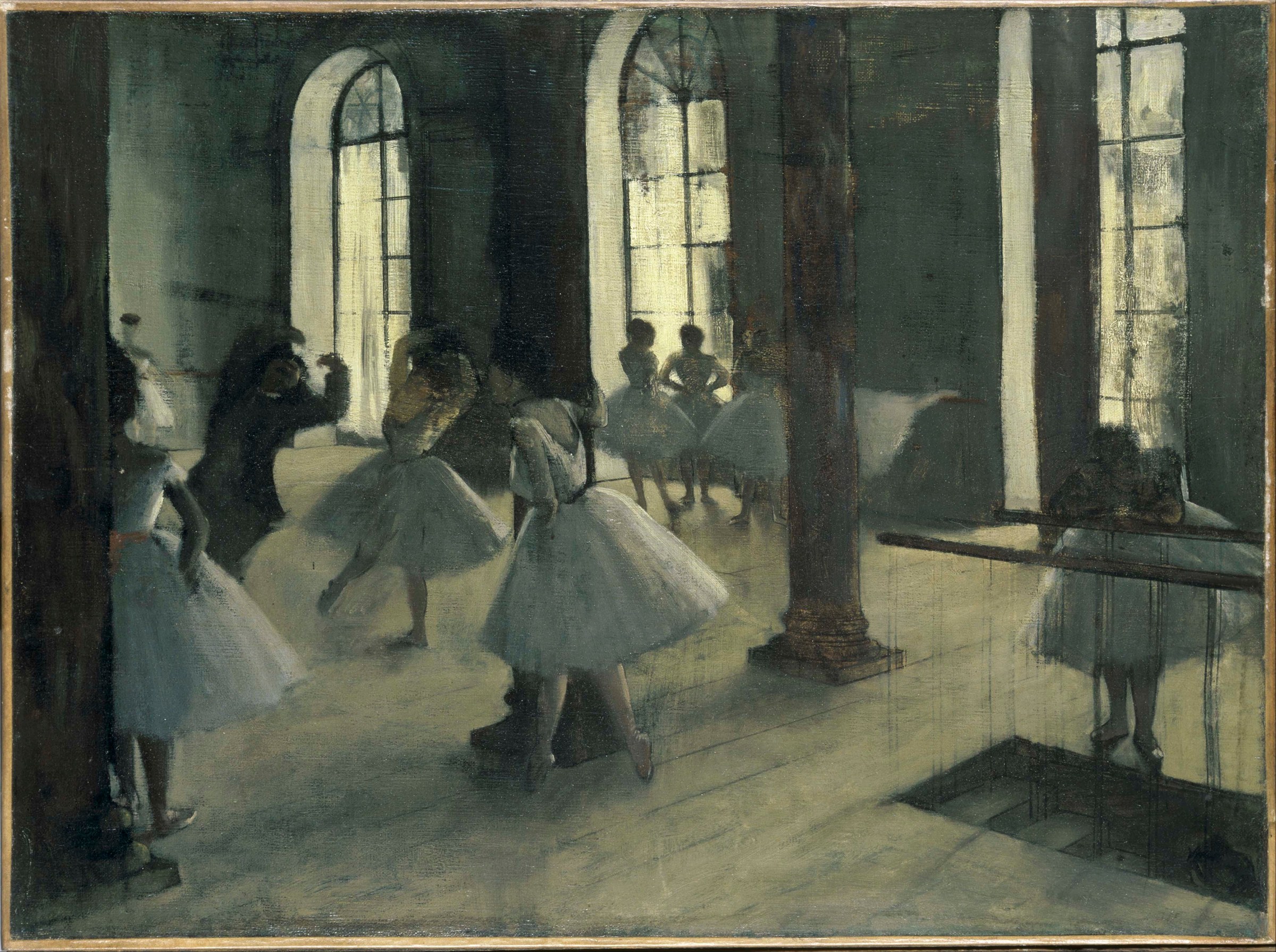
Edgar Degas - La Répétition au foyer de la danse
Edgar Degas
- Medium:
- Oil Painting
- Dance:
- Ballet
- Era:
- Late 1800s (Victorian Ballroom)
- Source:
- Wikimedia Commons
- Rights:
- Public domain — free to use, share and adapt.
- Recorded as:
- Public Domain
This work is crucial evidence for how ballet was taught, rehearsed, and inhabited as an institutional practice in the nineteenth century—not the polished stage spectacle but the unglamorous daily work of training and preparation. Degas's unprecedented access to the Paris Opéra rehearsal rooms and his sustained artistic commitment to capturing ballet as a working art form rather than as entertainment gives this image singular documentary and aesthetic authority.
What you are looking at
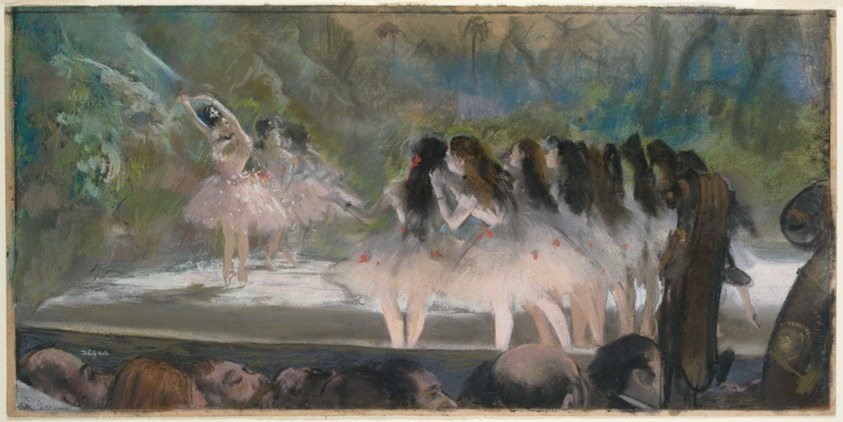
A large, light-filled studio or rehearsal hall with tall arched windows along its walls, their panes glowing softly with diffused daylight. The space has classical architectural details—supporting columns dividing the room and a polished wooden floor. Multiple young female dancers in pale practice tutus are scattered throughout the studio in various states of waiting, conversing, and preparation. Some stand clustered near the windows in the background; others occupy the foreground, their white skirts catching the light. The composition emphasises the languid, off-duty atmosphere of a rehearsal break rather than active dancing: the women are posed in stillness and informal conversation, creating an intimate domestic quality unusual in dance imagery of the period. The muted palette of greys, taupes, and pale cream tones, with the tutus glowing bright white, creates a sense of quietness and contemplation.
The dancing
The dancers are not in active motion but in repose—standing, waiting, and conversing. Their posture is upright and refined, consistent with ballet training, but not engaged in steps or the formal holds of partnered dance. Several figures in the foreground show the characteristic silhouette of ballet costume: fitted bodices and full, short tutus falling just below the knee. The artist captures the particularity of ballet's trained carriage even in stillness, with elongated necks and squared shoulders. The composition shows perhaps a dozen figures, distributed across the space to suggest depth and casual occupation of the studio rather than choreographic arrangement.
The dance depicted
This is a ballet rehearsal scene, specifically a 'répétition' or practice session, as the title indicates. The dancers wear the practice tutus standard to classical ballet, and the formal architecture suggests the rehearsal rooms of a major opera house ballet school—almost certainly the Paris Opéra, where Degas had access and painted repeatedly. The image documents the down-time and preparation phases of ballet training rather than the performed dance itself, showing how dancers inhabited and used these elite institutional spaces. The moment chosen is entirely characteristic of Degas's interest in capturing ballet at rest, as a working practice rather than as spectacle.
How it was made
Oil painting on canvas. The technique employs a soft, diffused palette and delicate handling of light to suggest the quality of daylight filtering through large windows—a signature Degas concern. The muted tonality and the way the white tutus are built up with reserved highlights against the darker surrounding space create an almost photographic immediacy, though the composition is entirely painterly. Degas's technique here captures the ephemeral quality of the moment: the casual groupings, the soft focus on figures in the middle distance, and the emphasis on light and atmosphere over narrative drama.
About this work
This oil painting depicts a moment of pause in a ballet rehearsal, capturing a group of young female dancers in a grand studio flooded with natural light. Rather than action, Degas records the institutional life of ballet—the waiting, the conversation, the trained bearing of dancers between efforts. The work exemplifies Degas's unusual focus on dance as labour and lived experience rather than finished spectacle, and his technical mastery of light, space, and the female figure in motion and repose. It belongs to a substantial body of work Degas created documenting the Paris Opéra ballet world from the 1870s onward, and it remains one of the most searching artistic records of how ballet training actually occurred in the nineteenth century.
How to look at it
Attend first to the handling of light: the way the tall windows dominate the composition and flood the space with a diffused radiance, and how Degas uses the bright white of the tutus to anchor the viewer's eye and to contrast with the darker architectural surround. Notice the compositional asymmetry—the clustering of figures at different depths, the way the nearest dancer frames the space but does not centre it. Observe the specificity of the dancers' poses and bearing: even in repose, their bodies show the effects of rigorous training. The painting rewards close attention to the moment Degas chose—not a dramatic peak of movement but a held pause, a moment of waiting and preparation that is the true substance of ballet training.
The artist
Edgar Degas (1834–1917) was a French painter, printmaker, and sculptor whose engagement with dance—particularly ballet—was unparalleled among visual artists. From the 1870s onward, he gained access to the rehearsal spaces and backstage areas of the Paris Opéra through his association with the institution, and he used that access to create hundreds of works in multiple media exploring ballet dancers at work, rest, and training. His approach was anthropological and intimate rather than celebratory; he was interested in the bodies, training methods, and social circumstances of the dancers—often working-class young women and girls—rather than in romantic fantasy. His use of asymmetrical composition, unusual viewpoints, and studies from life drew on photography and Japanese prints and gave his dance works a modern, candid quality that distinguished them from earlier theatrical imagery.
The period
The 1870s saw the consolidation of classical ballet as an institutional art form centred on the Paris Opéra, with standardised training methods and a body of canonical roles. This was also the period when visual artists began to treat the modern urban landscape, working life, and leisure with unprecedented aesthetic seriousness. Degas's rehearsal paintings participate in both developments: they document the professionalisation of ballet and the emergence of the ballet school as a distinctive modern space, while they also share with Impressionism a commitment to capturing the transient, the ordinary, and the effects of light in contemporary settings. The 1870 date places this work early in Degas's sustained engagement with ballet, in the years immediately following the Franco-Prussian War and the Paris Commune.
Where it lives
The source record indicates this work was accessed via Wikimedia Commons; the current holding collection is not recorded in the catalogue. This is characteristic of Degas's ballet works, many of which are housed in major international museums but some of which remain in private collections or have incomplete provenance documentation.
Dance in this work
Questions about this work
Is this a real rehearsal or imagined?
Both. Degas worked from direct observation in the Paris Opéra rehearsal rooms, making sketches and studies from life. He then composed finished paintings in his studio, selecting, arranging, and refining the observed moments. This painting is based on real experience but is an artistic construction, not a transcription.
Who are these dancers?
Degas did not typically identify individual dancers in his finished works. They were young female students and professionals training and rehearsing at the Paris Opéra, many from working-class backgrounds. Their anonymity was part of Degas's approach: he was interested in the type and the experience rather than in individual celebrity.
Why does Degas show dancers at rest rather than dancing?
Degas was committed to depicting ballet as a lived practice—the work, discipline, fatigue, and social reality of dancers' lives. The rehearsal room, not the stage, was where ballet actually happened. By focusing on rest, preparation, and instruction, he captured something truer about ballet than the conventional theatrical image.
What kind of ballet is this?
This is classical ballet training—the academic tradition of the Paris Opéra school. The tutus, the upright carriage, the formal institutional setting, and the date all confirm that this documents the Classical or Academic style that dominated nineteenth-century European ballet.
More Ballet artwork