49 works in this view — arrow keys or swipe to move between them.
Dance in Art · 1874
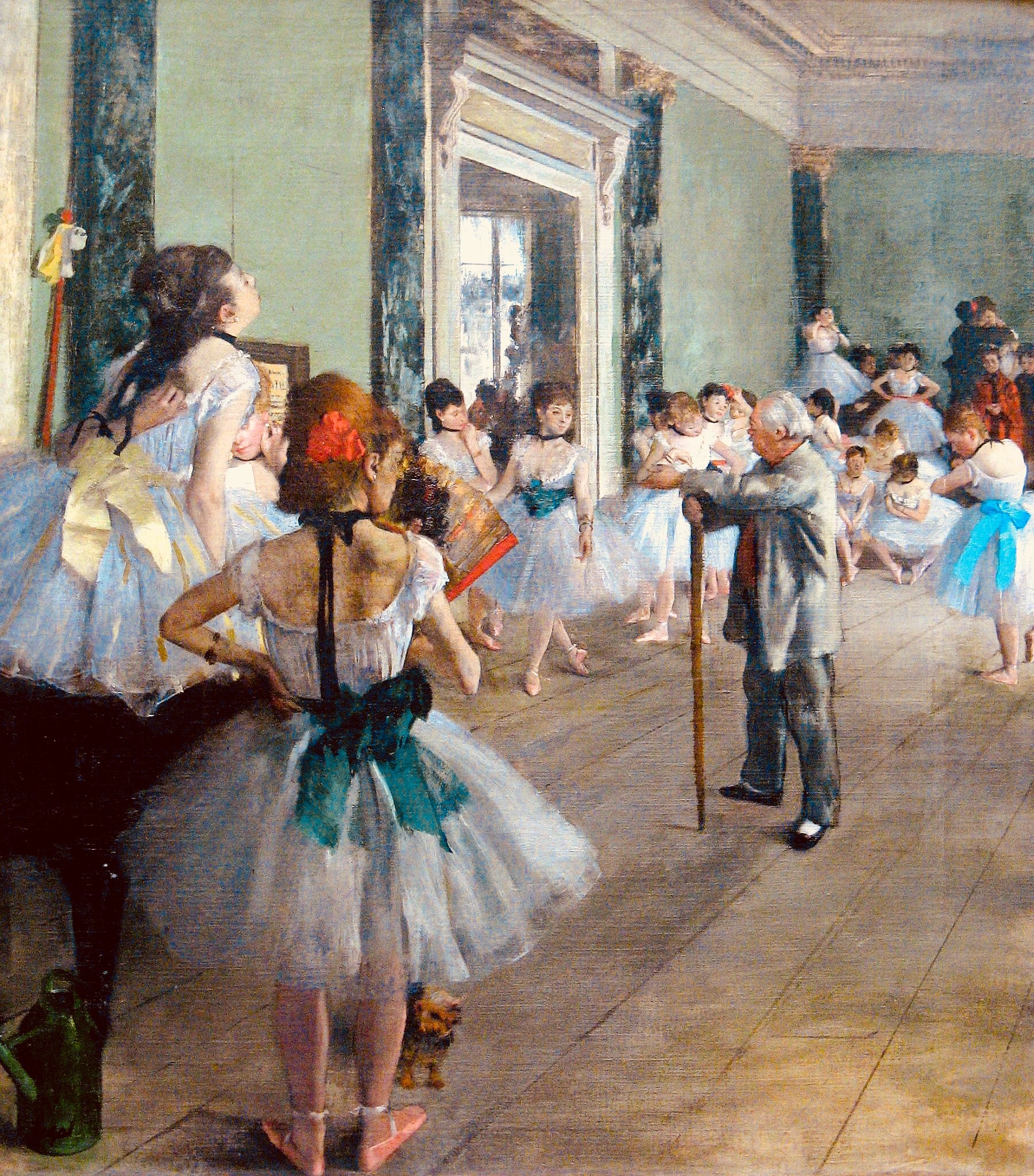
Degas, Ballet Class, 1874
Edgar Degas
- Medium:
- Oil Painting
- Dance:
- Ballet
- Era:
- Late 1800s (Victorian Ballroom)
- Source:
- Wikimedia Commons
- Rights:
- Public domain — free to use, share and adapt.
- Recorded as:
- Public Domain
This painting is one of Degas' first major ballet subjects and established a model he would return to obsessively throughout his career. It shows ballet not as spectacle but as labor and discipline, a view that was novel in art at the time. For historians and practitioners, it provides documentary evidence of 19th-century studio practice, dress, and pedagogy.
What you are looking at
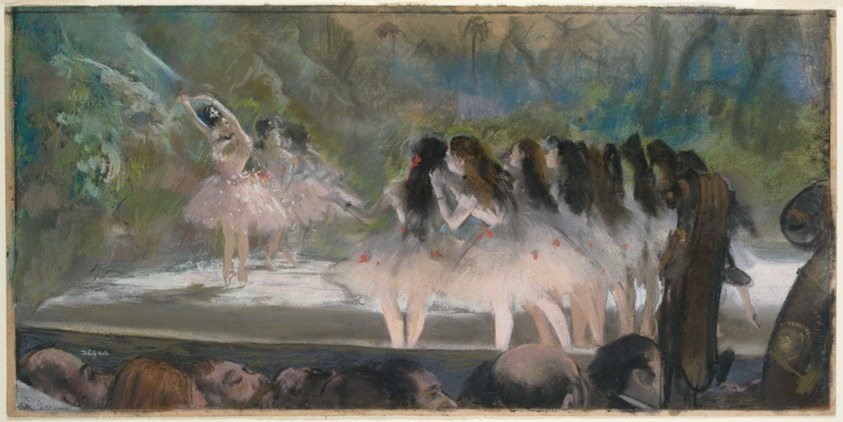
A ballet class unfolds in a sunlit studio with pale green walls and tall dark pilasters. An elderly instructor in dark coat and hat stands center-right, leaning on a cane, observing a group of young female dancers in practice. The dancers wear pale tutus and pointe shoes; most stand or move in the middle distance, while a few are positioned near the doorway at the rear, which opens onto a brighter space. In the foreground left, a pianist in yellow jacket sits at a grand piano. The light is cool and diffuse, creating soft shadows on the wooden floor. The composition draws the eye from the intimate instruction at center outward to the scattered figures of dancers, capturing a moment of focused work rather than performance—the ordinary labor of ballet training.
The dancing
The dancers hold themselves in the vertical carriage expected of classical ballet: upright spine, lifted ribcage, arms held in rounded positions. Most stand at rest or in preparatory positions; none are executing a demanding phrase. The instructor's pose—weight on the cane, body angled toward the pupils—is a teaching position; he is observing rather than demonstrating. The dancers' bodies show the alignment and turned-out legs characteristic of academic ballet training. The spatial scatter suggests individual attention and correction rather than synchronized group work.
The dance depicted
This is a ballet class, likely the daily instructional session that formed the core of ballet training in the 19th century. The setting and dress place it in a professional school or opera house studio. The presence of an elderly male instructor with a cane is consistent with the ballet masters of the period—often senior male dancers who had retired to teaching. The informality of the arrangement, with dancers positioned at various points in the room rather than arranged in ranks, suggests Degas witnessed an actual working class rather than a formal demonstration.
How it was made
Oil on canvas, a medium that allowed Degas to work rapidly and capture atmospheric effects—here the soft play of light through tall windows, the subtle modeling of flesh and fabric, the veiled colors of the studio itself. Oil permitted the compositional freedom visible here: the off-center placement of the instructor, the informal scatter of figures, the shallow depth. The technique shows confident handling of light and texture, suggesting either study from the actual studio or careful memory work by an artist who spent years observing ballet classes.
About this work
This is a ballet class observed in a moment of work: not performance, not costume, but the daily instruction of young dancers under the eye of a master. The painting dates from the early period of Degas' intense engagement with ballet as a subject. It captures both the physical discipline of academic ballet training and the social hierarchy of the studio—the aging instructor commanding attention, the pianist serving the dancers' needs, the pupils scattered in various states of attention and fatigue. The work belongs in a gallery of dance because it documents how ballet was actually taught and learned, not as it appeared on stage but in the spaces where technique was built.
How to look at it
Look first at the spatial composition: the way the room is defined not by a single vanishing point but by the rhythm of the pilasters and the scatter of figures. Notice how Degas uses the tall windows—barely visible but their effect unmistakable—to establish the quality of light. Observe the instructor's body language: the weight on the cane, the slight bend forward, the gaze directed at a student. Watch for the individual differences in the dancers' poses and alertness; Degas is not presenting an idealized tableau but a lived moment. The piano in the foreground reminds us that music was present but is almost inaudible in this image—the visual dominates.
The artist
Edgar Degas (1834–1917) was a French painter and printmaker trained in academic drawing but drawn to scenes of contemporary urban life: the café, the theatre, the racecourse, the ballet studio. From the early 1870s onward, ballet became one of his central subjects. Unlike Romantic painters who saw ballet as a vehicle for fantasy and spectacle, Degas was fascinated by the unglamorous side—rehearsal, fatigue, discipline, the body in training. He spent years attending classes and rehearsals at the Paris Opéra, developing an unusually intimate knowledge of how ballet actually worked. His extensive series of ballet paintings and pastels made him the artist most closely identified with the subject in the 19th century.
The period
The 1870s saw ballet in transition. The Romantic era's dominance was fading; classical technique and academic rigor were reasserting themselves under the influence of Italian masters. The Paris Opéra, where this class likely took place, was the world's leading ballet institution. Degas' work coincided with a broader shift in artistic attention toward the modern world and away from historical or mythological subjects. His choice to paint ballet classes rather than performances aligned him with a realist aesthetic that valued truth to observation over idealization.
Where it lives
The catalogue record identifies this as held in the Musée d'Orsay, Paris, the major French museum of 19th-century art. The work is substantially documented in Degas scholarship and is recognized as one of his early major ballet paintings.
Dance in this work
Questions about this work
Did Degas paint this from life or from memory?
Degas was known for extensive on-site observation followed by studio painting. He attended ballet classes regularly and made many sketches and pastel studies in the studio. This painting was likely built from accumulated observation rather than a single sitting, a practice that gave his work both authenticity and compositional sophistication.
Who was the ballet master Degas painted?
The figure cannot be identified with certainty from the painting alone. Degas painted several instructors at the Paris Opéra during this period. The cane and posture suggest an older master, possibly one of the senior teachers of the era, but the record does not confirm a specific identity.
What was this painting's influence?
It established ballet as a serious subject for fine art and proved that the unglamorous side of dance—the studio, the work, the discipline—could be as artistically powerful as stage spectacle. Degas' ballet paintings influenced how later artists understood dance and its relation to modern life.
How does this compare to other ballet paintings of the time?
Most 19th-century ballet imagery showed performance or idealized dancers. Degas was unusual in his sustained attention to the studio and the body in training. His approach was more akin to realist painting of workers and laborers than to conventional ballet representation.
More Ballet artwork