49 works in this view — arrow keys or swipe to move between them.
Dance in Art · 1875
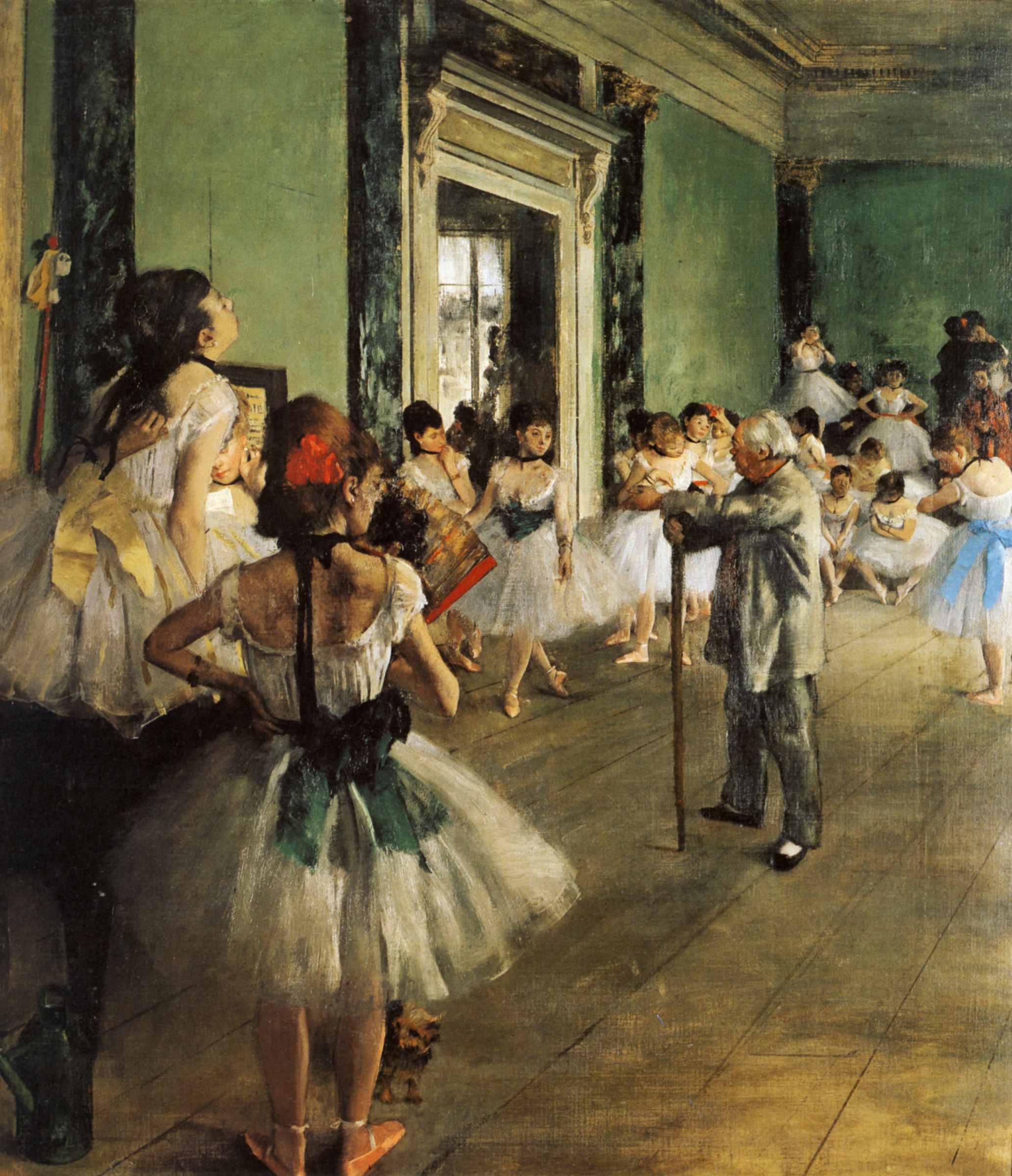
Degas- La classe de danse 1874
Edgar Degas
- Medium:
- Oil Painting
- Dance:
- Ballet
- Era:
- Late 1800s (Victorian Ballroom)
- Source:
- Wikimedia Commons
- Rights:
- Public domain — free to use, share and adapt.
- Recorded as:
- Public Domain
For dance historians, this image is invaluable documentation of nineteenth-century ballet pedagogy, studio practice, and the physical training that produced the dancers of the Romantic era. For art historians, it represents Degas's unparalleled attention to the body in motion and his commitment to the ballet as a subject worthy of sustained, serious attention at a moment when fine art was increasingly turning away from academic historical painting toward the fleeting moments of modern life.
What you are looking at
A ballet instructor observes a class of young female dancers in a light-filled studio. The dancers wear white tutus and practice in a loose formation across a wooden floor, their bodies at various points in their exercises. An older man in dark clothing—the teacher or répétiteur—stands to the right, watching intently. Tall windows with cream-colored frames punctuate the sage green walls, flooding the scene with natural light that models the dancers' forms and casts soft shadows across the wooden floorboards. The space feels working and intimate rather than formal: this is a rehearsal in progress, not a performance. A young dancer in the foreground wears a distinct green skirt over her white tutu, breaking the uniformity of dress and drawing the eye. The composition is asymmetrical and loosely structured, as if captured mid-moment rather than arranged for formal presentation.
The dancing
The dancers display the upright carriage and turned-out positions characteristic of mid-nineteenth-century ballet technique. Most stand or move in the classical positions, with arms in various port de bras. Several dancers appear to be executing simple allegro steps or weight shifts rather than complex combinations. The children's bodies are not yet fully developed dancers—there is an informality to some of their postures that suggests they are young students rather than professionals. The teacher's stance is observational and slightly removed from the action, typical of the instructor-student relationship in a working studio.
The dance depicted
This is a ballet class, most likely a rehearsal or study session for young dancers in training. The image documents the pedagogical side of ballet—the repetitive, patient work of building technique through structured exercises rather than performance. The informality of dress (one child in a green skirt, others in varying states of white costume) and the loose arrangement of bodies suggest this is an actual working class rather than a formal demonstration. The presence of the male instructor and the scale of the space indicate this is likely a professional ballet company or school, not an amateur setting. The late nineteenth-century studio would have been a new kind of social space: one of labor and systematic training for young, primarily female dancers.
How it was made
This is an oil painting executed with a painter's responsiveness to light and form rather than a strict documentary approach. Degas has captured the ephemeral quality of movement and moment through loose brushwork and careful attention to how light falls across the dancers' bodies and the studio walls. The technique allows him to render both the precision of ballet positions and the informal, almost awkward reality of students at work. The oil medium and Degas's handling suggest a work made from memory or sketch rather than a literal transcription—the painter's eye has mediated between observation and composition.
About this work
This is one of a substantial series of ballet studio scenes that Degas produced across several decades, making him the primary visual chronicler of mid-to-late nineteenth-century ballet practice and training. The work documents not the spectacle of ballet performance, which filled the grand theaters of Paris, but the hidden labor of the studio—the repetition, the instruction, the young bodies learning technique under the eye of a master. It is a sociological image as much as an aesthetic one: it shows us who danced ballet (primarily girls and young women), where they trained (in light-filled studios owned by major dance companies), and what that training looked like (disciplined, formal, hierarchical). The painting belongs to a larger modernist project of looking at everyday or overlooked subjects with the same care previously reserved for historical or mythological grand subjects.
How to look at it
Attend to the asymmetry of the composition: the teacher is not centered but observed from the side, and the dancers fill the space unevenly, as though we have happened upon them rather than been invited to view a posed scene. Notice the light—how it comes from the tall windows on the left and models the dancers' forms, creating a sense of three-dimensionality despite the relatively flat interior space. Look at the variation in the dancers' bodies: they are not identical or perfectly uniform, but children of different ages and development, some alert and others absorbed in their own work. The green skirt of the child in the foreground is jarring and specific—it suggests a real moment observed rather than a constructed ideal. The teacher's quiet attention—he is not gesturing dramatically but simply watching—conveys the intensive, patient work of instruction.
The artist
Edgar Degas (1834–1917) was a French painter and sculptor who is now recognized as one of the primary modernist painters, though he worked during a period when impressionism dominated avant-garde discourse. Beginning in the 1860s, Degas became fascinated with the Paris Opéra, its dancers, and its infrastructure of training and performance. Over several decades he produced hundreds of works depicting ballet: classroom scenes, rehearsals, performances, backstage moments, and portraits of individual dancers. Degas worked from sketches, memory, and his own deep study of anatomy and movement. His ballet works are not sentimental—they show fatigue, inelegance, and the plain labor of the art form alongside moments of grace. He was a skilled draftsman trained in the academic tradition but revolutionized his practice through sustained observation of a single subject pursued over time.
The period
In the 1870s, ballet in Paris was entering a transitional moment. The heyday of Romantic ballet (the 1830s–40s) had passed, and the genre was being reinvigorated through new choreography and dancers. The Paris Opéra was the center of French ballet and also a major institution of social prestige. Behind the scenes, the studio was where technique was built and transmitted through the systematic training of young dancers, mostly girls from working and lower-middle-class backgrounds. This was also the era when academic painting itself was undergoing transformation—the salon system was being challenged, photography was forcing painters to reconsider representation, and modernist artists were turning toward subjects that had previously been considered unworthy of serious art. Degas's choice to paint the ballet studio repeatedly was not nostalgic; it was a deliberate commitment to representing modern labor and modern life.
Where it lives
The painting is dated 1875 in the catalogue record and titled La classe de danse. The work is sourced from Wikimedia Commons and held in an unrecorded collection. The painting is recognized as part of Degas's substantial body of ballet imagery, which is distributed across major museums and private collections internationally.
Dance in this work
Questions about this work
Is this a real ballet class or an imagined scene?
It is based on careful observation of real ballet classes, though Degas worked from sketches and memory rather than painting directly from life in the studio. He spent considerable time in the Paris Opéra studios and produced many drawings and studies that he then worked up into finished paintings. The informality and specificity of detail suggest he observed actual classes closely, but the composition and arrangement are the painter's own.
Who was the teacher in these classes, and how do we know?
Degas did not always identify the specific teacher in his works. This figure remains anonymous—he is a type of the ballet master of the era. Degas may have based his studies on actual teachers and répétiteurs at the Paris Opéra, but the painting documents the role and practice rather than a particular historical person.
Why did Degas paint ballet so many times?
Degas was drawn to ballet as a subject for aesthetic and modern reasons: the human body in disciplined motion, the effects of light on form, the intersection of labor and grace, and the complex social hierarchies of the ballet world fascinated him. The ballet studio was also a space where he could observe and sketch without the demands of formal portraiture, giving him freedom to develop his visual ideas.
What does the girl in the green skirt tell us?
Her distinct dress breaks the uniformity and suggests a moment captured from life rather than a composed ideal. She may be a student of different status, or simply a child in costume during a rehearsal or examination. The specificity of her presence argues for Degas's commitment to observed reality over beautification.
More Ballet artwork