49 works in this view — arrow keys or swipe to move between them.
Dance in Art · 2017
Degas- La classe de danse 1874 (perspective)
derivative work: Fulvio314
- Dance:
- Ballet
- Source:
- Wikimedia Commons
- Rights:
- Public domain — free to use, share and adapt.
- Recorded as:
- Public Domain
For dancers and choreographers, this image reveals what a great painter understood about ballet: that the studio is where dance actually lives, that informal positions and scattered groupings can be as expressive as formal formations, and that the mathematics of spatial composition can enhance the naturalism rather than destroy it. For art historians and students, it is a masterclass in how Impressionist and post-Impressionist artists used geometric structure to organize apparently casual scenes.
What you are looking at
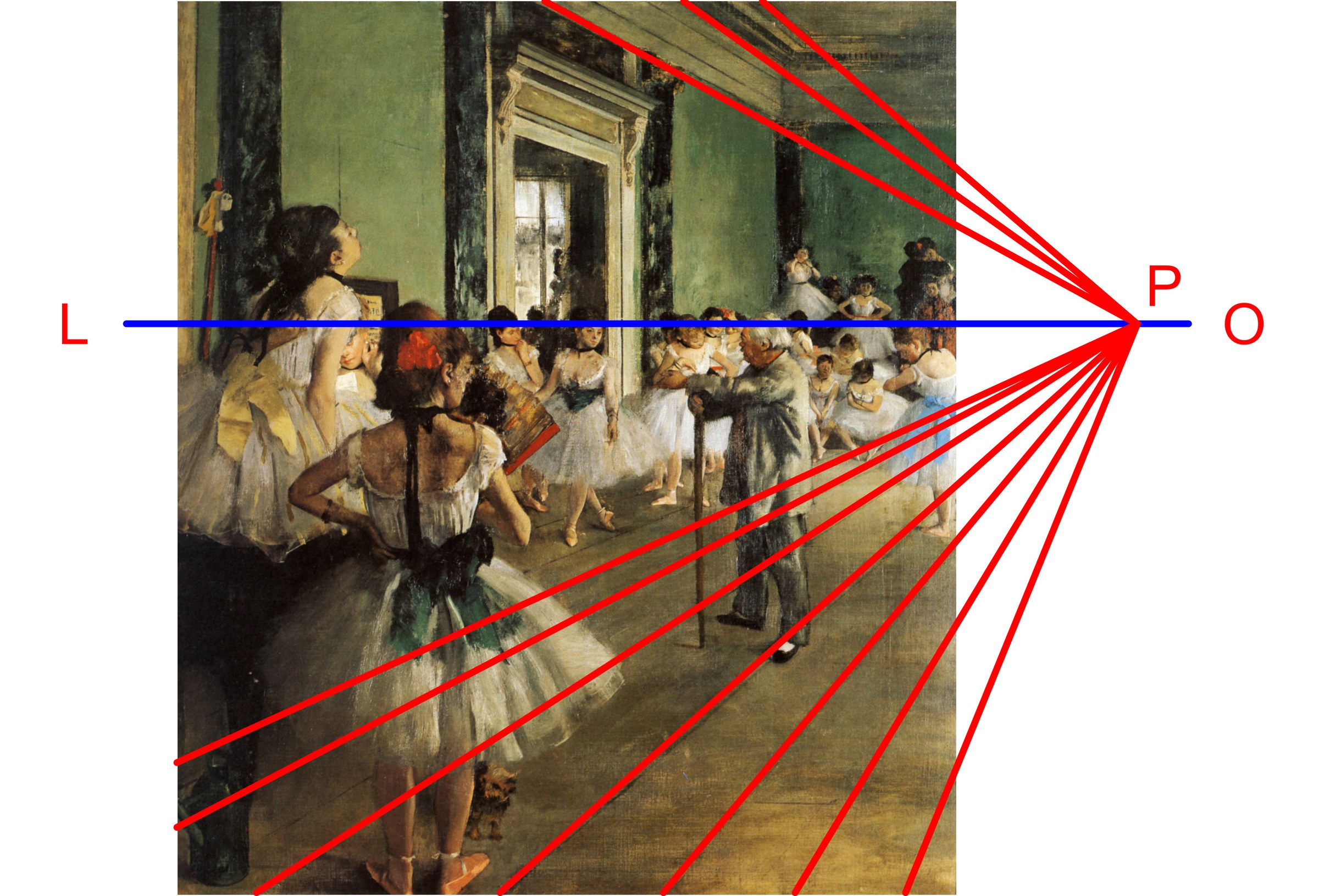
This is a scholarly diagram overlaid on a Degas dance class scene, isolating the perspective geometry of the original composition. The underlying painting depicts a ballet studio with pale green walls, a tall doorway with cream-coloured trim, and natural light falling across the wooden floor. Multiple young female dancers in white practice dresses are scattered throughout the space in informal poses—some standing, some seated or resting, one in the foreground with her back to us adjusting her clothing. An older man in dark clothes (the dance master) stands near the centre-left, observing. The red perspective lines radiating from point O on the right margin demonstrate Degas's use of linear perspective to structure the composition, with the blue horizon line running through the middle ground. The diagram converts a lived, casual moment of rehearsal into a geometric exercise, making visible the mathematical armature beneath the seeming spontaneity of the scene.
The dancing
The dancers are not posed in a formal line or synchronized positions. Instead, they occupy the studio as it might appear mid-class: some weight-shifted onto one leg, others standing at ease or bending slightly. The closest figure in the foreground shows the informal posture of a working dancer between exercises. The master observes from a standing position, his dark silhouette framing the group. There is no corps de ballet uniformity here; each figure occupies individual space and maintains an independent stance. The geometry of their placement creates spatial recession rather than symmetry.
The dance depicted
This depicts a ballet rehearsal or class session, most likely from the mid-to-late nineteenth century based on the practice dress and studio setting. The dancers are not performing but working—executing exercises, resting, or waiting for instruction. The practice clothes (simple white dresses rather than costumes) and the presence of the male instructor establish this as professional or advanced amateur training. Degas frequently documented dancers in these private working moments rather than onstage; this image captures the quotidian labor of ballet rather than its public spectacle. The dancers shown are female pupils or dancers employed by the Paris Opéra.
How it was made
The underlying work is a painting (oil on canvas is standard for Degas's ballet studio scenes, though not recorded in the catalogue). The perspective diagram itself is a modern digital overlay created by Fulvio314 in 2017, using red lines to extract the geometric structure from the painting. This analytical technique reveals Degas's deliberate compositional strategy: the painting is not a casual sketch but a carefully constructed spatial composition using linear perspective. The diagram transforms the artwork into a teaching tool, making the artist's method visible to viewers unfamiliar with such analysis.
About this work
This is a composite image: Degas's mid-1870s painting of a ballet class, overlaid with a perspective-line diagram that exposes its underlying geometry. The painting itself is a domestic scene of professional dancers at work in a Paris studio, rendered with Degas's characteristic attention to informal movement and spatial complexity. The superimposed red lines and blue horizon reveal the mathematical precision with which Degas constructed what appears to be a casually observed moment. The work exemplifies Degas's practice of documenting ballet as both an art form and a workplace, combining intimate observation with rigorous compositional structure.
As a diagram, the image serves dual purposes: it is both a historical artwork and a pedagogical instrument. It demonstrates how nineteenth-century painters used formal perspective to organize complex figure compositions, and it shows the gap between the finished effect of a Degas painting (which feels observed and spontaneous) and its calculated underlying structure.
How to look at it
Observe the blue horizon line and the way it anchors the composition at the level of the dancers' bodies, not above or below them. Follow the red lines radiating from point O: they organize the floor, the walls, the doorway, and the dispersed figures into a coherent spatial field. Notice that the closest dancer (lower left) sits slightly below the horizon, while distant figures above it appear smaller—textbook linear perspective, used to make the studio feel deep and inhabited. Then look away from the diagram and at the painting alone: the geometry should disappear, leaving only the fleeting moment of a rehearsal. This gap between structure and appearance is Degas's great achievement.
The artist
Edgar Degas (1834–1917) was obsessed with ballet from the 1870s onward, producing hundreds of paintings, pastels, drawings, and prints of dancers. He had unusual access to the Paris Opéra, attending rehearsals and classes, sketching directly from life. Unlike other Impressionists, Degas was trained in classical draughtsmanship and remained committed to compositional structure and drawing throughout his career. His ballet works are not romantic idealizations but unflinching documents of labor, bodies in fatigue, and the economics of the dance world. He moved gradually toward abstraction and dissolution of form as he aged, but his ballet scenes always grounded formal experiment in observed fact. Fulvio314 is a contemporary Wikimedia Commons contributor who creates analytical diagrams of artworks to make their structure visible.
The period
Degas began painting ballet classes in the 1870s, during the height of Romantic ballet's afterlife and the emergence of new dance forms. The Paris Opéra was a major cultural institution with a rigorous training system; Degas's access to its studios was exceptional and gave him an insider's view of dancers as workers rather than performers. In art history, the 1870s were a moment of formal experimentation: artists were simultaneously discovering Japanese prints (with their flattened perspective and unexpected viewpoints) and absorbing lessons from photography about cropping and unusual angles. Degas's ballet paintings sit at the intersection of all three: mathematical perspective, photographic framing, and the spatial inventiveness of Japanese composition. The diagram itself is a twenty-first-century tool reflecting contemporary interest in making artistic technique and mathematical structure explicit and teachable.
Where it lives
The underlying painting is held in a major collection (not specified in the catalogue record provided). The diagram version shown here is a digital derivative created by Fulvio314 and published on Wikimedia Commons, making it freely available for educational and analytical purposes.
Dance in this work
Questions about this work
Is this a real painting by Degas, or is the perspective diagram the whole work?
The underlying painting is a genuine Degas work from 1874 titled 'La Classe de danse' (The Dance Class). The red and blue lines are a modern analytical overlay, created in 2017 to reveal the geometric structure of the original composition. The painting is the artwork; the diagram is a scholarly tool applied to it.
Why did Degas paint so many ballet class scenes?
Degas had privileged access to the Paris Opéra's studios and was fascinated by dancers as working professionals—not as romantic ideals but as bodies in labor, training, and exhaustion. He painted what he actually saw in rehearsal rather than imagining theatrical performance. The repetition of the subject allowed him to explore compositional problems: how to arrange multiple figures in a deep space, how to balance formal structure with observed casualness.
What is the point O on the diagram?
Point O is the vanishing point—the theoretical spot on the horizon line toward which all parallel lines recede in linear perspective. By radiating lines from O, the diagram shows how Degas used perspective to organize the floor, walls, and figures into a coherent spatial illusion. The viewer's eye is drawn inward toward that point, structuring the composition even though the dancers are scattered informally.
Are the dancers wearing pointe shoes?
The image is not clear enough to confirm pointe shoes from this distance and angle. The dancers are in practice clothes (white dresses) in a studio setting, which was standard for rehearsal in the nineteenth-century ballet world. Pointe work existed by the 1870s but was not universal to all classes or exercises.
More Ballet artwork