27 works in this view — arrow keys or swipe to move between them.
Dance in Art
Antidance Literature | Western Social Dance: An Overview of the Collection | Articles and Essays | A
Unknown artist
- Dance:
- Ballroom
- Source:
- Library of Congress
- Rights:
- Public domain — free to use, share and adapt.
- Recorded as:
- public_domain
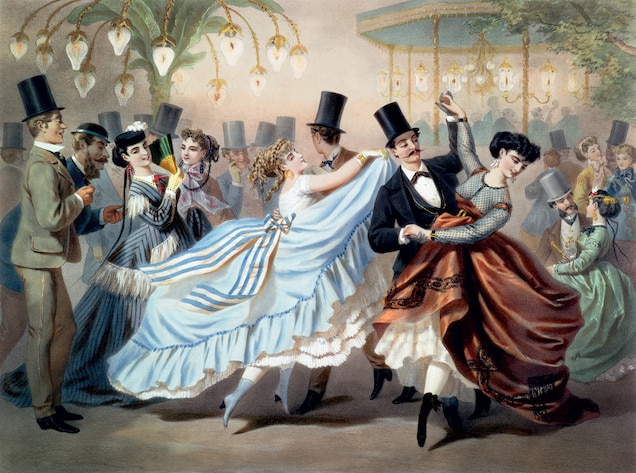
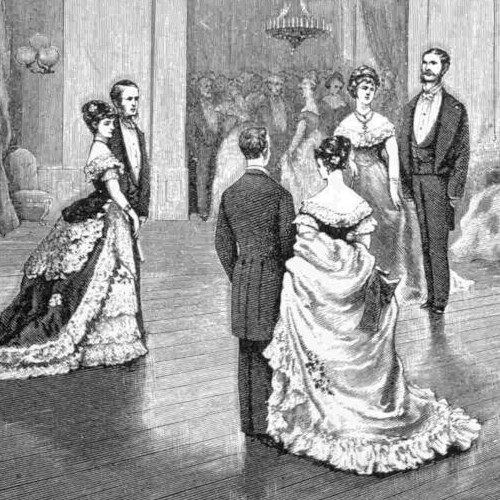
This print provides direct visual evidence of how a major social dance was actually performed and staged in the 19th century—the hold, the frame, the setting, the audience configuration. It contradicts any account that relies only on written dance manuals, which often omit or stylize what engravers documented in precise detail. It also reveals the dance floor itself as a social stage where rank, fashion, and propriety were constantly on display.
What you are looking at
A formal interior reception is underway in what appears to be a grand ballroom or palace gallery, with tall classical columns visible in the background. The engraving shows two couples in the immediate foreground engaged in a dance, while a large crowd of formally dressed observers—both men and women—fills the space behind them. The dancers nearest the viewer are rendered in sharp detail: a woman in an elaborate ball gown with a heavily decorated skirt and fitted bodice faces a man in formal evening dress (dark coat, white shirt front). A second couple is visible just beyond them. The women wear the full-skirted gowns characteristic of mid-to-late 19th-century formal dress, with tight corseting at the waist; the men are uniformly attired in dark tailcoats. The setting is clearly one of high social occasion—the architecture, the crowd, the formality of dress all suggest an aristocratic or court gathering. The engraving technique renders the scene with fine cross-hatching and allows sharp definition of individual figures throughout the crowded composition.
The dancing
The foreground couple holds the closed ballroom position standard to 19th-century formal dance: the man's right hand on the woman's back, his left hand holding her right hand at shoulder height; the woman's left arm rests on the man's right shoulder. Both dancers are upright and formal in frame, facing slightly to their left in profile or three-quarter view. Their posture is dignified and controlled rather than energetic. The woman's skirt is caught in mid-movement, billowing outward in a way that shows the dance involves rotation or turning. The couple behind them adopts a similar hold and orientation. All the dancers shown maintain the upright, reserved carriage typical of ballroom partnered dance of this era.
The dance depicted
This is almost certainly a waltz or other ballroom couple dance of the mid-19th century, depicted during a formal court or high-society ball. The closed-position hold, the turning motion suggested by the woman's skirt, the formal setting, and the date all point to the Waltz or possibly a Quadrille. The waltz was the dominant couple dance of this period in European high society, and the composition—a formal dance floor in a grand interior with an audience of observers—is typical of how such occasions were documented in prints. The dance shown here is a social rather than theatrical performance, part of the structured social rituals of aristocratic and upper-middle-class life.
How it was made
This is a wood engraving or steel engraving, executed in fine line work with cross-hatching for tone and shadow. The technique allows precise rendering of fabric detail, architectural elements, and individual faces throughout a complex multi-figure composition. The quality of the engraving—the crispness of line, the subtlety of the tonal gradations, and the ambitious size and composition—suggests this was a commercially produced print of some importance, likely created for circulation in illustrated newspapers, magazines, or as a standalone print for sale to the educated public. Engraving was the standard medium for news illustration and social documentation in the 19th century before photographic reproduction became feasible.
About this work
This engraving documents a formal ballroom dance scene, almost certainly a waltz or quadrille at a high-society gathering, dated to an unknown point in the mid-to-late 19th century. The work is valuable as evidence of how couple dances were performed and understood in aristocratic and upper-class contexts: the formality of dress and setting, the dignified carriage of the dancers, and the presence of an audience all reflect the social conventions that governed ballroom dance in this era. The engraving captures both the visual spectacle of the occasion and the technical requirements of the dance itself—the closed position, the turning action, the controlled frame. As a commercial print, it served to circulate images of fashionable life among a broad educated audience, making ballroom dance visible and legible to those who did not themselves participate in such gatherings.
How to look at it
Observe the closed position and the specific placement of hands and arms—this is the ballroom frame that defined the era's formal dance. Notice how the woman's skirt is caught mid-turn, which tells you the dance involves continuous rotation rather than side-to-side or linear movement. Look at the posture and carriage of all the dancers: they remain upright and controlled, never leaning, never appearing to lose balance or composure. That restraint, combined with the formal setting and audience, defines the social meaning of the dance. The engraver has chosen the moment mid-turn, which shows the motion while still allowing the dancers' faces and costumes to be legible to the viewer.
The period
The waltz emerged in Vienna in the late 18th century and became the dominant couple dance of European and American high society in the 19th century, shocking moralists with its close embrace and continuous turning motion. By the time this engraving was made, the waltz was fully established as the fashionable dance of formal balls, and was regularly documented in illustrated newspapers and magazines catering to the urban middle and upper classes. The mid-to-late 19th century saw a profusion of such engravings, which served both as fashion documentation (the gowns are as important as the dance) and as aspirational social imagery for readers who consumed these prints in periodicals.
Where it lives
This engraving comes from the Library of Congress and is catalogued as part of their collection on Western social dance. The original catalogue provides no artist, date, or medium attribution, suggesting it may be part of a larger serialized or periodical publication that has been disbound and catalogued by subject rather than source.
Dance in this work
Questions about this work
Is this a waltz or a quadrille?
Almost certainly a waltz. The closed position and the continuous turning motion visible in the woman's skirt are characteristic of the waltz. A quadrille would show couples in changing formations and different positions. However, without more specific documentation, the distinction cannot be made with absolute certainty from the image alone.
Why are there so many people watching?
Formal ballroom dances in aristocratic and upper-class society were semi-public performances. A grand ball was a social and political event where status was displayed through dance, dress, and participation. The presence of onlookers—those waiting their turn, those too elderly or of insufficient rank to dance, and those simply observing the spectacle—was normal and expected. The dance floor was a stage.
Why is the woman's skirt so large?
This reflects mid-to-late 19th-century fashion, when women's formal gowns featured full skirts supported by crinolines or bustles. The engraver has deliberately caught the skirt mid-turn to show how the fabric moves and balloons during the dance—this was part of the visual spectacle and charm of the waltz.
Who made this print and when?
The Library of Congress record does not identify the artist or provide a precise date. The style of dress and engraving technique suggest the mid-to-late 19th century, but without more information we cannot be more specific. It may have been published as part of an illustrated newspaper or magazine.
More Ballroom artwork