49 works in this view — arrow keys or swipe to move between them.
Dance in Art · 1875
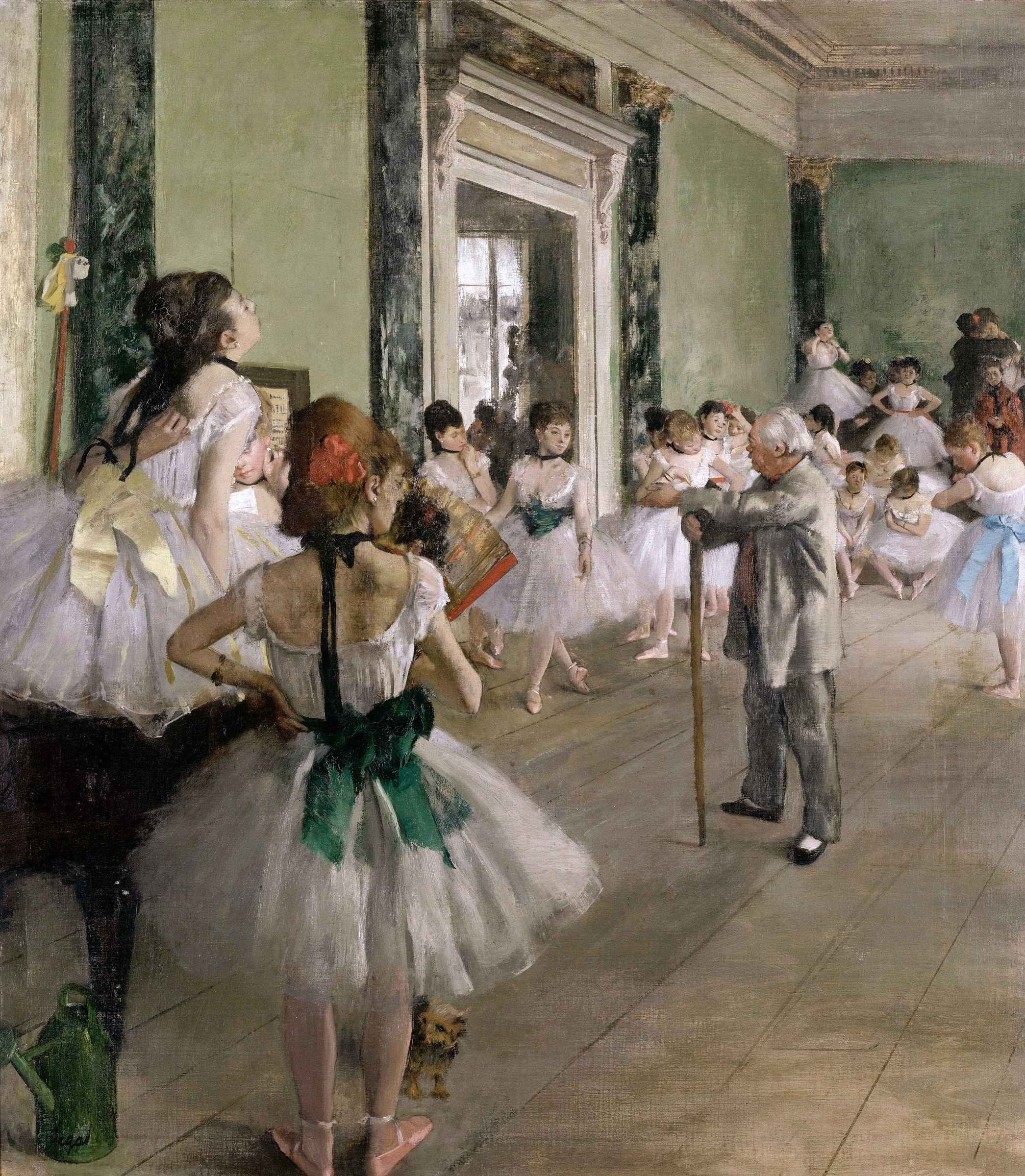
Edgar Degas - La Classe de danse
Edgar Degas
- Medium:
- Oil Painting
- Dance:
- Ballet
- Era:
- Late 1800s (Victorian Ballroom)
- Source:
- Wikimedia Commons
- Rights:
- Public domain — free to use, share and adapt.
- Recorded as:
- Public Domain
This is one of Degas's most famous ballet paintings and establishes him as the first major artist to treat dance classes and rehearsals as subjects worthy of sustained attention and aesthetic investment. For dancers and historians, it is a primary historical document of how ballet technique was taught and transmitted in the nineteenth century—the dress, the studio, the role of the master, the bodies of the students. It also shows Degas's deep understanding of ballet as a kinetic practice: he does not paint perfect poses, but the scattered, half-ready bodies of students learning, which conveys more truth about dance than any theatrical tableau could.
What you are looking at
An elderly ballet master, white-haired and dressed in dark formal coat, conducts a class of young female dancers in a large, high-ceilinged studio with soft sage-green walls. The studio is divided by dark pilasters and opens through tall double doors to a second room. Perhaps fifteen young dancers, dressed in pale pink and white practice tutus and pointe shoes, scatter across the floor in various attitudes of attention and movement—some standing, some adjusting their positions, one seated on the floor. The light is cool and diffuse, entering from the tall windows visible through the rear doorway. The master gestures with a stick or cane, commanding the class; the dancers orient themselves toward him with the mixture of focus and restlessness typical of a rehearsal or examination. The composition emphasizes the authority of the solitary male figure against the constellation of attentive but still-developing bodies.
The dancing
The dancers are positioned in first and second positions, standing or caught mid-port de bras, wearing the regulation practice dress of the period—pale tutus, pointe shoes, pale tights. Their bodies are upright and engaged, showing the formal carriage and turned-out legs characteristic of academic ballet training. The master stands apart, using a stick or cane to indicate positions and correct alignment; his posture is commanding and his gesture directive rather than demonstrative. The youngest dancers appear almost static with concentration, while older students show slightly more fluidity and confidence in their placement.
The dance depicted
This is a ballet class, the foundational institutional practice of nineteenth-century academic ballet training. The setting and the formal dress indicate a class at a major ballet academy, probably the Paris Opera Ballet School, where such classes were daily practice and part of the formal curriculum. The image captures the hierarchical relationship between male pedagogue and female students that characterized professional ballet training in this period—the master as authoritative instructor, the young women as disciplined bodies learning technique. The stick is both tool and symbol of authority, used to correct positioning and tap out rhythms for exercises.
How it was made
Oil painting on canvas, executed with the loose brushwork and light palette characteristic of Impressionist technique. Degas uses thin layers of paint with visible brushstrokes to suggest form, fabric, and atmosphere rather than define them precisely. The soft greens of the walls and the diffused light suggest interior illumination rather than dramatic chiaroscuro, allowing focus to remain on the human figures. This technique was still relatively novel for academic subject matter in 1875 and signals Degas's break from rigid academic convention even as he painted strictly academic subject matter.
About this work
This is a ballet class at a major European academy, painted from the perspective of a careful observer of institutional dance practice. Degas documented ballet training and rehearsal throughout his career and produced dozens of such images, making him arguably the first artist to treat dance pedagogy as a primary subject rather than background spectacle. The painting shows not a performance or a moment of theatrical magic, but the unglamorous, disciplined, repetitive work of learning ballet—the true content of a dancer's life. The painting belongs in a dance collection precisely because it records a form of dance (training) and a moment (instruction) that performance imagery alone cannot convey.
How to look at it
The viewer should first locate the master—the dark figure with the cane—and understand the composition as arranged around his authority and attention. Then scan the bodies of the students: notice which are engaged and upright, which are tired or distracted, which are still learning to hold a position. Degas has frozen a moment of instruction, not of performance, so the dancers are not arranged for beauty but scattered as they would be in a real class. Pay attention to the hands and feet—the turned-out positions, the pointe shoes, the port de bras—which show Degas's precise knowledge of ballet technique. The light and the interior setting emphasize that this is work, not spectacle; the everyday rather than the theatrical.
The artist
Edgar Degas (1834–1917) was a French painter and sculptor who documented Parisian dance, theatre, and urban leisure with obsessive intensity from the 1860s until his death. He was not a choreographer, composer, or dancer, but had intimate access to the Paris Opera and its ballet school through patronage and friendship. His interest was not in the spectacle of performance but in the labour and institutional structure of dance—classes, rehearsals, behind-the-stage scenes, the bodies of dancers at rest. He was trained in academic drawing and history painting but abandoned grand historical subjects for the careful observation of modern life, especially the bodies and gestures of women in labour (laundresses, dancers, bathers). His technical innovation—asymmetrical composition, unusual viewpoints, the influence of Japanese prints and photography—made his representations of ballet visually modern even as his subject matter was institutional and traditional.
The period
In 1875, academic ballet in France was at a transitional moment. Romantic ballet, with its emphasis on otherworldly heroines and ethereal movement, had given way to a more virtuosic, technically demanding style centred on the ballerina's technical command. The ballet school of the Paris Opera was the most prestigious institution for training female dancers in Europe, and its pedagogy—emphasizing turned-out positions, port de bras, and the vocabulary of classical technique—was becoming standardized. Degas painted at a moment when ballet was being professionalized and systematized, when training was increasingly formalized and when the artist could observe the daily work of the institution. In fine art, Impressionism was nascent; Degas exhibited with the Impressionists but remained committed to drawing and structured composition, making him a bridge between academic tradition and modern practice.
Where it lives
The work is recorded in the catalogue as sourced from Wikimedia Commons, with no holding collection listed. It is one of Degas's most frequently reproduced images and exists in multiple versions and studies.
Dance in this work
Questions about this work
Who was the master teaching this class?
The figure is not identified in surviving records. Degas painted many such ballet masters and did not always record their names. The image is valued as a record of the type and role of the master—the authority figure who trained the dancers of the Paris Opera—rather than as a portrait of a specific individual.
Were these real students at the Paris Opera?
The image was painted from observation and study, likely at the Paris Opera Ballet School, but Degas has arranged and recomposed the scene. The dancers are not identifiable individuals but types—young women of varying ages and stages of training, positioned to show the hierarchical and collective nature of ballet instruction.
What are the dancers wearing?
The regulation practice dress of academic ballet: pale pink or white cotton tutus (short skirts), pale pink tights, and pointe shoes. This dress was standardized in the nineteenth-century ballet academy and distinguished serious students from amateurs. The uniformity of dress emphasizes that these are members of an institution, not individual performers.
Why did Degas paint so many ballet scenes?
Degas was fascinated by the ballet as a modern institution and by the bodies and labour of dancers. He had privileged access to the Paris Opera and was interested in the gap between the theatrical spectacle and the unglamorous work of rehearsal and training. Ballet also gave him an ideal subject for exploring movement, composition, and the modern body.
More Ballet artwork