49 works in this view — arrow keys or swipe to move between them.
Dance in Art
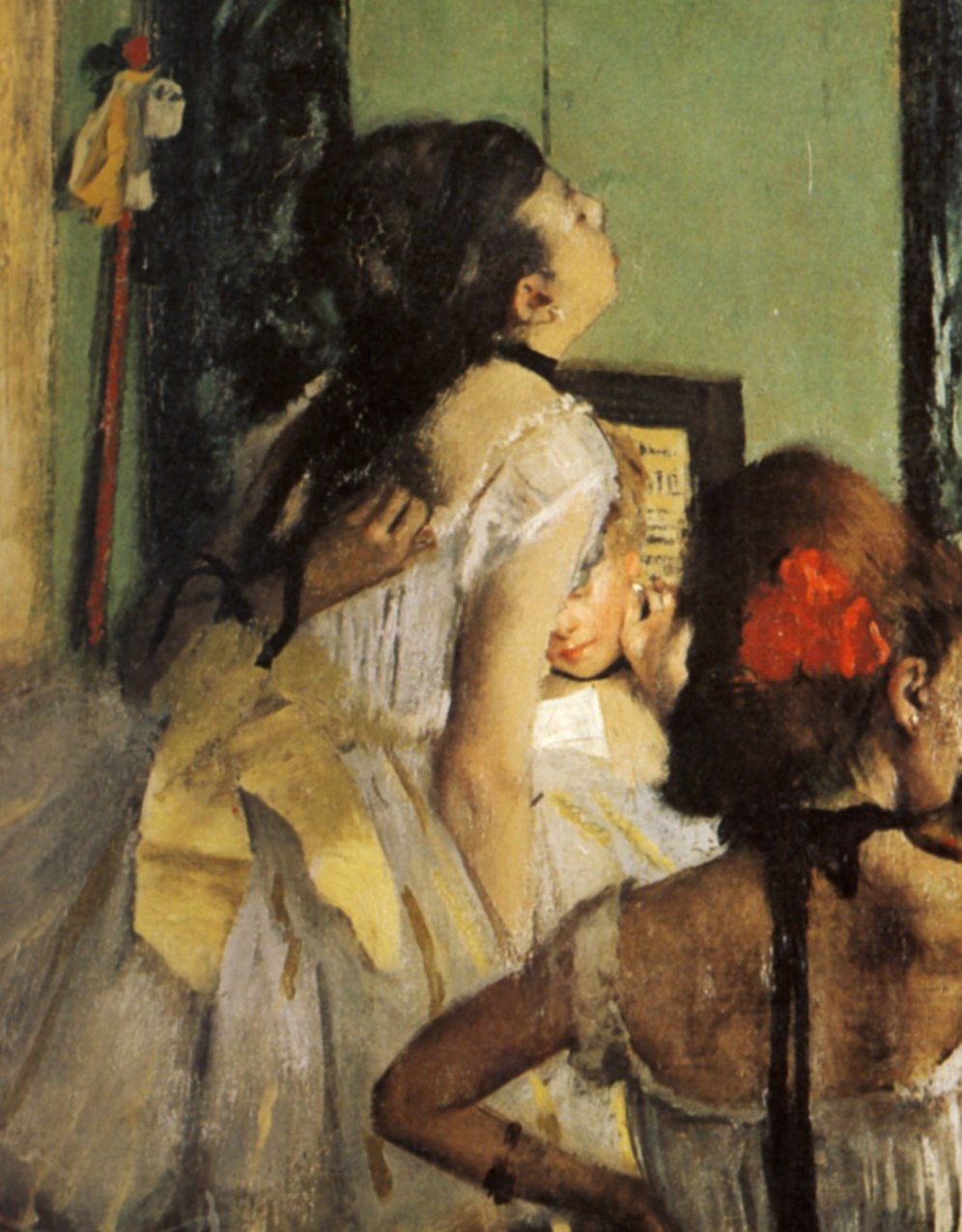
La Classe de danse, Degas, detail n. 1
Edgar Degas
- Medium:
- Oil Painting
- Dance:
- Ballet
- Era:
- Late 1800s (Victorian Ballroom)
- Source:
- Wikimedia Commons
- Rights:
- Public domain — free to use, share and adapt.
- Recorded as:
- Public Domain
This work fundamentally changed how dance could be represented in visual art: not as performance or spectacle, but as labor and craft. Degas was the first artist to paint the dancer's life rather than her myth, and his example opened the subject to realism and photography. For historians of dance, these paintings are primary sources documenting the physical training and studio practices of the Romantic and early modern ballet tradition.
What you are looking at
Three young female dancers in a practice studio, their bodies angled toward a wall or barre in the left middle distance. The nearest and largest figure, in the foreground right, wears a pale chemise and leans forward with her gaze lifted, her posture suggesting either preparation or the moment of beginning movement. A second dancer, partially obscured, stands behind and to her left in similar dress. A third, smaller figure in a red-ribboned hat sits or rests lower in the composition, watching. The studio interior is rendered in warm ochres and cool greens; the walls are plain, the floor bare. The light is soft and interior, without dramatic shadow—the kind of north-lit working space typical of a rehearsal room. The composition is intimate and unidealized: these are bodies at work, not in performance.
The dancing
The foreground figure's weight appears shifted forward onto her left leg, her torso inclined, her right arm extended but relaxed—a posture of readiness or the instant before motion begins. Her head is held high and tilted slightly back, the neck elongated. The figure behind her echoes this vertical alignment. Both wear simple linen shifts with short sleeves, their hair pinned up. The seated or resting figure on the right, smaller in scale and wearing a hat with a red bow, observes rather than participates. None of the standing figures are in a formal ballroom closed hold; the staging is loose, naturalistic, caught between poses rather than frozen mid-step.
The dance depicted
This depicts a ballet class or rehearsal, most likely in the Romantic era (mid-to-late nineteenth century) given the costume, studio conventions, and the artist's known practice. The white practice dress and bare feet (though feet are not clearly visible) are consistent with ballet training of this period. The informality of the scene—the watching student, the casual spacing, the ordinary studio interior—suggests this is not a performance but the workaday reality of dance training. The composition captures the pedagogical moment: preparation, observation, the pause before or after an exercise.
How it was made
Oil on canvas, identifiable from the soft blending of tones, the luminous handling of flesh and linen, and the visible brushwork in the background walls. The technique allows for the subtle modulation of interior light and the psychological presence of the figures—qualities that would be flattened in a drawing or print. The painting's finish and scale suggest it was made for a collector's cabinet rather than public exhibition, though it became widely known through reproduction.
About this work
This is a study of ballet rehearsal by Edgar Degas, one of a series of paintings, pastels, and drawings he produced from the 1870s onward depicting dancers in the Paris Opéra Ballet. The work is part of Degas's sustained investigation of modern labor, movement, and the female body—themes that preoccupied him across all his mature work. Within the tradition of dance imagery, it is revolutionary: not a celebration of the performance or the ballerina as ethereal muse, but a clinical, affectionate record of training, exhaustion, and the ordinary life of dancers. The painting subordinates spectacle to observation.
Degas had access to the Paris Opéra through his social connections and produced hundreds of works in this genre. His dancers are anatomically studied but never heroized; they scratch, yawn, adjust their clothing, and rest. This particular scene is undated in the record, but the style and handling place it in the mature phase of his practice, when he had fully developed his distinctive composition—asymmetrical framing, high viewpoint, cropped figures, and the use of empty space to suggest a larger world beyond the canvas edge.
How to look at it
Look first at the composition: the foreground figure dominates by proximity and scale, but she is cropped and off-center, her gaze directed away from the viewer. The eye is drawn upward and leftward, toward the implied barre or mirror she faces. Notice the three different states of the body—standing alert, standing upright, sitting at rest—arranged almost as a sequence or study of postures. Observe the artist's choice not to depict movement itself but the preparation for it: the moment of readiness, not the leap or turn. The cool walls and warm flesh create intimacy despite the sparse setting. The seated figure's hat and posture suggest she may be a student waiting her turn, or a model or chaperone—ambiguity that invites the viewer to construct a narrative of studio life.
The artist
Edgar Degas (1834–1917) was a French painter and printmaker best known for his images of ballet dancers, racehorses, laundresses, and women at their toilette. Unlike the Impressionists, with whom he exhibited, Degas was a rigorous draftsman trained in the academic tradition; his innovation lay not in color or light but in composition and the choice of subject. He began to frequent the Paris Opéra in the 1870s and became obsessed with the physical reality of dancers—their bodies, their discipline, their social position. He produced over two thousand works on dance subjects, in oils, pastels, prints, and sculpture. His approach was anthropological and unsentimental; he treated dancers as he did laundresses or milliners—as modern workers whose labor was worth sustained artistic attention.
The period
This work was made during the height of Romantic ballet and the transition toward modern dance. In the 1870s–1890s, when Degas was most active on dance subjects, the Paris Opéra Ballet was an institution of significant cultural prestige but low social status for its female performers; many were drawn from poor families and sold by their parents. The rise of photography and the demand for realism in art coincided with a new interest in representing modern, everyday life rather than historical or mythological subjects. Degas's dance paintings emerged from this context—a modernist rejection of academic idealization in favor of observation and truth to material reality.
Contemporaneously, ballet itself was fragmenting into tradition and innovation: the great Romantic ballets (Giselle, La Sylphide) remained in the repertory, but choreographers were beginning to question the form. Degas's paintings were made while classical ballet was still dominant, but they align with a broader cultural shift toward honesty about bodies, labor, and the social world.
Where it lives
The work is recorded here from Wikimedia Commons. The catalogue record provides no accession number, current holding, or exhibition history, which limits verification. The title format 'La Classe de danse, Degas, detail n. 1' suggests it may be a detail or photograph of a larger work, or a reproduction in a catalogue or study.
Dance in this work
Questions about this work
Did Degas have formal access to the ballet studio?
Degas had connections through his family and social circle that gave him unusual access to the Paris Opéra, unusual for an artist of the period. He was able to attend rehearsals and sketch dancers in the studio, though the nature and extent of his access varied over time. These paintings were made from studies and memory, not necessarily on the spot.
Are these real dancers or models?
It is unclear whether Degas used actual dancers as models, hired models to pose in ballet dress, or composed the scenes from memory and sketches. His working method combined observation, drawing, and invention. The figures are idealized enough to suggest studio practice rather than portraiture, but the physical detail suggests direct study from life.
Why did Degas paint so many dancers?
Degas was interested in the modern body in motion and at rest, and in capturing moments that revealed character and strain rather than beauty. The ballet studio offered him access to bodies in controlled, repeating movement, and to a world—the Opéra—that was marginal to polite society and thus fresh subject matter for art. His dancers are not heroes; they are workers, and Degas wanted to see them as they were.
Is this painting finished?
The work appears complete, though Degas's paintings often have a sketchy or unfinished quality. He valued the impression of spontaneity and did not always labor toward high finish. The soft handling and absence of fine detail suggest deliberate artistic choice rather than incompletion.
More Ballet artwork