49 works in this view — arrow keys or swipe to move between them.
Dance in Art · 1874
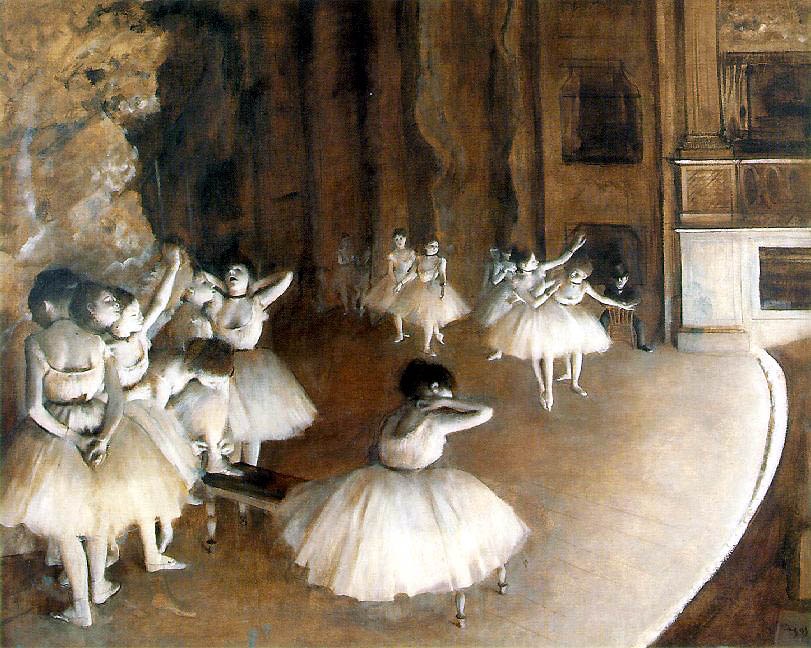
Degas dance class
Edgar Degas
- Medium:
- Oil Painting
- Dance:
- Ballet
- Era:
- Late 1800s (Victorian Ballroom)
- Source:
- Wikimedia Commons
- Rights:
- Public domain — free to use, share and adapt.
- Recorded as:
- Public Domain
This painting is foundational to how modern art sees dance. Instead of romanticizing or theatricalizing ballet, it insists on the reality of the studio, the body at work, and the gap between training and performance. For dancers and historians, it is evidence that artists of the highest caliber understood ballet as a discipline and a craft, not merely as decoration or spectacle.
What you are looking at
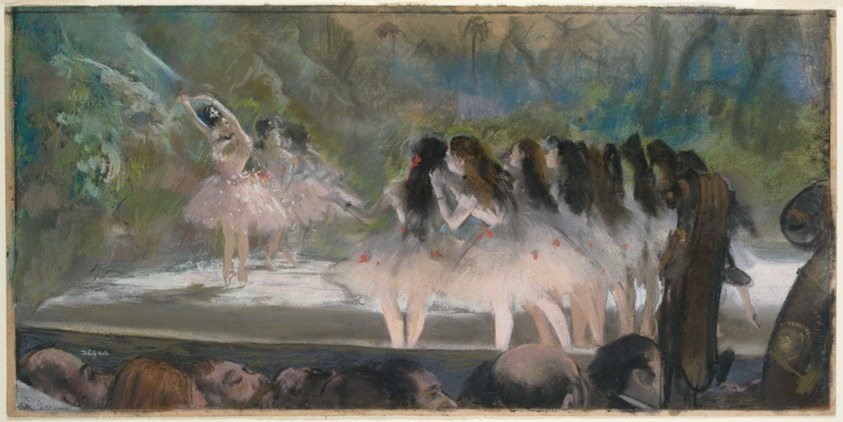
A ballet class in progress in a large, austere studio with high ceilings and tall windows. The walls are a warm ochre-brown, rendered in loose, atmospheric brushwork that creates a sense of cavernous space. A group of young female dancers in white tutus are scattered across the floor at various stages of an exercise or combination, some standing, others bent or in transition. In the foreground, one dancer leans forward sharply, her body angled down toward the floor; others stand upright or in arabesque-like positions. A figure in dark clothing—likely the instructor—can be seen among them. The composition is asymmetrical and informal, catching the dancers mid-movement rather than in posed formation. The lighting is soft and diffused, emphasizing the tutus against the darker architecture. A fireplace or architectural feature is visible on the right side of the canvas.
The dancing
The dancers wear pale, short ballet tutus and pointe shoes, their bodies arranged in classical ballet positions but caught in an unguarded moment. One dancer in the foreground bends at the torso with her head down, weight forward, in a stretching or recovery posture. Others maintain upright posture with what appears to be correct turnout and port de bras. The poses suggest a classroom exercise rather than performance—they are functional and varied rather than synchronized or theatrical. The scale and distribution of the figures across the studio floor creates a sense of individual work within a group setting.
The dance depicted
This is a ballet class, specifically a rehearsal or training session. The work captures the pedagogical rather than performative dimension of ballet, showing dancers at different points in an exercise, likely during or immediately after a combination. The informal grouping and the presence of the instructor suggest this is drawn from observation of actual teaching practice. The dancers' dress, bodies, and the studio setting confirm this as 19th-century classical ballet training, probably in France where this practice was systematized and documented.
How it was made
Oil painting. The work employs loose, impressionistic brushwork, particularly in rendering the walls and architectural space, which dissolve into atmospheric color. The tutus and dancers' bodies are more precisely defined than their surroundings, creating a focal depth. The technique allows Degas to capture movement and momentary gesture rather than static pose—the soft edges and lack of hard outline suggest dancers caught mid-action. This approach was characteristic of Degas's serial exploration of ballet subjects and differs from academic finish, prioritizing the immediacy of observation.
About this work
This painting documents a moment inside a 19th-century ballet studio, showing a class in session rather than a finished performance. It belongs to a long tradition of ballet imagery but differs from that tradition by refusing spectacle: these are working dancers in a workaday space, observed with the same serious attention given to performers on stage. The work is part of a sustained artistic investigation into ballet as a lived practice—the training, the strain, the individuality of bodies in motion—rather than as spectacular illusion. It is one of dozens of ballet-related works by its artist and represents a crucial shift in how dance was depicted in European art.
How to look at it
Notice the asymmetry and apparent casualness of the composition: Degas is not arranging dancers for effect but catching them between moments. The dancer bending forward in the foreground is the strongest vertical anchor, but the eye moves across the canvas through the scattered group. Observe how the tutus glow against the warm, dark walls—a study in light and material. The architectural space is as important as the figures; the studio is not a neutral backdrop but a place of labor and constraint. Degas's loose brushwork in the walls contrasts with his more precise rendering of the dancers' bodies and dress, creating a hierarchy of attention.
The artist
Edgar Degas (1834–1917) made ballet his obsessive subject from the 1870s onward, producing hundreds of paintings, pastels, drawings, and prints exploring dancers in rehearsal, performance, and rest. His interest was in capturing movement and the strain of training, not in romantic idealization. He had unusual access to rehearsals and classes, and he studied anatomy and motion intensively. For Degas, ballet was a subject through which to investigate light, composition, spatial depth, and the body in motion—concerns central to modern painting.
The period
In the 1870s, ballet was undergoing a profound transition. The Romantic era of ethereal, supernatural ballets had given way to a period of technical innovation and realism in choreography. The Paris Opéra was the center of ballet training and performance, and the dancers (mostly young women of limited means, often from working-class backgrounds) were gaining new visibility in art and society. Degas's sustained attention to ballet coincided with a broader modernist interest in contemporary urban life and the lived experience of work. His approach—capturing unguarded moments and informal compositions—aligned with Impressionist aesthetics, though his finish and technique remained distinctive.
Where it lives
The catalogue record does not specify a holding collection. The work is known from Wikimedia Commons, suggesting it is in a public collection, likely the Musée d'Orsay in Paris or another major French museum, as most of Degas's ballet works are institutionally held in France.
Dance in this work
Questions about this work
Did Degas attend actual ballet classes to make these paintings?
Yes. Degas had unusual access to Paris Opéra rehearsals and classes, where he made extensive studies and sketches. He was a serious student of anatomy and movement and would position himself to observe dancers at work. He also studied photographs and worked from memory and compositional studies, but his paintings are grounded in direct observation.
Why does this look so informal and unfinished compared to earlier ballet paintings?
Degas rejected the theatrical idealization of earlier ballet imagery. He was interested in the real labor of dance, the momentary and ungainly as well as the graceful. His loose brushwork and asymmetrical composition were also innovations of modernist painting, prioritizing immediate impression and movement over polished finish.
Are these real dancers or models?
These are likely studies from life, made in observation of actual dancers in the Paris Opéra classes. Degas may have used models to work out poses in the studio, but the painting is built on his sustained familiarity with how dancers actually move and hold themselves.
What is the significance of showing a class rather than a performance?
By painting the studio, Degas revealed ballet as work: training, discipline, physicality, and vulnerability. This was a radical departure from the public face of ballet, which presented it as fantasy and grace. It changed how artists and audiences understood dance.
More Ballet artwork