49 works in this view — arrow keys or swipe to move between them.
Dance in Art · 1873
Edgar Germain Hilaire Degas 033
Edgar Degas
- Medium:
- Oil Painting
- Dance:
- Ballet
- Era:
- Late 1800s (Victorian Ballroom)
- Source:
- Wikimedia Commons
- Rights:
- Public domain — free to use, share and adapt.
- Recorded as:
- Public Domain
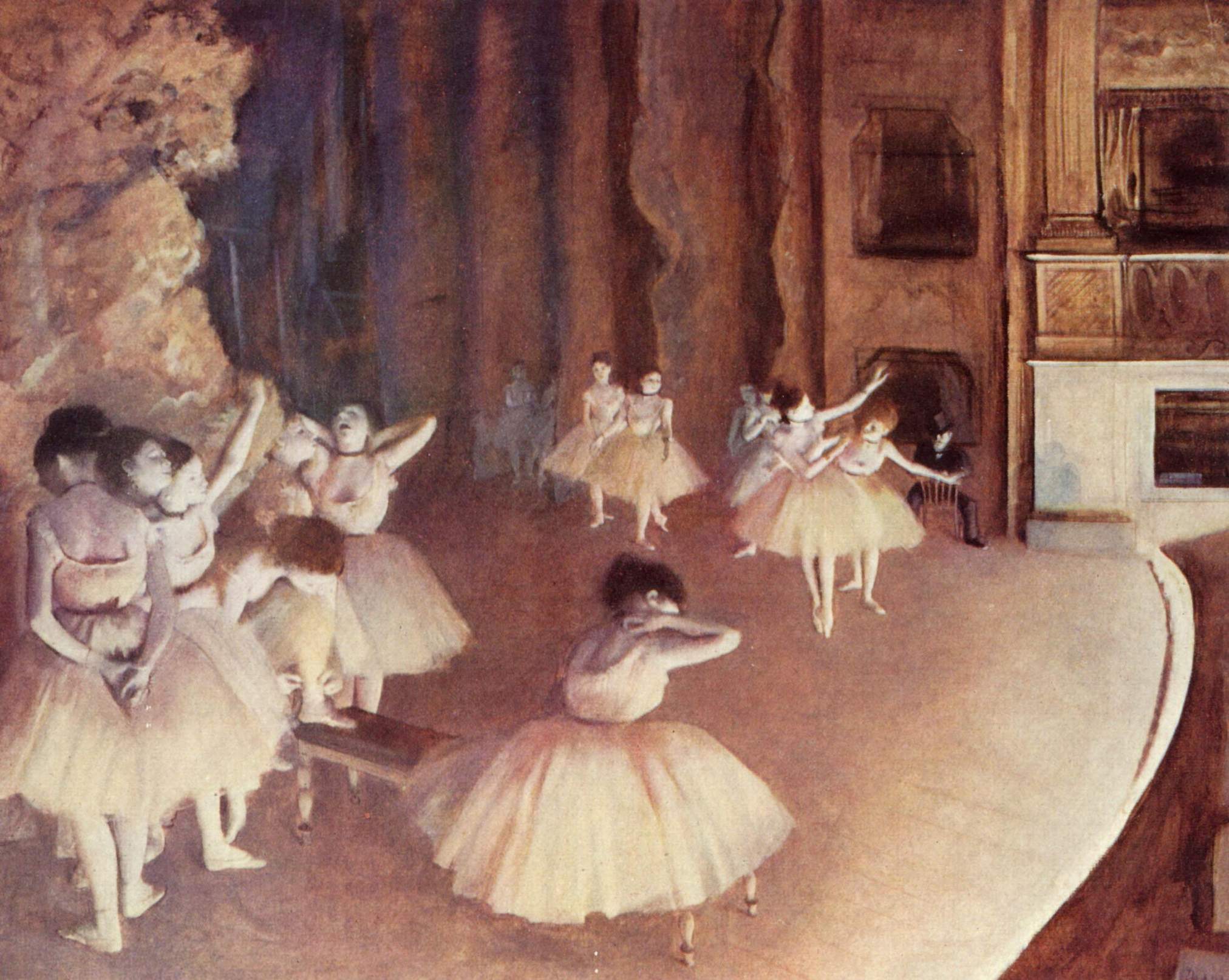
This image preserves evidence of how ballet training and the female dancer's body were understood and valued in the late nineteenth century. It shows that serious artists found the rehearsal studio worthy of sustained attention, elevating the everyday labor of dance practice to the status of fine art subject.
What you are looking at
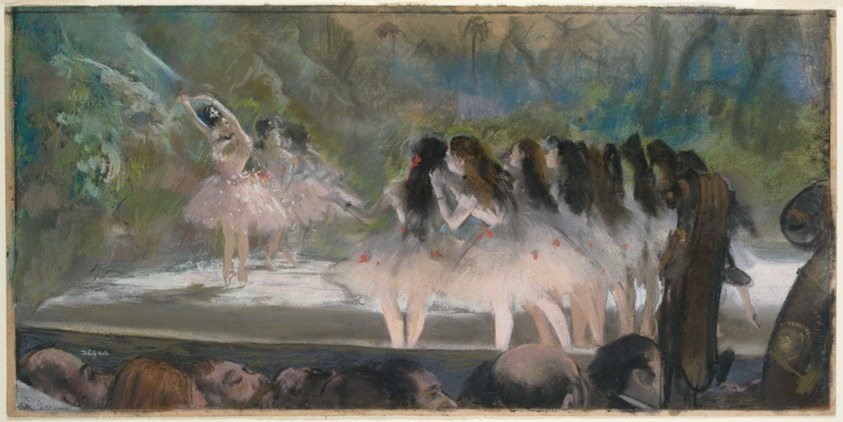
A ballet class or rehearsal in a sunlit studio, rendered in warm ochres and cool purples that suggest late afternoon light streaming through tall windows. The space is architecturally grand, with high walls and doorways visible at the back. A dozen young dancers in pale tulle skirts are distributed across the floor, most in attitudes of waiting or transition between exercises. In the left foreground, two dancers in darker practice clothes assist or instruct; in the center, a dancer executes a balance or développé; others stand in small groups or alone, some with arms raised, others at rest. A piano or similar instrument sits at the right edge. The painting captures the quiet intervals of training rather than climactic performance—a moment of gathered focus and individual adjustment.
The dancing
The dancers' posture and placement suggest classical ballet training. Several stand on supporting legs with the other extended or lifted, displaying the turned-out positioning characteristic of ballet technique. Arms are held in positions suggesting classical port de bras—some raised overhead, others extended to the side at shoulder height. The young dancers appear to be wearing standard ballet practice attire of the period: pale skirts, likely above the knee, with fitted bodices. The spatial composition shows dancers in varying depths and orientations, suggesting the artist understood that ballet rehearsal involves individuals working through sequences rather than coordinated groups.
The dance depicted
This is unquestionably a ballet class or rehearsal scene. The pale tulle skirts, the turned-out legs, the arm positions, and the studio setting with what appears to be a music source all confirm the genre. The informal arrangement—dancers scattered and in various positions of rest and practice—indicates a teaching or preparation moment rather than performance choreography. The predominance of young, apparently pre-professional dancers suggests this may depict a training studio or the Opera's corps de ballet in rehearsal, which was a frequent subject in Parisian art of this era.
How it was made
Oil on canvas. The artist employed a warm palette dominated by ochres, taupes, and dusty pinks for the dancers' flesh and costumes, set against cooler purples and browns for the architectural setting. The brushwork is loose and atmospheric, particularly in the rendering of light and shadow, which creates a sense of quiet movement even in static moments. The soft modeling and the diffused quality of the light suggest work made from life studies or close observation, a technique that required sustained attention to the ephemeral qualities of the studio environment.
About this work
This is a study of the ballet rehearsal room, a subject that fascinated late-nineteenth-century European artists and that revealed the machinery behind the illusion of performance. The work shows not the spectacle of the stage but the unglamorous and methodical work of training—the repetition, the waiting, the individual focus required of each body. It belongs in the history of dance art because it documents not what ballet looked like to an audience but what it looked like to itself, in the moment before performance. The painting insists on the studio as a space of work and discipline, populated by young women engaged in the precise, exhausting business of learning their craft.
How to look at it
Attend to the spatial composition: notice how Degas has scattered the dancers across the floorspace rather than aligning them in rows, creating a sense of an actual studio moment rather than a posed assembly. Look at the light: it comes from the upper left, modeling the bodies in a way that suggests natural studio illumination. Observe the range of bodily states—some dancers are fully engaged in an exercise, others are observing, still others are waiting. This is the artist's principal insight: that ballet rehearsal is not a single unified action but a space where multiple bodies occupy different temporal moments, all part of the same work.
The artist
Edgar Degas (1834–1917) was a French Impressionist painter whose fascination with ballet and the opera house became one of the defining subjects of his career. He attended rehearsals at the Paris Opéra, sketched dancers in motion and at rest, and created hundreds of works—paintings, pastels, prints, and drawings—depicting the studio, the dressing room, and the stage. Degas's approach to the dancers was unsentimental and anatomically acute; he was interested in the mechanics of the body, the repetitive training that produced virtuosity, and the social reality of young women (often from working-class families) whose labor sustained the institution. His work on dance subjects spanned five decades and fundamentally shaped how artists have since depicted bodies in motion.
The period
The 1870s in Paris were a period of consolidation for the ballet studio as a subject in fine art. Photography had recently made motion studies possible but was still primitive; painters and printmakers could capture something photography could not—the continuous, lived experience of the dancer's body learning and repeating. Ballet itself was at a transitional moment: the great Romantic era had passed, and the Paris Opéra was establishing itself as an institution of rigorous technical training. The rise of Impressionism coincided with a new willingness to treat ordinary, everyday subjects (including the working bodies of dancers) as worthy of serious artistic attention.
Where it lives
Sourced from Wikimedia Commons. The catalogue record indicates an oil painting dated 1873, though the holding collection is not recorded. The title in the catalogue is generic ('Edgar Germain Hilaire Degas 033'), which suggests this is catalogued from a database or reproduction rather than from direct handling.
Dance in this work
Questions about this work
Did Degas paint only finished performances?
No. Degas was fascinated by the studio and backstage, often depicting dancers in rehearsal, resting, or preparing. He believed the rehearsal room and the dressing room revealed something true about the dancer's life and labor that the stage performance concealed. Many of his most acclaimed works show dancers in these private, working moments.
Why are the dancers' skirts short?
These are practice skirts, shorter than performance tutus to allow full visibility of the legs and ease of movement during training. The palette of pale, simple tutus is historically accurate for ballet class in this period; elaborate costumes were reserved for performance.
How did Degas study the dancers without disrupting the class?
Degas was allowed to attend rehearsals at the Paris Opéra, where he would sit quietly and sketch. He made hundreds of drawings and studies from life, which he then worked into larger compositions in his studio. His intimate access to the ballet world was unusually privileged and was rarely granted to artists.
More Ballet artwork