49 works in this view — arrow keys or swipe to move between them.
Dance in Art · 1874
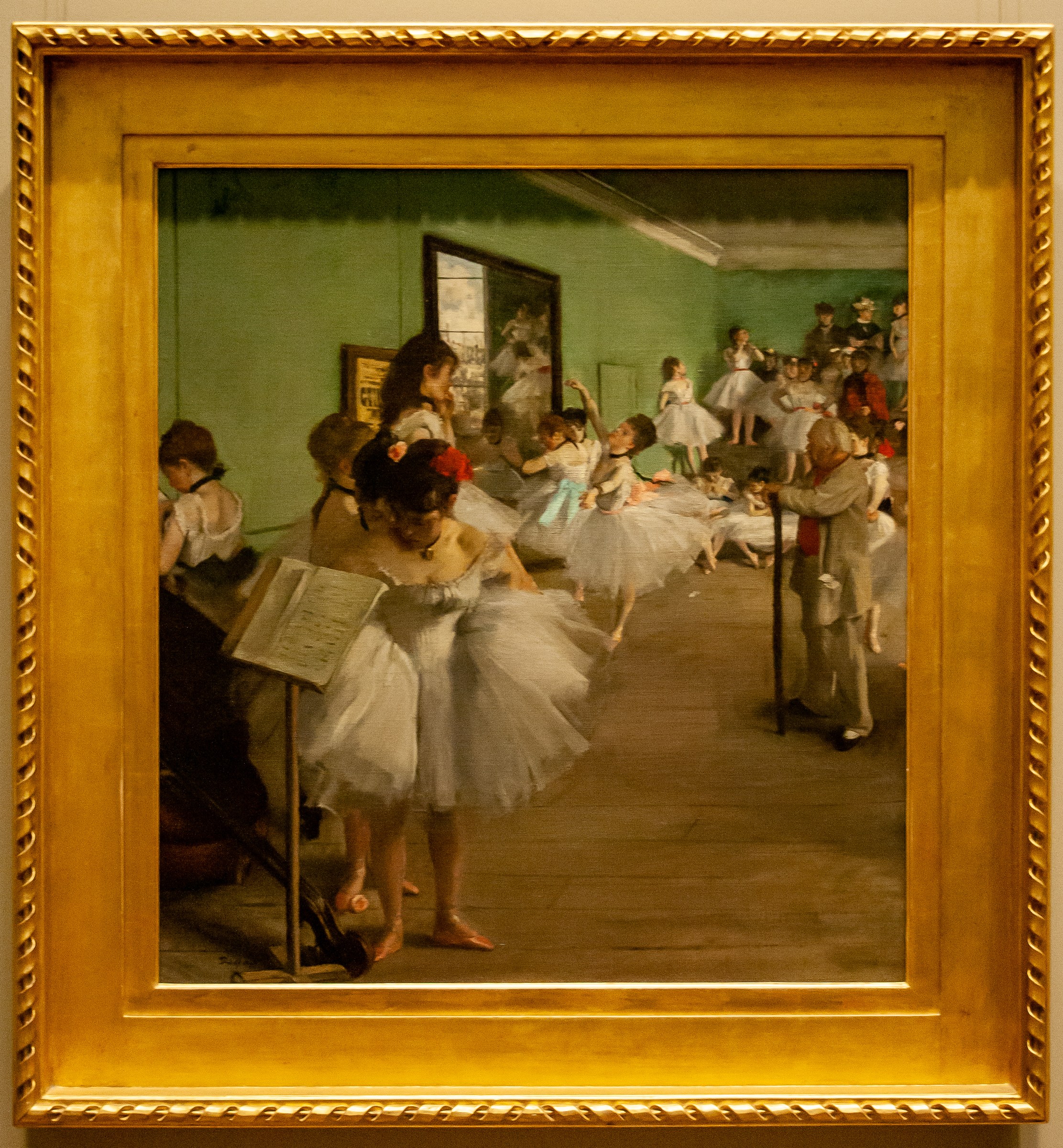
Degas - The Dance Class - with frame
Edgar Degas
- Medium:
- Oil Painting
- Dance:
- Ballet
- Era:
- Late 1800s (Victorian Ballroom)
- Source:
- Wikimedia Commons
- Rights:
- Public domain — free to use, share and adapt.
- Recorded as:
- Public Domain
This work is one of a series by this artist on the same subject, and it fundamentally changed how visual art recorded dance—shifting from celebrating the stage illusion to documenting the hidden labour of rehearsal and training. For dancers and historians, it is evidence of how the late nineteenth-century ballet class was organized, who taught it, what students wore, and what relationship the teacher claimed to the student's body. It is also a rare document of the moment of correction itself—the exposure and vulnerability that are central to classical training but almost never captured in earlier art.
What you are looking at
A ballet class is in session in a high-ceilinged studio with pale green walls and natural light from a skylight. An older male instructor in dark clothing stands at right, observing or correcting a young female dancer in a white practice dress and pointe shoes who faces him with her arms raised. Around the studio, approximately a dozen other young dancers in white dresses wait, sit, or stand at various distances—some clustered at the back near a mirror or barre, others scattered across the wooden floor. The composition is deliberately asymmetrical: the foreground is occupied by the single student under instruction, while the background recedes into shadow and crowded expectation. The light is cool and even, flattening the forms slightly—characteristic of interior studio conditions. This is a moment of individual correction within collective instruction.
The dancing
The central dancer stands upright in what appears to be an arabesque or open position, her arms extended and her posture alert to the instructor's attention. The instructor's posture—leaning forward slightly, watching intently—communicates active assessment rather than passive observation. The waiting dancers in the background show the varied stillness of a rehearsal break: some seated, some standing, some turned away. The contrast between the isolated, exposed student at centre and the grouped witnesses behind her captures the particular vulnerability of being watched during correction.
The dance depicted
This is a ballet class—specifically a professional or advanced training session given the number of students and the formal studio setting. The white practice dresses and the pointe shoes visible on several figures confirm classical ballet training. The composition emphasizes the pedagogical relationship central to ballet: the individual correction of a student's position or movement by the instructor, observed (sometimes uncomfortably) by peers. The work captures not the performance of ballet but its private making—the repetition, observation, and incremental correction that constitute training.
How it was made
This is an oil painting on canvas, using a palette of cool greens, creams, and earth tones. The paint application is fluid and observational rather than laboured; forms are suggested with broad strokes rather than precisely delineated. The lighting is handled with particular sophistication—the skylight creates a diffuse glow that reveals form without harsh shadow, a technique that allows the artist to render the subtle transparencies of muslin and the spatial relationships within the crowded studio. The finish is luminous and intimate in scale, suited to viewing at close range in a domestic or gallery setting.
About this work
This is a record of a ballet class in the mid-to-late nineteenth century, capturing the institutional and pedagogical reality of classical training rather than the fantasy of performance. The artist has chosen a moment of individual correction—a student under scrutiny—rather than a unified group movement, making visible the social and physical work that precedes any stage appearance. The painting is a document of how ballet was actually made: through patient, repetitive, uncomfortable exposure to expert judgment. The cool light, the casual postures of the waiting dancers, and the nervous attention of the student being corrected all register as authentic observation rather than idealization.
How to look at it
Look first at where the light falls: it comes from above, flattening and clarifying, without romance. Notice the young dancer's face and posture as she receives the instructor's attention—her stillness is different from the slouching waiting of the others. The instructor's body language is worth studying: he is not demonstrating but observing and judging, his hand and attention fully absorbed. Look at the scattered arrangement of the other dancers—some have turned away, some watch, some are lost in thought. The painting captures the psychology of a group in the presence of individual correction: waiting, watching, learning from another's exposure. The composition is deliberately off-balance, with more dancers crowded at the back than in the foreground—a compositional choice that makes the empty space around the corrected student feel more exposed.
The artist
Edgar Degas (1834–1917) was fascinated by ballet from the 1870s onward, making it a central subject in his work alongside racehorses and laundresses. He frequented the Paris Opéra ballet school and studio rehearsals, gaining access to the unrehearsed moments and pedagogical structures of professional training. His ballet works are among his most admired paintings and pastels; they are also his most sustained engagement with a single subject. Unlike earlier artists who painted ballet as spectacle, Degas treated it as labour and craft—observing the backstage world, the bodies in repose, the moments of correction and exhaustion. His compositional innovations—steep perspective, off-centre framing, cropped figures—were developed partly through his study of these scenes. He was interested not in the fantasy of ballet but in its physical and social reality.
The period
This painting was made during the height of the Romantic and early Classical ballet revivals in Paris, when the Paris Opéra Ballet was the most prestigious company in Europe. By the 1870s, ballet training was increasingly institutionalized and professionalized; the ballet school attached to the Opéra was rigorous and competitive. The studio setting and the formal instruction shown here reflect the emergence of ballet as a technical discipline requiring systematic pedagogy—a shift from earlier, more improvisatory practices. Visually, the cool palette and interior lighting align with broader movements in European art toward more naturalistic, less theatrically lit subjects. The late 1870s also saw the rise of Impressionism, and though Degas remained distinct from that movement, his attention to light, momentary gesture, and modern urban subjects shares some of its concerns.
Where it lives
Sourced from Wikimedia Commons, the specific holding collection is not recorded. The work is a canonical example of Degas' ballet paintings and is widely known; it is held in a major public collection (the Musée d'Orsay, Paris), but the present description is based on the catalogue record and image supplied.
Dance in this work
Questions about this work
Why did Degas paint ballet classes instead of performances?
Degas was interested in ballet as labour and craft rather than theatrical spectacle. He gained access to the Paris Opéra ballet school and painted the unrehearsed moments—the corrections, the waiting, the exhaustion—that revealed how dancers' bodies were actually made. These scenes interested him artistically for their difficult compositions and lighting, and philosophically for their honesty about discipline and exposure.
What can we learn from this painting about nineteenth-century ballet training?
The painting shows that ballet was taught in formal studios attached to major companies, by senior male instructors who stood apart from the dancers and observed their work intently. Students trained in white practice dresses and pointe shoes, and the structure of the class involved individual corrections made in front of peers. The number of students and the scale of the studio suggest that ballet training was becoming professionalized and institutionalized.
Is this a finished painting or a sketch?
It is a completed oil painting, though Degas often worked in a broad, fluid manner that can appear sketch-like. The handling of light and the subtlety of the colour relationships—the warm and cool tones within what appears at first glance to be a monochrome scene—demonstrate careful finish rather than rapid study.
Why are the dancers arranged so unevenly?
The off-centre composition is deliberate and characteristic of Degas' approach. It makes the empty space around the corrected student feel more exposed and emphasizes her isolation, while the crowded group at the back suggests both the competitive environment of professional training and the psychological discomfort of collective observation.
More Ballet artwork